 |
Subscribe / Renew |
 |
Contact Us |
| ► Subscribe to our Free Weekly Newsletter | |

Construction Bids
| home | Welcome, sign in or click here to subscribe. | login |


 print print  email to a friend email to a friend  reprints add to mydjc reprints add to mydjc |  |

March 7, 2013
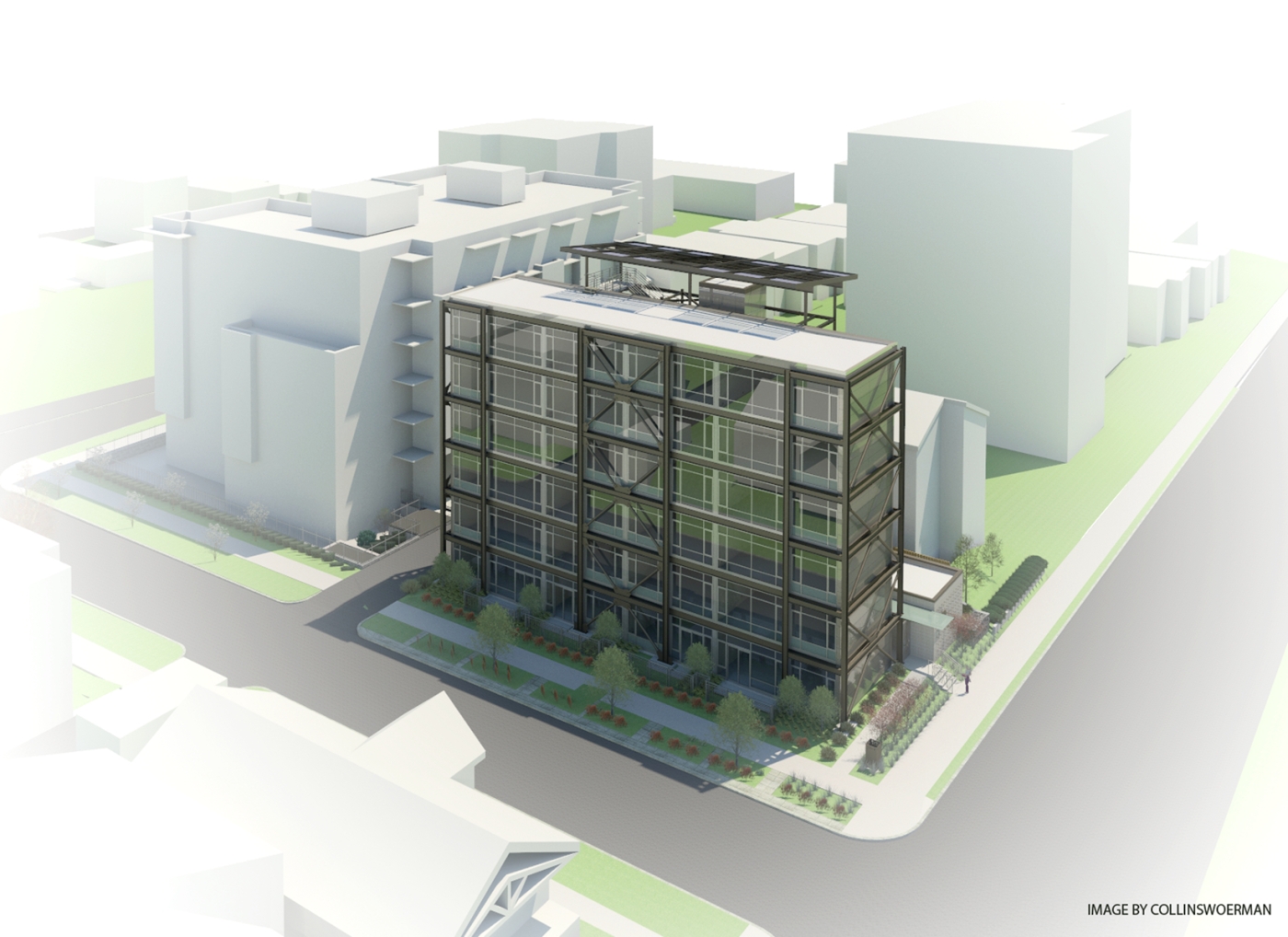
Bellevue developer Wallace Properties is working with a division of CollinsWoerman on a Seattle apartment project that will mesh a “kit of parts” approach with modular construction.
The 24-unit, six-story project called 47 + 7 will be in the University District at 4558 Seventh Ave., just off Interstate 5.
The design was created by Seattle-based architecture firm CollinsWoerman and is being sold by its division, Sustainable Living Innovations.
Construction is expected to start by July 1, said Rick Osterhout, SLI's vice president of sales and marketing.
SLI received buzz when it was launched in spring of 2011, but developers were reluctant to be the first to use the innovative process. This is its first project.
“Anytime that something's new, people don't want to be first,” Osterhout said.
Wallace Properties loaned SLI the money to buy the development site, and is collaborating with it on development and financing of the project, said Kevin Wallace, the firm's president.
“We're hopeful that this really is the start of something great,” he said. “The idea is to do this first one and look to do a lot more.”
The units will be one bedrooms, some 595 square feet and some 466, with floor-to-ceiling glass and 10-foot ceilings. “They're gorgeous units and they're very livable,” said Wallace.
SLI said it's working with several contractors on the project, but declined to name them. The engineering team is: DCI Engineers, structural; Sparling and Q Tran, electrical; and PAE Consulting Engineers, mechanical.
Some other local developers have said they intend to build modular, but SLI's approach has an added twist.
It blends a “kit-of-parts” with modular construction. Building systems, walls, cabinets and windows are manufactured off-site, and loaded onto concrete floor slabs, which have been poured on-site. A computerized hydraulic lift pulls the loaded slab up through a prefabricated steel frame that has been erected on the site. The initial slab is bolted to the top of the frame and the components are installed. The process is repeated for each floor below.
The cost of 47 + 7 is about the same as traditional wood-frame construction.
Wallace said a developer can also achieve economies of scale by using the same type of modular units on other projects rather than building new on each site. The buildings would look different from the outside as the skeleton and skin can be changed. “Its design potential is really limitless,” he said.
Wallace also sees the SLI approach as a way to build affordable workforce multifamily projects that are taller than 75 feet.
The fire code limits wood-frame buildings to that height, but Osterhout said SLI has met criteria established by the city of Seattle to go to 12 stories without fireproofing using the SLI process.
However, he said, the city will still require that each SLI project be looked at on its own merits.
Developers can build above 75 feet with traditional concrete and steel, but that raises the price, said Wallace.
“The concrete product being delivered today is really geared toward luxury,” he said, “and the opportunity you have with the SLI product is to hit something a little lower than the 1521 tower” — a luxury condo building in downtown Seattle.
The 47 + 7 units are smaller than typical wood-frame, but feel bigger because of how efficiently they are designed, Wallace said. There's evidence that they will garner higher square foot rent than traditional construction, but the market will ultimately decide that, he said.
According to Wallace, there's less waste with factory-built units, making them more sustainable, and they aren't damaged by the elements.
He also said the SLI product should last longer than traditional wood-frame, making it a better long-term value.
SLI is starting small with 47 + 7. The plan is to learn from it and eventually do projects up to four times bigger.
The division wants to work in multiple cities, and is focusing on fast-growing global gateway markets. Customers will be private developers as well as colleges, universities and other institutions.
Osterhout said SLI is in negotiations with a number of developers to build with its process.
Lynn Porter can be
reached by email or by phone
at (206) 622-8272.
Related Stories:
Previous columns:


