 |
Subscribe / Renew |
 |
Contact Us |
| ► Subscribe to our Free Weekly Newsletter | |

Construction Bids
| home | Welcome, sign in or click here to subscribe. | login |


 print print  email to a friend email to a friend  reprints add to mydjc reprints add to mydjc |  |
May 17, 2000
A soil amendment process designed for developers may help save salmon, as well as aid homeowners and contractors.
Soils for Salmon is a program being developed by Sego Jackson, a principal planner with Snohomish County Solid Waste Management and an environmental expert.
Jackson was recently named Recycler of the Year for 2000 by the Washington State Recycling Association. In addition to the soil program, Jackson was recognized for a number of his other recycling efforts which involve manure, computers and sustainable buildings. He leads many of these efforts on a voluntary basis.
Jackson is working with farmers to manage manure by composting on site and he also is creating a Built Green program intended to give contractors incentives for building high-performance environmental projects. That program will be launched this summer.
The Built Green program and a similar one in Kitsap County, has prompted Fannie Mae, a national mortgage finance company, to test a "green mortgage" program in the Northwest.
|
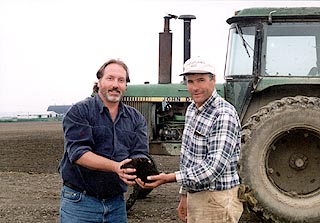
Soils for Salmon encourages developers to amend disturbed soils with compost during construction. Typically, new development includes stripping native topsoil and compacting the remaining subsoils, diminishing their environmental value. Lawns planted on poor soil behave like impervious surfaces -- like concrete. Stormwater quickly runs off them, carrying sediments, lawn chemicals and pet wastes into streams.
The lawns also require more irrigation and increased fertilization, both of which affect salmon habitat. The program calls for treating subsoils with compost to get them to act as a sponge for runoff and as a biofilter to degrade contaminants.
Jackson said the idea for the program came when he attended the "Salmon in the City" conference in Mount Vernon in 1998.
"I kept expecting scientists to talk about what we'd do with soil in development, but no one got to that point. I realized there was a gap in people's thinking in understanding how to manage it," he said.
To date, Jackson has worked with both King and Snohomish counties, the state Department of Ecology, the city of Redmond and various companies and nonprofits to determine how best to apply the program. "The city of Redmond's program was the genesis of our original thinking," he said.
Phil Cohen, a water resource engineer with Redmond Public Works, has gotten funding and formed partnerships with University of Washington scientists and other entities to develop the soil conservation program locally. Much of the research funding came from the state Department of Ecology's Centennial Clean Water Fund.
"It's basically about how to improve landscapes and deal with nonpoint contamination sources ... by upgrading soil," Cohen said of the project. "The plan is to take it and try it out in small public works projects, where there's more flexibility. We're giving (Redmond) time to try it out for size before making an ordinance, which would be much more rigid in its application.
"This approach could have a large applicability as far as the Endangered Species Act and water quality issues," Cohen said. "It's a positive step towards meeting some of the necessary things that have a minimal impact on development."
Jackson said much discussion surrounds offering incentives to developers and contractors who incorporate sound soil management plans and other "green building" techniques into projects, as well as regulatory possibilities.
"It's been fun and hair-raising at the same time. We started with no budget and this was not on any agenda. But it evolved with help from a tremendous number of people," said Jackson. "All of us are trying to find the appropriate mechanism for adopting it." Possibilities include provisions in state or local stormwater manuals or in the grading permit process.
Jackson noted that until now, many programs to protect salmon have been geared toward the homeowner.
"It's awfully hard to develop a healthy landscape when you start out with (poor) subsoil. But when you start out with good, healthy, functional soil when you purchase your house, it's a lot easier in the long run," he said.
Jackson pointed out that there are standards for the efficiency of other construction elements such as windows, doors and insulation. "There's a certain quality of house you expect to buy. We need to look at soil in the same way."


