
August 30, 1999
Architects busy updating master plan for Woodland Park Zoo
By ANNU MANGAT
Journal Staff Reporter
As the Woodland Park Zoo celebrates its centennial this year, architects are updating the master plan that gave birth to a place that Seattleites and outsiders adore.
That affection, apparently, hasn't been stymied by what zoo officials and visitors regard as one of the zoo's biggest problems -- parking.
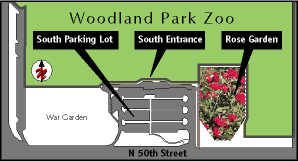
One solution recently suggested by members of the Seattle Design Commission, an advisory group to city officials, is bound to raise the hackles of some Seattleites. It calls for relocating the Woodland Park Rose Garden, which is near the zoo's south gate on N. 50th Street, to make room for increased parking spaces.
|
|
Phase I of the zoo's proposed capital improvements is estimated to cost $32 million. Total capital improvements, which zoo officials hope to fund with private contributions and tax dollars, are estimated to cost $40 million to $50 million. |
Despite the Design Commission's prodding, the idea to move the Rose Garden has no support at this point from zoo or park officials. Jim Maxwell, project manager for the Woodland Park Zoo, said the "idea has come up from time to time, but the Rose Garden has a long, strong history in that site and neither the Parks Department nor the Zoo is proposing any change to that."
David Towne, zoo director, underscored that sentiment, saying "what we would gain is so little" compared to what, in his view, might be lost by relocating the garden.
|
|
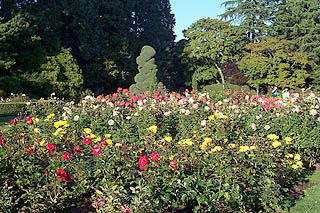
Owned by the Seattle Department of Parks and Recreation, the 2.5-acre Rose Garden features 5,000 rose bushes, a lily pond and gazebo. Members of the Seattle Design Commission have proposed the garden be relocated to increase parking spaces at the zoo. |
Coe is the principal of the Philadelphia-based architectural firm CLR Design, which specializes in zoos and aquarium projects.
He was a partner at the Seattle firm of Jones & Jones and with architect Grant Jones, authored the master plan for the zoo. That plan, considered a benchmark in zoo design, radically changed the way the zoo looked, removing animals from cramped cages to more naturalistic settings.
Coe, also noting that parking problems "are a big issue," suggested the zoo build a sunken parking lot in the south lot, near N. 50th Street, or a 4 1/2-to 5-story parking garage in the northwest lot, near N. 59th Street.
He said that developing the south lot would be best for general zoo visitors, while building parking on the north lot would be useful for visitors who attend the popular evening concerts at the zoo.
The Zoo Commission, he said, is leaning in favor of building up the south lot, which is a main ticketing area and houses the zoo's gift shop.
He said that based on several meetings he's had with the Phinney Ridge Neighborhood Association, the local community supports the construction of a parking structure to relieve spill-over parking in the area.
He said that encouraging greater use of public transportation would also help, but he noted that despite the existence of a bus stop on N. 59th Street, only about 1 to 2 percent of zoo visitors use Metro transit.
|
|
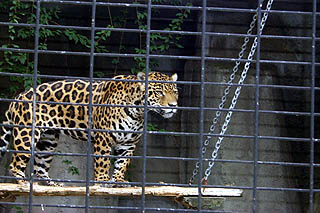
This jaguar, now housed in a relatively cramped cage at the Woodland Park Zoo, may someday dwell in a state-of-the-art exhibit if the city approves the proposed upgrades being planned for the zoo. The jaguar is one of 35 endangered species kept at the zoo. |
Rick Sundberg, chair of the Seattle Design Commission, told Coe and Maxwell he understood how "frustrating" it is to come up with a solution for the south entrance to the zoo, but he invited them to return and "show us a grander solution."
The discussion about parking is only one aspect of the zoo's $32 million renovation program, which is to be implemented over five years. The proposals will be detailed in an environmental impact statement, scheduled for release this fall.
In addition to the issue of parking, Coe also discussed several options for improving visitor circulation and wayfinding at the zoo. Describing the current configuration as the "world's largest and most beautiful maze," he suggested an alternative layout. The proposal would create three clear "interpretive hubs" connecting the zoo's numerous exhibits. He also proposed adding a new primary path to reduce the length of travel around the zoo by about 2,000 feet.
These revisions to the zoo's original design are reflections of the changing use of zoos, he said, noting that zoos are now perceived as a safe park setting in which families picnic or relax. Zoo visitors, he said, spend about 60 percent of their time not looking at animals, but rather socializing, eating or playing in the park.
|
|
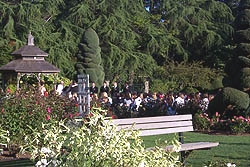
Located just before the south gate to the Woodland Park Zoo, on N. 50th Street, the Woodland Park Rose Garden is often used to hold outdoor weddings, as pictured in the background. |
Construction on most of the proposals won't begin until the updated master plan is adopted by the City Council, a decision that is expected in mid-2000.
However, Towne said that any projects that are considered consistent with the goals of the original master plan -- such as improved wayfinding -- could commence next year.