
December 16, 2009
City Forge thrives by doing it all
Journal Staff Reporter

The building industry didn't see many new players entering the market in the summer of 2008. But one such venture that includes design, construction, development, bookkeeping and staging is making money, selling houses and has plans to expand.
City Forge is the brainchild of Erik Cullen, a longtime Habitat for Humanity employee, Jim Barger, owner of Greenleaf Construction, and Quinn Borseno, a designer with more than a decade of experience building houses in Seattle. Their idea: Form separate companies providing each of the services they say make for successful speculative residential construction. By having access to all of the services under the same roof, they hoped to save money on their own projects and sell excess capacity to other builders and developers.
“We knew that was the biggest challenge for spec building was having cash flow,” Cullen said. “With these other operations, we've been able to take care of our overhead, which leaves the speculative side to be pure profit, ideally.”
City Forge is a holding company for Playhouse Design, managed by Borseno, and B3C Management, the bookkeeping and back office support arm managed by Marlene Boone. City Forge Investments, managed by Cullen, is the development arm, and Barger's Greenleaf Construction provides the general contracting services.
In-house builds efficiency
The group recently moved into a new shared office space at 2331 E. Madison, but Cullen points out that each of the companies stands on its own, with each manager responsible for their own balance sheet, making them different from a design-build firm.

So far, the model is working for them. The companies, which employ a total of eight people, completed their first year with a small profit, Cullen said.
“We have found efficiencies in part because we have the building expertise in-house,” Cullen said. “They're going up faster, they're going up cheaper, and they're selling.”
Cullen said they have been able to cut their cost per square foot by about $25 from what Barger used to average. They've also shortened construction times– their single family projects are taking about four to six months to build, with multifamily projects taking eight to 10 months. Having everything in-house, Cullen said, means they are able to make changes that actually reduce costs.
The companies recently completed a house project at 2822 E. Olive St. that sold before construction was complete. Under construction: A four-unit townhouse at 2351 Yale Ave E., a single family home on Alder and a 1,400 square-foot single-family home at 4135 52nd Ave. S.W. in West Seattle.
Several projects are in permitting, including three live-work units at 2310 E. Cherry, a mixed-use building at 39th Avenue and Interlake, a single-family residence for a private client at 6403 Kensington Place N. in Tangletown, and a 13-townhouse unit project in the 8600 block of Delridge Ave. S.W.
Staging for modern
Playhouse Design offers architectural, interiors and staging services and employs three people. The firm takes its name from the concept of “playing house,” Borseno said, when people come together and make a home, and from playhouse, the place where children play.
“It's not serious or uptight,” Borseno said. “I didn't want to be another design firm with a name like a law firm.”
The staging work, says Borseno, came about rather accidentally. Borseno said after pricing staging for one of their earliest projects, he decided to buy modern furniture and accessories and stage the place himself. After that, people started asking about the service, he said.
“There's only a couple of stagers that specialize in modern,” Borseno said. “Because modern design has become the hip thing right now, you have a whole bunch of people with all this Pottery Barn furniture in these modern townhouse units.”
Playhouse now has enough furniture to stage about 15 units at once and Borseno said they're using almost all of it at any given time. He has put Japanese toys on the shelves of some houses, and graffiti-style artwork on the walls of others. Borseno says only a few of his pieces are from Ikea-- he says he has hit up the Kasala outlet and regularly trolls other modern furniture shops looking for floor models on sale. Other furniture came from a staging company that was going out of business.
Cullen said the staging has turned into one of their largest profit centers. In some cases, he said developers have raised the prices of their units after seeing them staged by Playhouse.
Designing a unique unit
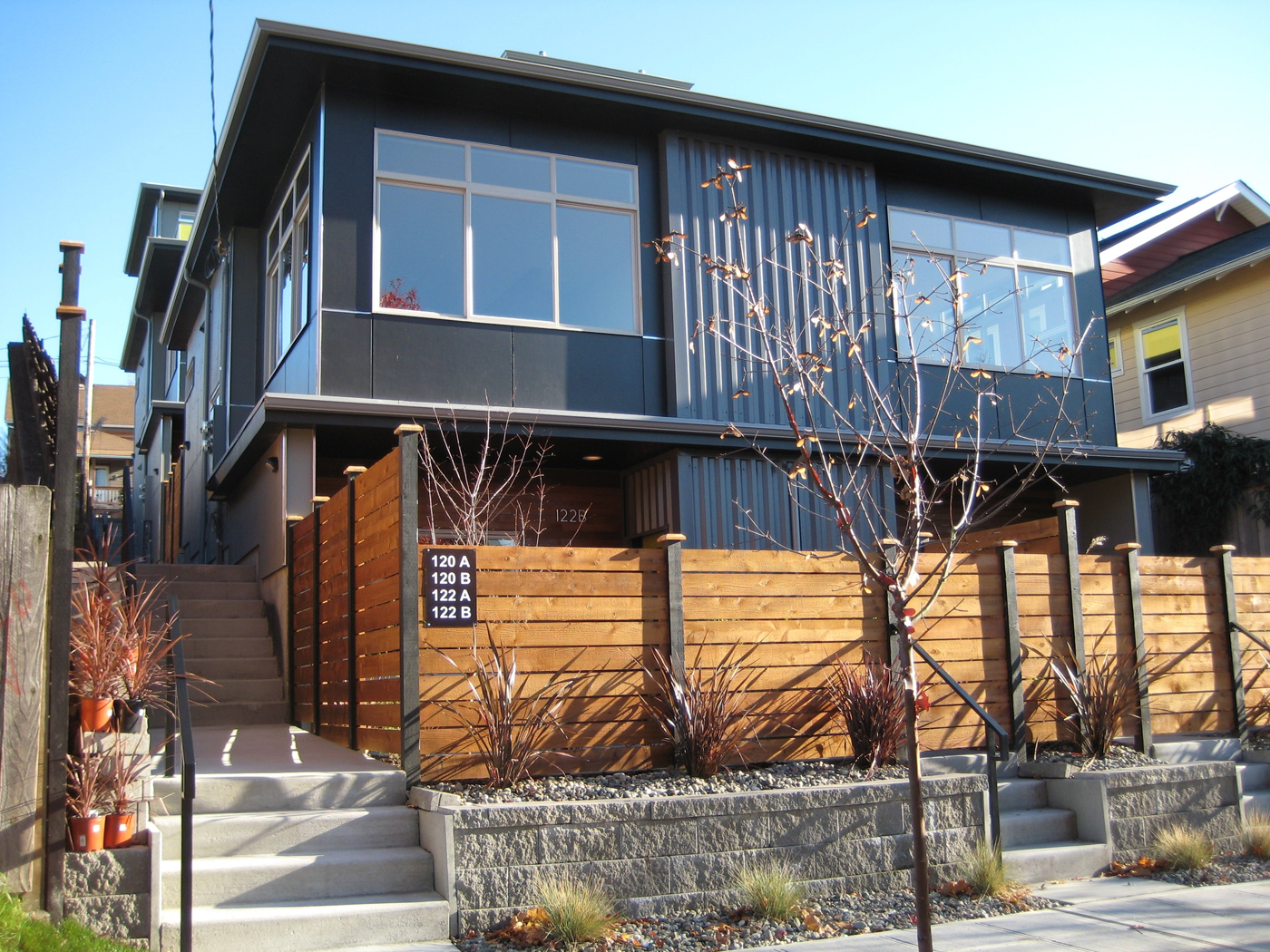
In addition to designing projects for City Forge and Greenleaf, Playhouse Design has found a niche in going back and redesigning projects for other builders and developers. Playhouse has designed about six or seven projects for City Forge and Greenleaf, Borseno said, compared to about 30 projects for others. Borseno said Playhouse could be adding another designer in the near future.
Paul Pierce, an architect who works for Playhouse who has designed Seattle homes for three decades, said today's buyers want to be able to buy a unique unit, and that is more important to them than space. He said builders are realizing that the days of making money from cookie-cutter multifamily designs are over.
In the projects they've redesigned, they try to add value and diversity while keeping the same footprint already permitted, Pierce said. He said sometimes that might mean taking off floors, simplifying accessory parts, or recrafting some of the layouts so that each unit has its own type, rather than just being a different color or facing in a different direction.
Pierce said a simple, modern look and a sense of community in multifamily units appeals to people. Inside, he said high ceilings, modern appliances and lots of glass should be included. Outside, he said landscaping is important. He said people want more than just a small fenced in plot of grass, and they want well-designed common space that contributes to the sense of community.
“They don't need the square footage, what they need is the quality,” Pierce said. “We pay really particular attention to building blocks and volumes and how forms and shapes go together to create a different type of volume.”
Borseno said his background on the construction side has also helped in the design firm's success.
“We design with a budget and with buildability in mind,” he said. “We're actually able to deliver to builders and developers things that can actually be built with reasonable square foot price.”
He said part of that experience has taught him that good design isn't enough on its own; you have to follow up with other project team members to make sure projects are a success.
Other designers “don't go out there and interact with the actual person building it so the whole plan gets lost in translation,” he said. “I will go out to a job site and literally fall on the ground and kick and scream because I care not only that it looks cool but also if they follow the prescription I know it will sell.”
Shawna Gamache can be
reached by email or by phone
at (206) 219-6518.