
September 6, 1999
Caterpillar wheel loaders can get the job done
Journal staff
|
|
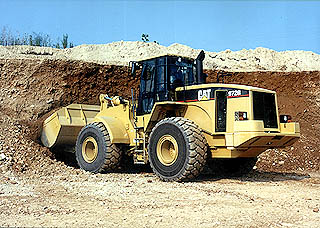
Caterpillar wheel loader |
The Caterpillar 966G and 972G wheel loaders are designed to excel in hard bank digging, truck or hopper loading, and general utility work.
The machines replace the 966F Series II and the 970F, a machine specifically designed for rehandling material. These two new G-Series loaders feature production-boosting enhancements such as increased engine power, improved operator comfort, low-effort control systems, and changes that reduce service time.
The 966G and 972G also feature the sleek and functional styling. Both wheel loaders use the responsive Cat 3306 engine that delivers 235 hp (175 kW) in the 966G and 265 hp (198 kW) in the 972G. An electronically controlled powershift transmission and durable power train components put the power to work. Compared to previous designs, the G-Series front linkage and lift arms create greater lift and breakout force as well as greater reach and dump height. The new machines also enhance operator efficiency and comfort through a more spacious cab and redesigned controls. New G-Series layouts and systems also aid service personnel.
Major features of the 966G and 972G include:
- The Caterpillar 3306 DITA six-cylinder (10.5 liter), direct injected turbocharged and aftercooled diesel engine produces 235 hp (175 kW) and 60 percent torque rise in the 966G for more rimpull. The 972G has 265 hp (198 kW) and 56 percent torque rise. These high torque rise engines produce maximum flywheel horsepower of 253 hp (189 kW) in the 966G and 275 hp (205 kW) in the 972G for more power in the working range when it is needed. The engine is fuel efficient and meets worldwide emissions standards.
- The durable planetary powershift transmissions utilize Electronic Clutch Pressure Controls for smoother shifts and transmission neutralization, improving operator comfort and control, and increasing clutch life.
- Two oil-immersed and cooled brake discs at each wheel increase brake surface area 156%, and provide superior braking capability. These fully enclosed brakes lock out contaminants, and brake wear indicators aid in serviceability.
- High flow rates in the hydraulic circuit provide fast lift and tilt speeds, which are matched to the machine's travel speed for faster cycle times.
- G-Series linkage geometry and lift arms increase dig depth, reach and dump height and boost lift and breakout forces.
- The ergonomically designed operator station features state-of-the-art controls to make operators more comfortable and productive. The Command Control Steering option with integrated transmission controls provides nearly half turn steering (approximately 70 degrees each direction). The option also includes electro-hydraulic bucket controls for precise fingertip lift and tilt movements.
- Ground-level access to key service points makes daily maintenance easy. The G-Series Monitoring System has a service mode that displays operating parameters and diagnostic codes.
To enable contractors, materials suppliers, and mine operators to precisely match their application requirements, the 966G offers nine combinations of general purpose buckets, four combinations of rock buckets and six combinations of materials handling buckets. Bucket sizes range from 4.25 cubic yards (3.3 cu m) to 5.25 cubic yards (4.0 cu m). The 972G provides six combinations of general purpose buckets, four combinations of rock buckets and six combinations of material handling buckets, ranging in size from 5.0 cubic yards (3.8 cu m) to 6.0 cubic yards (4.7 cu m).
The 966G and 972G power trains deliver aggressive performance, excellent fuel economy and low emissions. The 3306 diesel engine has many heavy duty features found on larger displacement engines. Dramatically increased torque rise on the new machines means the engines actually develop more than rated horsepower as they are lugged back in the working range. The increased power means greater rimpull when entering the pile or doing hard bank digging and more power available for lift and breakout forces.
Each machine's engine is precisely matched to a Cat torque converter, transmission, and axle. Both models use planetary powershift transmissions with 4 forward and 4 reverse gears featuring full powershift and autoshift capabilities. A transmission neutralizer allows the operator to disengage transmission clutches, which keeps engine speed up for full hydraulic flow to the lift arms and bucket or attachments.
Fully hydraulic brake controls eliminate the need for a compressed air system, and a new brake wear indicator simplifies brake wear monitoring. Multiple, oil-disc brakes are adjustment free. Optional limited slip differentials or no-spin differentials make the loaders more productive in a wider variety of working conditions. The oscillating rear axle helps ensure four-wheel ground contact.
The hydraulic systems in the 966G and 972G use separate circuits for steering and bucket controls. High flow rates in the hydraulic circuit provide fast lift arm, bucket, and attachment speeds. Also, hydraulic power is matched to torque converter power demands to help balance cycle and improve loader productivity.
Smart Ride Control is an optional attachment that can improve productivity and machine control. A nitrogen and oil accumulator in the hydraulic lift circuit acts as a shock absorber for the lift arms, reducing stresses on the linkage and loader frame and improving operator ride. The system can be set to activate or deactivate at preset ground speeds. Another option, Payload Control System, allows for on-the-go weighing of bucket loads to achieve target payloads with +/- 1% accuracy.
The redesigned loader linkage for both models increases dig depth, reach and dump height compared to previous models. This new design also contributes to improved lift and breakout force for better bucket fill factors and higher productivity.
The 966G and 972G are offered in two operator control configurations. Conventional steering provides low effort steering by producing pilot hydraulic flow when the operator rotates the steering wheel. The Conventional steering version uses pilot hydraulic bucket controls.
Command Control steering incorporates hydraulics and a mechanical feedback system to directly link steering wheel position to articulation angle. Command Control steering features nearly half turn steering (approximately 70 degrees each direction) for fast response, precise control, low steering efforts, and reduced steering busyness. The result is less operator fatigue and increased productivity.
Transmission controls are integrated into the Command Control steering wheel for one-hand operation. The operator can keep one hand on the transmission controls in all steering positions. This configuration includes electro-hydraulic bucket controls which provide precise fingertip lift and tilt control. Controls are mounted on the end of the adjustable right armrest for comfortable operation. Lift and lower bucket kickouts are adjustable and programmable from the operator's seat. The electronically controlled bucket stops are cushioned, reducing bounce and operator fatigue.
The G-Series Monitoring System displays the status of key controls and functions on three instrument clusters. A three-level warning system alerts the operator of any impending or immediate machine problems.
The G-Series cab is 20 percent larger than its predecessor and features 50 percent more glass area for better visibility. Bonded front windshield glass eliminates metal window frames, improving visibility to the front, and the downsloped hood improves the view to the rear. Ladders are sloped away from the machine and have non-skid surfaces for easy entry and exit. Large platforms and grab rails have been added for operator safety.
The G-Series design emphasizes serviceability. All 250 hour service points are accessible from ground level, and site gauges allow quick assessment of radiator coolant, hydraulic oil and transmission oil levels. Doors on the right and left side of the engine enclosure provide access to daily service items, and the nonmetallic hood tilts approximately 70 degrees for full access to the engine and other major components. For quick diagnosis of machine conditions, the Monitoring System has a service mode to aid the technician by displaying diagnostic codes.