
August 4, 1999
The software life in Fremont
By Clair Enlow
Special to the Journal
|
|
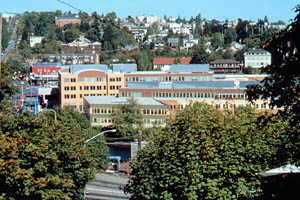
The Adobe Campus from Queen Anne Hill. Photo by Steve Keating |
For Adobe Systems' regional headquarters, which has occupied the new campus on the shore of Lake Union for one year, the new home has proven to be an advantage in the intensely competitive market for high-tech talent. Typically, employees leave when companies relocate - twenty percent is the typical fall-off rate. After moving from its cramped Pioneer Square location, Adobe netted zero losses after settling in its new home in Fremont. Employees in other cities chose to relocate there.
|
Project: Adobe Systems Regional Headquarters, Quadrant Lake Union Center
|
"It's the best of Seattle," said Adobe facilities manager Darren Toshi.
It wasn't easy to tuck over 300,000 square feet of corporate office space along with generous open areas into the heart of Fremont and keep the neighbors happy. Architect NBBJ, Adobe and owner Quadrant have shown that it can be done, with a cooperative attitude and skillful urban design. A year after completion, it's hard to remember when the new Adobe campus in Fremont wasn't there, or even to find the edge of the campus. The people sipping coffee at tables on the new sidewalks might be high-tech workers or long-time residents.
|
|
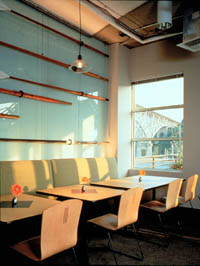
The Watermark Cafe was named through a company-wide competition. |
Adobe, liked all software developers, keeps its offices under tight security. But it has opened outdoor spaces to welcome the community, hosting traditional neighborhood events such as the Fremont Sunday Market and Solstice Parade.
Adobe has even met Fremont half way with its own alternative culture. Dressed in dry suits, employees kayak to work. A van pool runs to and from downtown Seattle. The bike cage is full, and the company is proud of the fact that only 100 of its 600 parking spaces are occupied regularly.
In keeping with the Fremont tradition of off-beat, Adobe engaged local artists in the project, putting them to work on a large tile sundial that enlivens the plaza leading to the main entrance and forging the intricate detailing that softens the surrounding wrought iron fence.
|
|
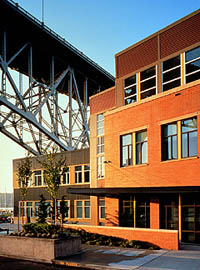
The Aurora Bridge dominates the view from the Adobe campus. |
The program lent itself to the kind of design that would best fit into the neighborhood. You might call it "divide and blend." The Adobe campus completes the urban grid between North 34th Street and the Burke- Gilman Trail along the waterfront. Buildings are tightly aligned along a new street through the middle of the campus. Facing Fremont, the Adobe corporate campus, which actually includes only two large buildings, appears as many. A mixture of right and odd angles helps to minimize bulk and scale, and the materials - multi-colored precast concrete, brick, aluminum and galvanized metal - also invites the illusion of several structures built over time.
|
|
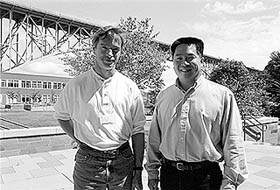
Design architect Chris Larsen and facilities manager Darren Toshi. Photo by Clair Enlow |
The urban theme continues inside, in what Larson calls an "interior urban plan." There are "thoroughfares" that meet at right and odd angles and "small streets" where office doors are found. Neighborhoods, in the form of work groups, have their own informal meeting places. There might be a gum ball machine or a snack bar nearby. The 24-hour customer service area has it's own punching bag, hung behind an elegant steel mesh curtain. To orient employees, each part of the building has its own carpet pattern and color.
Adobe wanted interiors to reflect an informal "work in progress" atmosphere for employees. At the same time, NBBJ was called upon to design spaces that would be inviting to potential hires in the hotly competitive software industry.
|
|
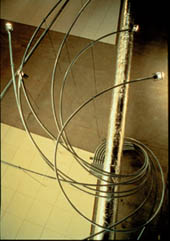
A swirl of electrical conduit on the ceiling over the conference zone was created by Freemont artist David Gulassa. |
Although the low-ceilinged interiors are spare, serviceable - and above all, flexible - the design stops are pulled out at circulation nodes, where sculpted walls, rich materials and dramatic light fixtures heighten the sense of arrival. The food service is more like a hot new waterfront restaurant.
In one thoroughfare, a prominent column is covered with scrawl in many colors. Employees signed it on their first visit to the campus, then under construction. The company covered the raw concrete and the signatures with Plexiglas, proud of the commitment the new offices have drawn.