($5 million - $10 million)
Pier 70
Location: 2801 Alaskan Way, Seattle
Owner/Developer: Triad Development
General contractor: J.R. Abbott Construction
Project Team:
Fuller Sears Architects, Robert Fossatti and Associates, Johnson Electric, Emerald Aire, Viking Fire Sprinkler, Auburn Mechanical, Northshore Sheet Metal, Pacific Construction Systems and V.P. Peri Painting.
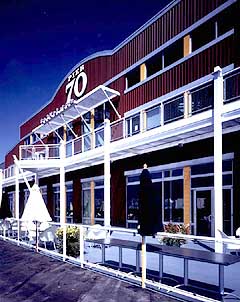
Rebuilding Pier 70 was tricky because the structure moved with the tide and when cruise boats docked up to it. Photo by Harriet Burger
|
The $8.2 million Pier 70 project involved the renovation of a Seattle waterfront landmark built around 1895.
The project started with demolition of every interior and exterior wall, utilizing unique shoring techniques to keep the building shear intact. Only the original timber framing and roof structure were kept.
The first floor was turned into restaurant space on the west/east ends, with an open air-parking garage in the middle. All of the existing heavy-timber structure in the parking area was sandblasted and clear coated to preserve the historical nature of the pier.
The second floor parking area and parking ramps were eliminated, and new shell office space was created along with two new elevators. Due to the nature of the pier, hole-less elevators were utilized with deck-hung elevator pits.
About 85,000 square feet of the third floor was added below the existing wood truss structure. The existing heavy-timber truss webs were strengthened with a plate/channel through-bolt system, and then the center chord of the truss was removed to create a hallway effect down the center of the trusses.
New clerestory windows were added to the north and south sides of the building to create large spacious offices between the trusses. The windows provide panoramic views of Elliott Bay and the Seattle waterfront.
The exterior of the building features an architectural “prow” and several balconies, including a wrap-around balcony on the west end. The main entry showcases a tower stair constructed with two 30-inch-diameter tube steel sections reaching all three floors.
All new heating, ventilating and air conditioning systems were added to the pier, along with revamped fire sprinkler and plumbing systems. The existing electrical service was eliminated, and a new switching vault was installed in the Alaskan Way right-of-way.
Due to the nature of the structure, J.R. Abbott had to deal with not only age, but dynamics too. The building structure rests upon a driven wood-pile foundation, and the entire structure was flexible and had a tendency to move with currents, storm activity or other forces (such as the cruise boat which was docked and in operation during construction).
Often, when taking measurements or trying to establish control lines, a plus/minus factor had to be given for use on shop drawings due to horizontal and vertical movement of the structure. To compensate for this, almost all sections of tube steel, wide flange beams and glu-lam beams used on the east and west end of the structure had to be shipped long and then field-modified because true measurements could not be established.
Working over the water also posed unique challenges. Workers were required to wear lifejackets when working near leading edges of the pier.
Boating-style safety had to be practiced, as well as abiding by maritime and nautical rules. Boats were utilized in the same fashion as a scissor lift for under pier work. Also, many hours were spent patrolling the waters beneath the pier, ensuring stray construction debris did not make its way into Elliott Bay.
With all of the challenges the project posed, not one lost time accident was recorded, and no serious injuries occurred.