(over 225,000 hours)
W.G. Clark Construction

Clark jobsites are monitored by a safety team.
|
W.G. Clark has maintained an extremely low experience modification rate over the years, with 2000 being no exception. The company’s current modification rate is .3128, which it attributes to its safety program and its zero tolerance policy.
Keeping safe has been a challenge for Clark, since about 70 percent of its work is performed by subcontractors. Jobsite safety is monitored by a combination of the firm’s full-time safety director, jobsite safety supervisors, representatives from its insurance firms and Approach Management Services, a risk management consulting firm that conducts regular loss control safety audits.
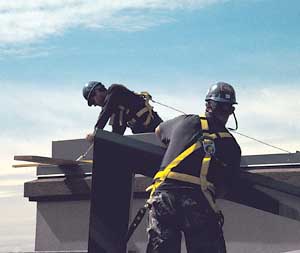
Photos courtesy of W.G. Clark Construction
|
The site safety supervisors’ responsibilities include conducting bi-weekly safety meetings attended by all employees and subcontractors on site. The site safety supervisors perform daily site inspections, with written documentation of these inspections. It is their responsibility to correct any hazards and/or violations immediately and implement the proper discipline needed if an employee is in violation of any safety standard.
All new hires, temporary labor and workers transferred from other projects receive a safety orientation covering all aspects of safety and focusing on the job-specific hazards for their project.
Each of Clark’s site safety supervisors now mentors an apprentice site safety supervisor. Apprentices accompany them on their daily site audits, help conduct bi-weekly safety meetings, assist in disciplining any employee in violation and help to correct any hazards. After six months, the apprentices become eligible to be on-site safety supervisors.
The company continues to support the AGC Back-to-Work Program by recruiting workers who were injured in the field and are in need of a safety internship. Currently, Dan Wallace is the seventh intern from the program. The previous interns have proven to be successful and are working in the field of safety.
Site safety supervisors are required to attend three or more Puget Sound Safety Summit meetings and share what they learned at their next safety meeting. One aspect of Clark’s modified duty program is to have employees with minor injuries work as an additional safety intern on a job site until they are released to full duty. The company says this has proven to be both effective and educational.
A few of Clark’s site safety supervisors are bilingual in Spanish and English, and they translate all safety meetings whenever necessary. The company also has hired a consultant, Hope Gonzales, who works part-time as a translator/trainer for Spanish speaking employees.
Bi-weekly safety meetings are a new standard of practice this year for the company, with the meetings held every Monday morning and every Friday afternoon. After evaluating incidents and injuries, Clark saw a trend of Mondays and Fridays being more accident prone, so it was decided to raise safety awareness at those times.
Job hazard analysis has been a common practice over the years, but Clark’s site safety supervisors are now directly involved in the process. They are responsible for approving and enforcing all site specific tasks that are hazardous on their job.
Supervisors meet with the foreman of each subcontractor’s crew and brainstorm on how to do a particular task that is potentially hazardous, document their plan and then implement it in the field.
Clark’s safety incentive program includes a cash bonus at the end of a project — provided the project is finished accident free. Safety points are awarded at the end of every year to all employees that remain accident/incident free. Recognition of outstanding performance goes to its “Safe Employee of the Year.”