
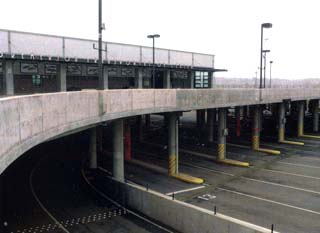
Bremerton Transportation Center
Location: First Street at Washington Avenue, Bremerton
Owner/developer: The Seneca Real Estate Group
Project team: Howard S. Wright Construction, general contractor; Seco Concrete Construction, concrete contractor; Hewitt Architects, architect; Cary Kopczynski & Co., structural engineer; and Fred Hill Materials, ready-mix supplier
The transportation center includes a ferry terminal, transit deck and parking structure. The ferry terminal houses the Washington State Ferries, Kitsap Transit offices and a walk-on passenger lobby. The transit deck serves as a bus drop-off and pick-up area for the terminal building.
Both the terminal building and transit deck are elevated over the ferry loading traffic lanes. The transportation center includes both auto and passenger-only ferry docks. All structures except the transit building were built of cast-in-place concrete.
A challenge in designing the project was its proximity to saltwater and the resulting corrosive environment. Soils were tested and found to have high levels of chloride, a serious corrosion threat to metal. Also, airborne chloride posed a corrosion threat to the superstructure.
Cast-in-place concrete was selected as the best alternative to thwart the corrosion threat. A mix was designed for all exposed concrete that included water/cement ratios limited to 0.4, fly ash at 100 pounds per cubic yard and air entrainment of 6 percent. Concrete strengths ranged from 4,000 psi in the foundations and walls to 6,000 psi in the elevated transit slab.
The transit deck is an 11-inch-thick post-tensioned concrete slab with shear caps at all columns to handle heavy loading imposed by buses and other large vehicles. Part of the slab was designed beefier to accept a future three-story addition to the commuter retail/office building.
Another design challenge resulted from the owner’s desire to maximize security and visibility by eliminating shear walls. Ductile frames would have typically been used to solve the problem, but they couldn’t be used because there wasn’t enough space for the beams due to high clearance requirements. The solution was to invert the frames by placing ductile grade beams in the foundation.