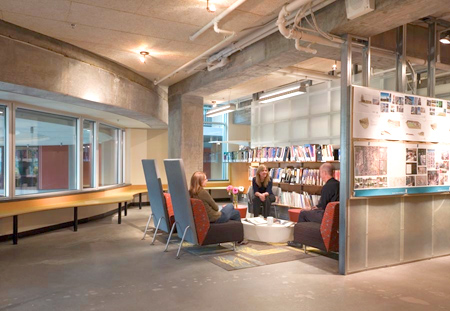
GGLO office improvements
Architect: GGLO
Owner: GGLO
ABC members: Pro-Staff Mechanical, All Phase Plumbing
GGLO chose Rafn Co. to renovate a 7,000-square-foot conference area and expand its offices by 7,300 square feet.
Working for an architecture firm with 13 principals raised the complicated issues of collaboration and ownership. GGLO fired itself twice during the early design stages, but the team worked together to keep the $703,304 project on schedule.
Rafn began construction by exposing and cleaning previously covered ceilings. Walls were then stripped, cleaned and refinished. Carpet was removed and the concrete floor beneath was ground down and polished. The glossy floors tie into the raw industrial feel of the office and never require sealing or refinishing.
The primary objective of the renovation was to maximize the sustainability of the design and reuse or recycle as much material as possible.
During demolition, the Rafn team inventoried and cataloged every piece of surplus material in both the existing workstations and the storerooms. The architecture team then based its design around reusing the materials. Ninety-five percent of the catalogued material — including workstations, countertops, shelves and wall panels — were used in the final space. Rafn obtained custom-made matching pieces to finish the design.
Rafn collaborated with Demolition Man to recycle or salvage 83 percent of the demolition waste and 74 percent of the overall construction waste. Materials were distributed to various recycling outlets: Independent Metals got the metal scrap, Ecolights NW took 122 fluorescent light bulbs, Second Use Building Materials received 22 oversized bags of unfaced batt insulation, Seattle Iron & Metal recycled the aluminum louvers and metal stud scrap, and BPB America took the waste drywall.
Some of the reused pieces included four sets of doors, 10 cabinets, and multiple can lights, junction boxes and conduits. The building engineer even took some scrap wood waste for his son's weekend Boy Scout campfire and a local kindergarten class used leftover blueprints as art paper.
The project achieved LEED silver, even though guidelines for LEED certification for tenant improvements were created during the project's design stages.
There were no injuries during 1,438 hours worked.