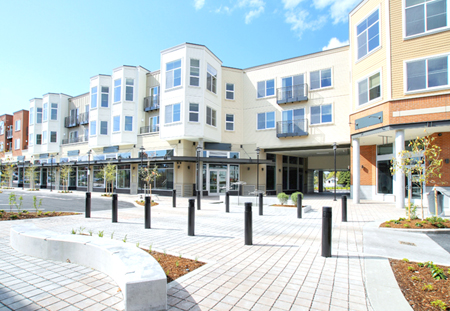
The Sedges at Piper Village
Architect: Schlater Partners Architects
Engineer: Coughlin Porter Lundeen
Owner: Greenwood Shopping Center
ABC members: CHG Building Systems, Evergreen Concrete Cutting, Custom Sprinkler, Green River Construction Co., Lockett Construction, Evergreen Refrigeration, Ketchikan Drywall Services, Rainbow Federal, TransTech Electric, Matheus Lumber Co., Nuprecon, Olympian Precast, Olympic Reprographics, Salmon Bay Sand & Gravel Co., Zee Medical Service, Propel Insurance, Clark Nuber PS
The site of Piper Village has a long history in Greenwood, an eclectic and tight-knit Seattle community.
Originally a dirt farm located on a peat bog, through the years the land evolved into a commercial district.
Replacing Greenwood Shopping Center, Piper Village is a 5.5-acre urban village with mixed-use retail and residential re-development.
Rafn Co. built phase one of the village, called The Sedges, which is a $13.5 million building with 46 market rate apartments over one level of retail. First phase work included exterior building renovation and substantial site improvements to First Avenue Northwest and Palatine Avenue North along the border of the project.
Additional site improvements included building Morrow Lane, a "woonerf" inspired roadway joining the new plaza with retail while creating a pedestrian-friendly, residential yard. Rafn also constructed North Seattle's first pervious asphalt parking lot, which helps recharge groundwater and the peat bog while reducing stormwater runoff.
Throughout construction, Rafn used green building practices, earning a Built Green Green Hammer 2010 Award.
Some of the green elements included extra insulation for less heat transfer and better noise control, energy-saving windows, energy- and water-efficient washing machines and dishwashers, and low-VOC paint and carpet. Rafn collaborated with ReNu to divert more than 79 percent of the project's construction waste through reuse or recycling.
The project includes landscaped swales to capture and retain water in the neighborhood.
Working within the peat bog presented continual challenges to the construction team, such as being prevented from dewatering the high-water table site in order to keep the bog fully charged. The peat layer and groundwater began just 5 feet below ground. Testing wells and weekly visits from engineers ensured that the groundwater levels were not being affected by construction.
The team installed 145 auger-cast piles at 29 feet down and a system of grade beams in order to successfully build on the bog.
A large sinkhole in the middle of Palatine Avenue complicated access to the site and prevented the building inspector from issuing the final certificate of occupancy. Although not in the original scope of work, the team ultimately fixed the sinkhole, negotiating with city inspectors and ensuring that the fieldwork would eliminate the issue.
Rafn used flaggers, temporary sidewalks and Seattle Police for traffic control to ensure the safety of residents during the substantial site and street improvements. There were no time-loss injuries in 26,595 hours worked.