
GCH
Specialty: Planning and landscape architecture for public and private clients locally and internationally
Management: Partners Pete Geyer, Jerry Coburn, Murray Hutchins
Founded: 1997
Headquarters: Seattle
Current projects: Planning and landscape architecture on San Juan Passage, a 100-home residential community in Anacortes; planning on Bear Mountain Ranch, a 30-home cottage development, inn and winery in Chelan; planning second phase village development at the SageCliffe resort in Quincy; landscape architecture on Clay Lacy Aviation at Boeing Field; several resort, residential and golf course projects in the Middle East, China and Korea
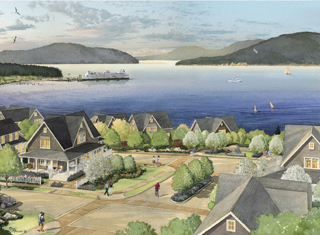
Rendering by Rick Mullen
GCH is the master planner and landscape architect on San Juan Passage, a 100-home community in Anacortes that is targeting LEED certification for its homes. Donald Powers Architects is the lead architect and Gilbane Development of Providence, R.I., is the developer. The first 14 homes are slated for completion this summer.
|
A slowing economy means GCH is doing a lot more master planning, whereas a year ago the firm was heavier on landscape architecture work, said partner Jerry Coburn.
GCH has benefitted from the diversified work load the company sought out after being hit hard by the fall of the Asian markets in the late 1990s, Coburn said.
“We had a lot of work in Asia and we lost it all,” he said. “We decided rather than being in one market we need to be in several markets.”
Recession hits all
Coburn said this recession has hit all markets. Last year, GCH had projects in 15 different countries and it now has new projects in three or four countries.
“Being diversified has really helped us through some of this,” he said. “The whole time, we’ve focused more on work locally, too, and that’s helped tremendously.”
GCH is working on master planning and landscape design in several new communities in Washington. The firm is master planner and landscape designer for San Juan Passage, a 100-home development under construction on 24 acres in Anacortes. That project is targeting LEED for homes and Fidalgo Backyard Wildlife Habitat Community certifications. The firm is also master planning Bear Mountain Ranch, a 30-home cottage development in Chelan.
More roof gardens
Coburn said the firm now has a handful of projects like Bear Mountain Ranch where the parking and driving areas are being moved to the perimeter of the project, with larger open spaces shared among homes. He said people in the Northwest are increasingly buying in to that type of development, and he’s glad to see it succeeding.
Another exciting local trend is the growing number of roof gardens and vertical landscape projects, Coburn said. He’s also glad to see more focus on stormwater at the planning level, both in the company’s local and international projects.
“We’re looking at the bigger picture with how we can utilize land so open space is used in a sustainable and smarter way,” he said.
Overseas opportunities
Internationally, Coburn said work is still pushing along in China, Korea and Vietnam, a country he expects will pick up even more in the future. He said a lot of work has disappeared seemingly overnight in the Middle East, but the firm is still getting planning and landscaping work in Abu Dhabi. He said South America is a market to watch.
Coburn said there is increasing awareness of water use and native and drought-tolerant plants in the firm’s international jobs. But he said it’s not always as easy to get native plants in other countries like Malaysia, where nurseries don’t necessarily carry them.
No layoffs yet
So far, GCH has been able to weather the economic storm without making any layoffs. Coburn, who got his architecture degree in 1988 and has worked in Seattle for more than 12 years, says this is the deepest recession he has ever seen.
“Before, because of having a broad base of regions to work in, you were almost OK,” he said. “This being a global recession, it makes it much more difficult.”
He said the economy’s effect on sustainability is a concern both locally and internationally. It becomes more challenging to find creative solutions that are environmentally sustainable and fit within the client’s budget. He said he is excited about the Sustainable Sites Initiative being developed by the ASLA and said that will be a big step forward in creating national guidelines and performance benchmarks for sustainable landscape design.