
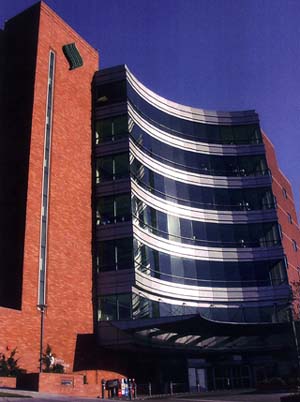
Seattle Cancer Care Alliance
Location: 825 Eastlake Ave. E., Seattle
Owner/developer: Cancer Care Alliance
Project team: Turner Construction Co., general contractor; Zimmer Gunsul Frasca Partnership, architect; KPFF Consulting Engineers, structural engineer; Stoneway Concrete, concrete contractor; and Glacier Northwest, ready-mix supplier
The design of the new Seattle Cancer Care Alliance clinic led to the development of, reportedly, the world’s heaviest concrete. The dense concrete was needed to shield radiation generated by the facility’s linear accelerator, a machine that kills cancer cells with a photon beam.
Linear accelerators are typically enclosed in massive concrete vaults in order to protect the surrounding space from radiation. Conventional vault design relies on normal weight concrete that weighs 145 pounds per cubic foot. For the alliance project, that would have put the top of the ceiling slab about 20 feet above the floor of the treatment room — and 6 feet above the second floor of the building, resulting in a loss of 2,000 square feet of space on that level.
An alternative to conventional vault design includes steel plates or lead bricks embedded in the slabs and walls. Using 12 inches of steel might have reduced the ceiling thickness to 5 or 6 feet, but the top still would have been higher than the second floor.
The solution was found in designing a concrete that weighs in at a hefty 350 pounds per cubic foot. The concrete was created using salvaged steel punchings in the mix instead of sand or gravel. The result was a thinner ceiling — 44 inches of heavy and 4 inches of regular concrete — allowing the space above on the second floor to be used for other purposes.
The extraordinary weight of the concrete posed several construction challenges. First, most ready-mix trucks are designed to carry 10-12 cubic yards of normal weight concrete. The heavy mix limited loads to only 3 cubic yards, requiring three to four times more trucks than normal.
Another concern of the heavy concrete was its high cement content. To keep the mix from setting too quickly or not at all, it had to be properly retarded.
Placing the concrete was also a challenge. It had to be discharged slowly to prevent the steel aggregate and cement slurry from separating. And, since it was so heavy and couldn’t be pumped, it was placed using chutes.