 |
Subscribe / Renew |
 |
Contact Us |
| ► Subscribe to our Free Weekly Newsletter | |

Construction Bids
| home | Welcome, sign in or click here to subscribe. | login |


 print print  email to a friend email to a friend  reprints add to mydjc reprints add to mydjc |  |

March 22, 2000
|
Q: What kind of land development consulting do you do?
A: Triad Associates offers a range of complementary land development consulting services from initial feasibility studies through site development. We not only work to secure entitlements; we help our clients design commercial and residential sites that fit with today's markets and regulatory frameworks. To be effective consultants, we have to stay on top of ever-changing requirements.
Q: What is your role at Triad?
A: I am the director of planning and an associate of the firm with the responsibility of managing our group of planning professionals. The planners work to orchestrate and expedite project approvals. To do this successfully, we figure out all aspects of a project site and its surroundings. This involves working with the owner, developer, other technical consultants, governmental staff reviewers and neighborhood interest groups.
Q: Are regulations driving development away from the Puget Sound region?
A: No. But only the more savvy developers who have capable consultants to help them maneuver through the maze of reviews are successful at developing medium to large projects in this region.
|
Q: Are you an employee-owned firm?
A: Ownership is offered to people in the firm who have shown excellence in their work and to those who we believe will add stability to the firm. About a third of the employees in the firm, including management, are stockholders, Every year or two we add more employee-owners. We believe that an employee-owned firm results in better client satisfaction and makes for a better place for people to work. An employee-owner is not a nameless person in a large, faceless firm. A good analogy is the difference between an owner and a renter of a house. The renter may or may not take care of the property. But owners have the self-interest to take pride in ownership.
Q: What are the critical aspects of a site feasibility study?
|
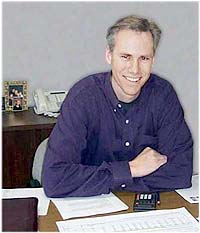
- Colin Lund, planning director |
Q: How did you get to this point in your career?
A: At California State Polytechnic University, I was given a hands-on education working on local land planning issues. After graduating with a Bachelor of Science in urban and regional planning, I worked for the city of Pasadena planning department on project plan reviews and site designs. I also staffed the hearing examiner, the planning commission and city council. I left the city not only understanding the technical aspects of project review and site design, but the ways in which the political process affected the outcome. I moved to Washington in 1990 and joined the planning staff at Triad Associates. A few years later, I went to work for Heartland as a project manager. While there, I learned in-depth how developers approach the land development process. I returned to Triad to head its planning department in 1997. Here I have been able to weave all my experiences together -- government reviewer, planning consultant and developer.
Q: What projects are you particularly proud of?
A: The planning group at Triad has put together a unique and comprehensive approach to site feasibility analysis. Using a 15-page checklist, we systematically assemble pertinent information that a developer should consider before closing on the acquisition of a piece of land. We put together a report that lets the developer assess the development potential, limitations and risks. Often land is optioned and we are brought in during the 45- to 60-day period for due diligence review. That means we hustle to get this analysis done in as short as two weeks. This report proves to be valuable later in the site development process as well because we identify the critical players, utility and service issues, site-specific environmental issues and critical aspects of the review process. We can adjust this tool for use in any jurisdiction. We are successfully using it on work we are doing in both Washington and California.

|
Q: What are the most challenging aspects of your work?
A: Accurate information is key to our client's success. Obtaining reliable information, even directly from regulatory agencies, has become more difficult because the rules for development review change so often. During the time it takes to bring a typical project from concept to construction the rules can change a lot. Our job is to continually be informed of new regulations so that we can proactively pursue development strategies to further our client's objectives.
Q: What do you like best about your job?
A: Every property and each jurisdiction is different. I enjoy the complexity of sorting out all the pieces and simplifying them into a road map that shows how the developer's vision for the property can be achieved. To do that, I work hard at fostering cooperation and positive relationships among the developer, local government and other interests. Staying current on changing local, state and federal regulations that affect development strategy keeps me alert and creative. Seeing a project move through the hoops of review and obtain the entitlements needed to proceed forward truly satisfies me.
Previous columns:


