 |
Subscribe / Renew |
 |
Contact Us |
| ► Subscribe to our Free Weekly Newsletter | |

Construction Bids
| home | Welcome, sign in or click here to subscribe. | login |


 print print  email to a friend email to a friend  reprints add to mydjc reprints add to mydjc |  |
June 25, 1998
By CLAIR ENLOW
Journal A/E editor
It may be a cool summer so far, but Paris architect Denis Laming is warming to Seattle. His project, the Boeing IMAX Theater and Ackerley Family Exhibit Gallery is taking shape, his English is nearly fluent and he feels "at home" here.
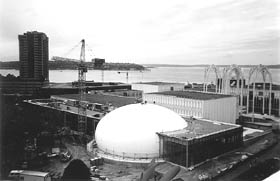
Yesterday Laming visited the site of the Boeing IMAX Theater and Ackerley Family Gallery, an addition to the Pacific Science Center. The top of the landmark "orb" was dropped into place three weeks ago.
|
|
The Boeing IMAX Theatre and Ackerley Family Gallery, is shown in the foreground next to the Pacific Science Center. Photo by Karen Rorie |
The project is coming together on the ground, too. From the courtyard of the Science Center, a new walkway leads around the corner to the glass facade of the Ackerley Family Exhibit Gallery, which will open to the public this fall.
Through blue-green glass are the outlines of the huge white orb -- actually an oblate spheroid -- that seems to have arrived from another world before the rest of the addition was built around it. Laming points out that, conceptually, the orb is not in the process of settling. In his view, it is about to rise -- captured in an eternal moment.
From the entrance, a path descends around the orb to the entrance of the IMAX theater. The screen inside, which will debut with "Everest" this fall, has the approximate dimensions of a tennis court.
In the gallery space beyond the orb, there will be a variety of exhibits and spaces for gathering. By December, two bays of the gallery will be given over to butterflies from around the world. Their futuristic habitat will be climate controlled at 80 degrees and 80 percent humidity.
Even as the spaces become real, they seem to belong in the realm of the imagination.
"It's really very simple," said Laming. "All is in the details."
The steel and glass that surround the orb seems to break in a wave form, adding to the illusion of a giant bubble.
|
|
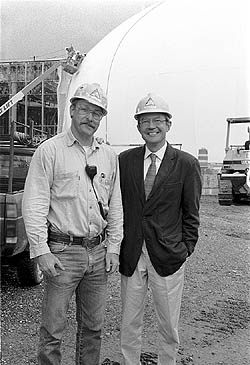
Architect Denis Laming (right) joins Kiewit project superintendent Pete Elliott at the site. Photo by Clair Enlow |
To Laming, the imaginary and the practical are both very important. "It is the frontier between both that makes the quality of architecture."
European architectural critics have given Laming credit for initiating "futurism" within the Post Modern movement in architecture.
"I'm not concerned by the present," he said. "I find sources of inspiration in the past to build on the future."
In his original visit to the site, Laming was inspired by Minoru Yamasaki's design for the Pacific Science Center, originally built for the 1962 Seattle World's Fair.
"The clear and delicate architecture of Yamasaki's design is stunning," he said. However, Laming regards the design of the Pacific Science Center to be "introverted."
"I felt that the addition should open the building and act as a welcoming signal to people visiting the center. My hope is that the visual image of the addition will one day be synonymous with Pacific Science Center itself."
"I philosophically relate to an ancient Chinese proverb which believes a house belongs to two people: the owner who lives in the house and the passerby who sees it."
The executive architect for the project is Callison Architecture. The general contractor is Kiewit Construction. A subcontractor, Ratech Industries of Sparks, Nev., manufactured the panels for the orb and assembled it.
The science center addition is Laming's first U.S. project. His second is already underway: another pavilion and IMAX theatre in a new high-tech office park outside of Denver.


