 |
Subscribe / Renew |
 |
Contact Us |
| ► Subscribe to our Free Weekly Newsletter | |

Construction Bids
| home | Welcome, sign in or click here to subscribe. | login |


 print print  email to a friend email to a friend  reprints add to mydjc reprints add to mydjc |  |
August 24, 1999
By ANNU MANGAT
Journal Staff Reporter
It took a lot of sand, inspiration -and perspiration -for a team of local designers to clinch first prize at the recent U.S. Open Sandcastle Competition in Imperial Beach, Calif.
|
|
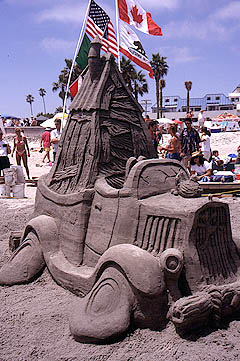
A jalopy with a hen perched on its hood is one component of the sand sculpture entitled "Moon Swine," which took first place at the recent U.S. Open Sandcastle Competition. Designed by a team of local architects, the 8 1/2-foot sculpture took about five hours to build. |
Team captain Vern Cooley of LMN Architects in Seattle said participation in the contest is, of course, fun, but he was quick to add: "There's an awful lot of work involved in this."
Under rules for the annual U.S. Open Sandcastle Competition, the teams have no more than six hours to complete their masterpieces, which can be built only with sand and water. "It's a race," said Cooley. "You have to be very coordinated and organized."
|
|
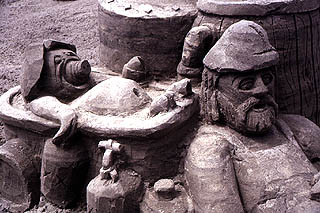
Another part of the sand sculpture features a pig lounging in a bathtub and a hillbilly leaning against a barrel of moonshine. |
Before the contest begins, team members fill water buckets and dig pits, which are lined with plastic, around the sculpture site as a reservoir. Once the competition starts, members quickly go into action, pounding sand and water into plywood forms to make dense blocks; known as the "pound-up," this compaction of sand and water is the most critical aspect of construction, Cooley said. He said the team starts laying the blocks at the bottom to be shaped later in greater detail, with each team member pre-assigned a specific part to sculpt.
|
|
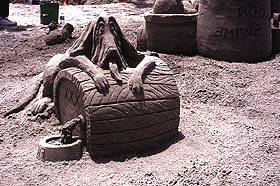
A bloodhound, made from highly compacted sand and water, droops over a barrel of moonshine. |
Though these designers devote their careers to shaping things that endure the test of time, the fleeting, temporary nature of sand sculpting is part of the thrill of the contest, Cooley said.
"Everyone remembers making sandcastles on the beach as kids. We've just never stopped," he said.


