 |
Subscribe / Renew |
 |
Contact Us |
| ► Subscribe to our Free Weekly Newsletter | |

Construction Bids
| home | Welcome, sign in or click here to subscribe. | login |


 print print  email to a friend email to a friend  reprints add to mydjc reprints add to mydjc |  |
June 2, 2004
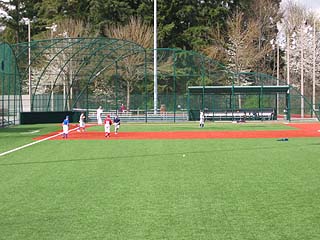
Bruce Dees & Associates called for improvements to Grass Lawn Community Park including softball fields surfaced in synthetic turf.
|
Bruce Dees & Associates developed a master plan and construction documents for two phases of the recently re-opened Grass Lawn Community Park in Redmond. The new park features a synthetic turf softball field and six tennis courts.
This park was originally built in the late 1970s. The original all-weather soccer field often flooded and eroded due to poor drainage. Storm sewer lines were frequently full of sand and silt after storms.
Improvements include a porous rubber-coated track surrounding the synthetic field. The softball fields were also surfaced in synthetic turf and both fields are underdrained in the same manner.
The re-design solved problems that limited park use and were causing damage to nearby salmon habitat in the Sammamish River. The synthetic material eliminates nutrient runoff into the storm sewer and subsequent tests have proven that no harmful materials are in the water that percolates through the sand/rubber infill, crushed rock base and sub drain lines into the storm sewer, according to Bruce Dees & Associates.
The new fields, including a soccer field, have a lighting system designed by Sparling.
Central Library tours: online and in person
A half-hour documentary on the opening of the new Central Library -- featuring behind the scenes planning with architect Rem Koolhaas -- can be viewed at www.seattlechannel.org. The documentary, "A Library for All," features librarian Deborah Jacobs, staff and architects explaining the library from conceptual design to completion.
Lead architect Joshua Ramus of the Office for Metropolitan Architecture in Rotterdam explains the evolution of the design, from program to spread sheets and models.
The library is also offering tours beginning at 1:30 and 3:30 p.m. Saturdays and Sundays. They will also be offered at 6 and 7 p.m. Mondays through Wednesdays. Sign up on the day of the tour at the Fifth Avenue welcome desk. Reservations will not be accepted by phone or e-mail. For more information about tours, call (206) 733-9609 or e-mail centraltours@spl.org.
Candela wins lighting awards
Candela Architectural Lighting Consultants recently received the international IIDA Paul Waterbury Award and several other awards at the 2004 International Illumination Design Awards ceremony, hosted by the Puget Sound section of the Illuminating Society of North America.
Exterior lighting of the Museum of Glass and Contemporary Art in Tacoma received section and regional awards in addition to the first-place international Paul Waterbury Award. This category acknowledges Paul Waterbury's achievements in the lighting field, including the development of 1500 W metal halide lamps for stadiums.
"Visible light fixtures in the form of poles and bollards were banished from the vocabulary on this project," said Mary Claire Frazier, Candela principal and project designer. "Instead, the design team sought to interact lighting with materials and surfaces to reveal a breathtaking array of textures. This museum sparkles, shimmers and glows day and night."
Candela also received region and section Guth Interior Awards for interior lighting design of University of Washington Medical Center Surgery Pavilion, and a Guth Interior Section Award for interior lighting of University of Washington William H. Gates School of Law.
Sunday forum on Dutch 'interiority'
In conjunction with Seattle Art Museum's current exhibit, "Van Gogh to Mondrian," the museum will host a discussion titled "The Abstract Interior: Dutch Modernism from Van Gogh to Mondrian." It will be held from 4 to 5:30 p.m. Sunday at Plestcheeff Auditorium.
Marek Wieczorek, assistant professor of art history at the University of Washington, will explore Dutch modernism and "interiority," which for some artists led to new ways of understanding the interior of the home as an abstract reflection of the inner self and, by extension, the community.


