 |
Subscribe / Renew |
 |
Contact Us |
| ► Subscribe to our Free Weekly Newsletter | |

Construction Bids
| home | Welcome, sign in or click here to subscribe. | login |


 print print  email to a friend email to a friend  reprints add to mydjc reprints add to mydjc |  |
August 1, 2016
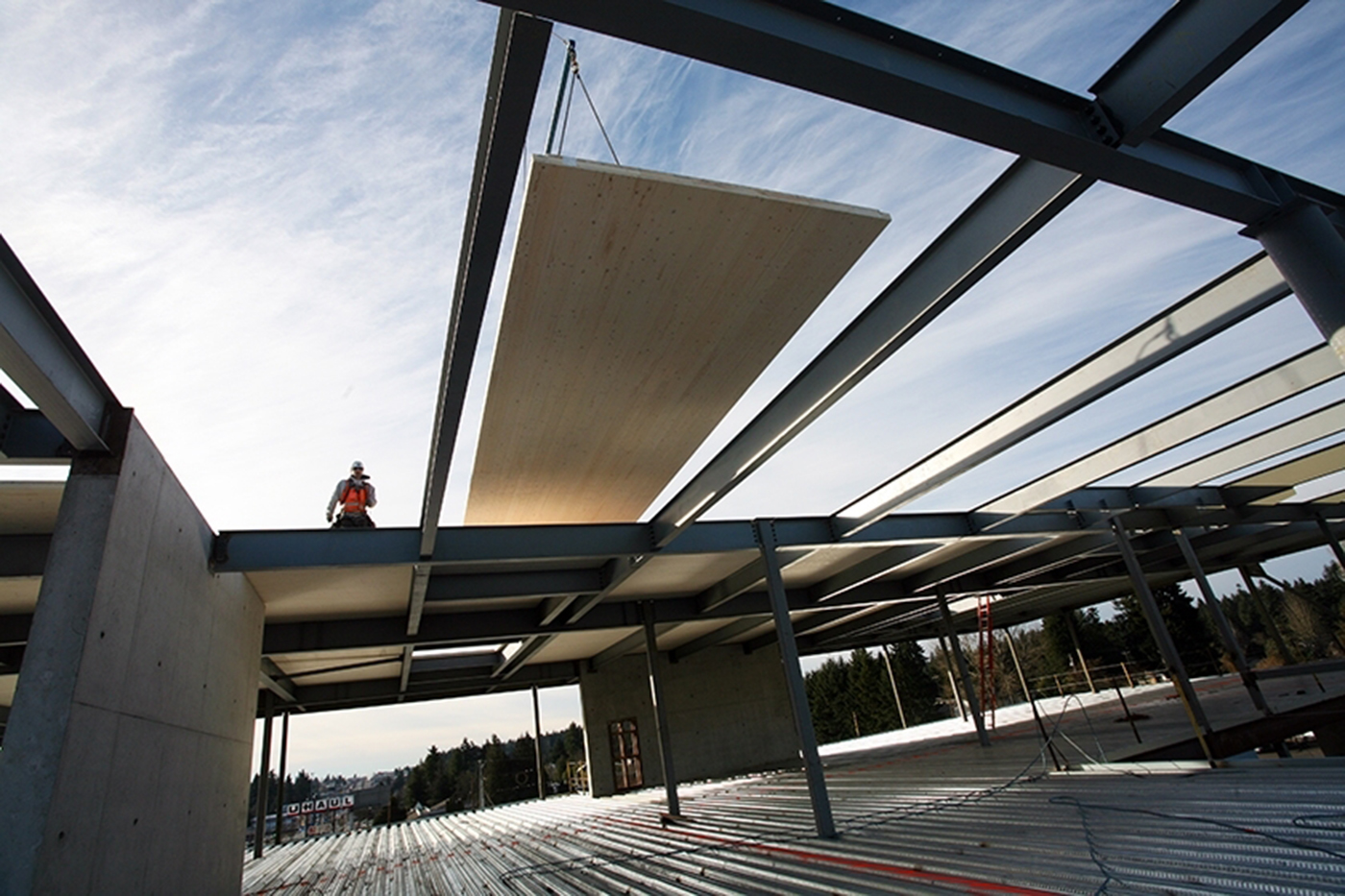
The state wants in on the new construction material that people here are talking about: cross-laminated timber.
Debra Delzell of the Department of Enterprise Services says five school districts in the state are part of a $5.5 million program that will use CLT for elementary classrooms.
Two design-build teams are the front runners to get the work: Walsh Construction Co., Mahlum and Coughlin Porter Lundeen for classrooms in Seattle, Mount Vernon and Sequim; and Graham Construction Co., NAC Architecture and atelierjones for classrooms in Wapato and Toppenish.
The schools are Maple in Seattle, Greywolf in Sequim, Jefferson in Mount Vernon and Adams in Wapato. Officials have not decided which school they will pick in Toppenish.
Delzell said four 900-square-foot classrooms will be contained within a 4,000-square-foot building at each school. Enclosed walkways will connect the classroom buildings to the existing schools.
Classrooms will be for kindergarten through third grade. They will be plumbed with water lines and kindergarten classrooms will have restrooms. Delzell said the single-story buildings will be made from large CLT panels with cutouts for doors, windows and utilities. She said they will use kit-of-parts construction to build atop traditional foundations. Restrooms will be prefabricated.
Cross-laminated timber has been used in Europe for a couple of decades but is just catching on in the U.S. Some local projects that used CLT are First Congregational Church in Bellevue, a home in Seattle's Madison Park and Shoreline Medical & Dental Clinic.
The large wood panels are made from several layers of planks that are stacked crosswise and glued together under pressure. Panels can range from 4 to 12 inches thick, depending on the number of layers.
Jacob McCann, a project manager for KPFF Consulting Engineers, told the DJC in 2014 that CLT is structurally similar to precast concrete planks or super-thick pieces of plywood.
A state news release says the panels are strong and rigid enough to replace steel and concrete as the main structural elements for buildings, even multi-story structures. It says the panels don't ignite as easily as conventional wood-frame construction, and even if they do burn, charring on the outside protects the interior, leaving the panel structurally sound.
The state also notes that using CLT could help solve the problem of what to do with millions of beetle-kill fir and pine trees that pose a huge forest fire risk.
Funding for the projects is coming from a proviso in the state's supplemental capital budget that aims to reduce classroom size and stimulate the timber industry. CLT uses small-diameter softwood that can't be used for traditional dimensional lumber and is considered a waste product. There are no CLT manufacturers in Washington and only a handful in North America, according to the state.
Delzell said they are working to get preliminary contracts with the design-build teams so that guaranteed maximum prices can be set. She said they hope to sign final contracts by mid-September and start construction shortly afterward.
Delzell said the goal is to have some of the classrooms finished by the end of the year, but the project in Seattle may be another four months out due to permitting.


