 |
Subscribe / Renew |
 |
Contact Us |
| ► Subscribe to our Free Weekly Newsletter | |

Construction Bids
| home | Welcome, sign in or click here to subscribe. | login |


 print print  email to a friend email to a friend  reprints add to mydjc reprints add to mydjc |  |
December 27, 2016
If you've ever stayed at a Residence Inn by Marriott, the Tukwila architecture firm Johnson Braund would like to thank you.
Since 1992, the firm has provided the hotel chain with what's called “prototype documentation,” a kit of architectural drawings that outline what Marriott franchisees should include when they build or renovate Residence Inns. The kit details the type of furniture, wall coverings, paint and other elements.
Every six years or so, Marriott has Johnson Braund do an update to reflect new trends and changes in the industry. This, as you might imagine, keeps the 39-year-old design firm busy.
“I take great pride in Residence Inns,” said Greg Allwine, who stepped down as president of Johnson Braund earlier this year. “It's a great brand.”
Johnson Braund recently named Jeff Williams as president, promoted Diana Keys to vice president, and Jamie Gilmore, Eli Tuttle and Seth Terry to associate.
Greg Eckert manages the firm's new Nashville office.
Allwine is a principal and secretary of the firm, and owns 55 percent of its stock. Williams owns 30 percent; Keys owns 5 percent, and some associates own the rest. Steve Allwine, Greg Allwine's son, directs the firm's marketing and IT.
Johnson Braund has 19 people on staff, and offers architecture, interior design and planning. Besides hotels, it designs condos, apartments, senior housing and commercial projects, including Banner Bank branches.
Revenue in 2015 was $2.9 million, and is projected to be $3.2 million in 2016. The firm is licensed to practice in 45 states.
Johnson Braund usually has about 15 hotel renovations going at a time, and its design work has included the high-rise The Courtyard Marriott in downtown San Francisco and The Residence Inn by Marriott in downtown Sacramento.
Greg Allwine said hotel guests now expect to be wowed and also to feel part of the community. “Hotels are becoming, as they need to be, more localized,” he said.
That means installing regional art, having exteriors that reflect the area, or suggesting local, unique restaurants to guests.
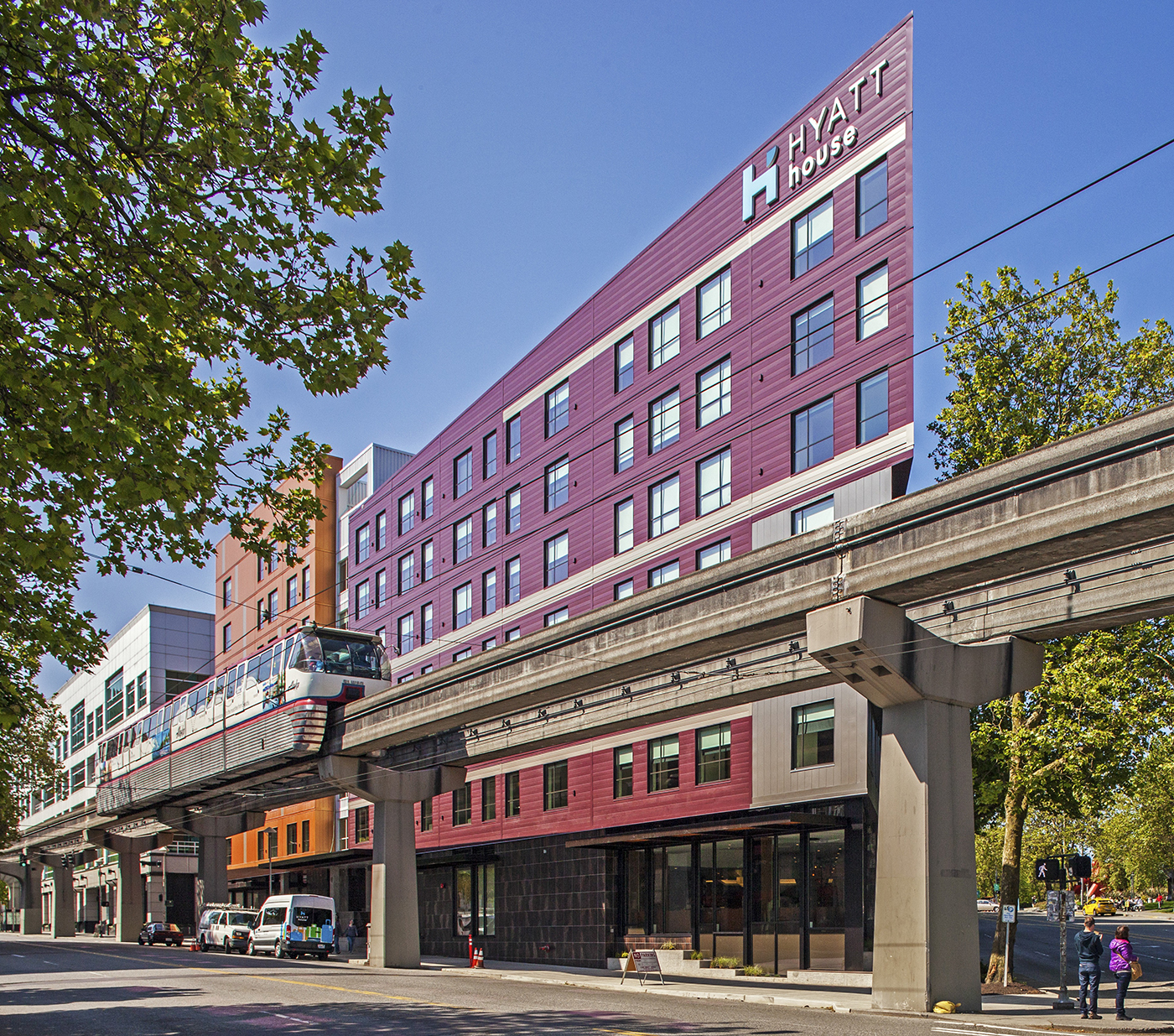
For instance, Johnson Braund designed the Hyatt House and Hyatt Place in Seattle so guests on the first floor can see through the buildings to the Space Needle and Museum of Popular Culture. The bars and restaurant also look out onto those iconic structures.
In 2002, the firm helped develop prototype documents for all Marriott limited-service hotels, and that brings in business from Marriott franchisees who want to build or renovate.
Greg Allwine said it takes work to adapt the prototypes to different sites and climates.
For instance, he used his firm's kit of parts to design a new Courtyard by Marriott on Maui in Hawaii. The design opens up the building to take advantage of natural breezes, and the materials have a Hawaiian flavor.
He used the same prototype to design a Courtyard in Mankato, Minnesota, where outdoor temperatures can go below zero. Modifications allowed for adding the first solar array on a roof of a Courtyard.
The firm has also designed projects for Hilton, IHG and Wyndham. It is architect of record for Hilton Garden Inn in the Hill7 project in Seattle.
Senior housing work includes The Terrace apartments in Seattle, Tri-Court in Kent and Tukwila Village. Multifamily work includes Vik Condominiums in Ballard and Oregon 42 Apartments in West Seattle.
Greg Allwine said there's more freedom in multifamily design than hotels because those footprints are pretty fixed and the unit layout is primarily a decision about queen or double beds. With apartments and condos, you can play with the unit mix to make a project more efficient.
Amenity spaces in downtown Seattle apartment complexes are market driven, he said. If a building is under 75 feet, the question is how to have things like a roof deck, barbecue area and dog walking space.
Bryan Park is president of Pacific Northern Construction Co., which develops and manages senior housing projects in Washington. It partners with Senior Housing Assistance Group, which helps market, lease and provide services to residents.
He said his firm has consistently hired Johnson Braund because it understands building codes and development standards in different cities, and designs high quality buildings with the most efficient rentable area. If an architect is not good at addressing inefficiencies, the cost of construction could be higher, he said.
Johnson Braund Design Group was founded in 1977 by Larry Braund and Tom Johnson in Tacoma, but soon moved to Tukwila.
Braund relocated to practice engineering elsewhere and Johnson does commercial real estate development.
Karim Khalifa is senior vice president of global design for Marriott International. He met Greg Allwine in 2005, while Khalifa was managing design of Marriott's select service brands in the U.S. and Allwine was an architectural consultant.
He said Allwine could come up with ways to improve even his own work on the early Residence Inns. “He never defended anything that he had thought through with all his brain the first time. He was just very current and present with his thinking,” Khalifa said.
The original Residence Inns “were absolutely correct for their time,” he said, but guests' needs changed and that promoted Marriott to simplify the kitchen and upgrade the bathroom.
In earlier decades, bathrooms were just functional, but now guests want more luxury, he said. They also wanted extended-stay hotels to have a “proper” kitchen with an oven, he said, but fast food and urbanization changed that. “Nobody's baking in an oven when they go into a hotel,” Khalifa said.
He said Allwine introduced green design ideas to Marriott at an early stage, using his firm's office — which gets about half its power from solar — as an example.
Like other design firms during the Great Recession, Johnson Braund had to lay off employees. In 2011, it went out of business under the name Johnson Braund Design Group and reopened the next day as Johnson Braund. It spun off the landscape architecture division, which became The LA Studio. That firm is owned by Mel Easter, who had been co-owner in Johnson Braund Design Group.
Greg Allwine said he learned a lot from economic downturns, including how to control costs and make decisions early. “It's turned out great,” he said. “We're still here.”
Lynn Porter can be
reached by email or by phone
at (206) 622-8272.


