|
Subscribe / Renew |
 |
Contact Us |
| ► Subscribe to our Free Weekly Newsletter | |

Construction Bids
| home | Welcome, sign in or click here to subscribe. | login |


 print print  email to a friend email to a friend  reprints add to mydjc reprints add to mydjc |  |
November 16, 2020
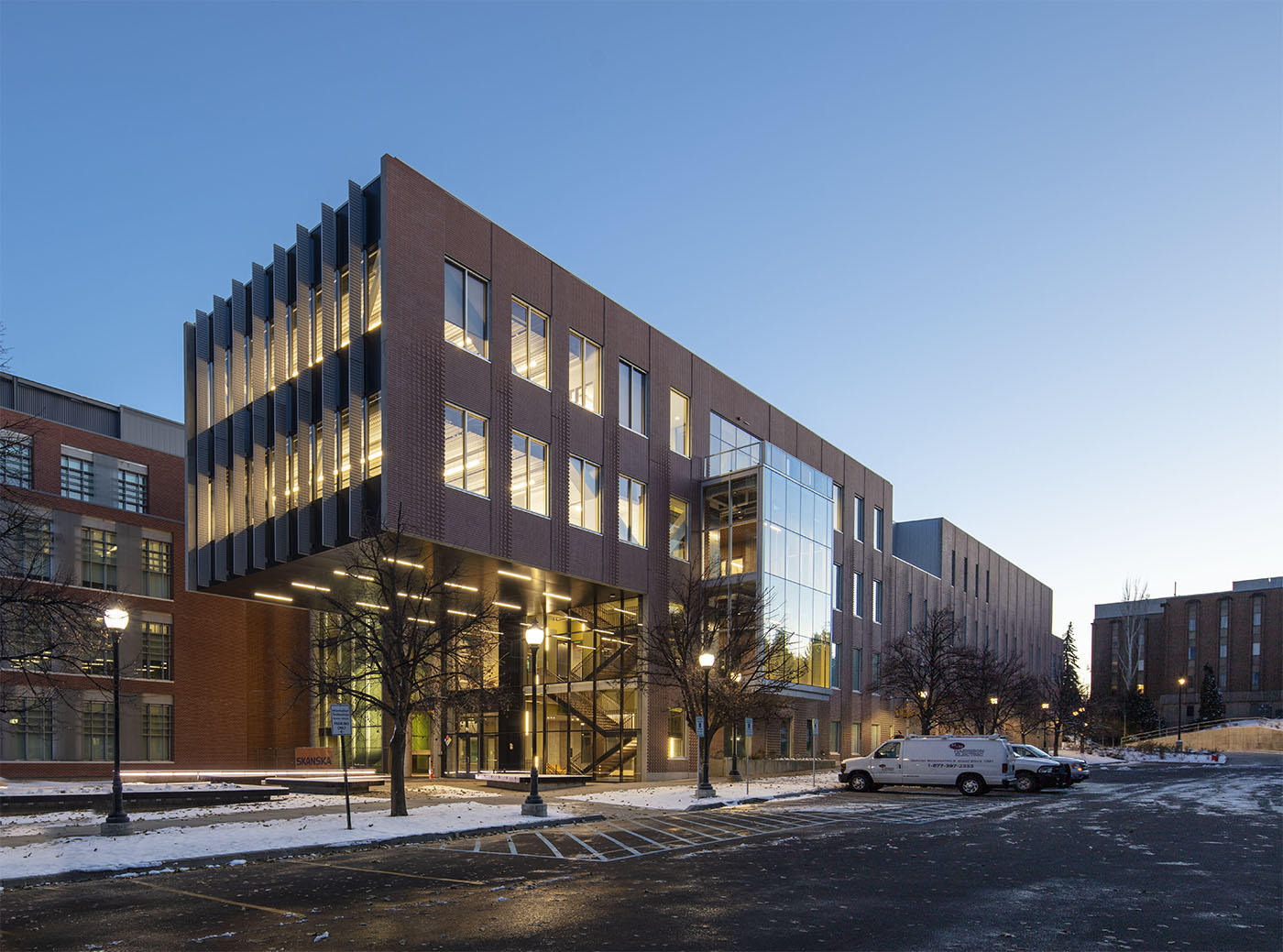
The $66 million Plant Sciences Building at Washington State University in Pullman will be virtually dedicated through a commemorative video to be released today.
LMN Architects and Skanska were the design-build team for the five-floor, 82,437-square-foot new center for interdisciplinary research.
In a press release, LMN said the building integrates several disciplines from the College of Agricultural, Human, and Natural Resource Sciences. It supports Washington's $51 billion food and agriculture industry by providing a modern research venue for faculty and students in the Institute of Biological Chemistry, WSU's Molecular Plant Science Program and portions of the Departments of Horticulture, Plant Pathology, and Crop and Soil Sciences.
The Washington legislature funded the project at WSU, an agricultural research institution. It is the fourth building to be completed within the master plan for the V. Lane Rawlins Research and Education Complex at the university, developed by LMN in 2005. The plan envisioned laboratory buildings alternately flanking a glazed spine element that serves as the connective tissue for the social and research life of the complex.
The Plant Sciences Building is to the south of the Biotechnology and Life Sciences building, designed by LMN and completed in 2009. As the central element of the completed complex, the building forms a prominent primary entry point that frames a new public space along Stadium Way.
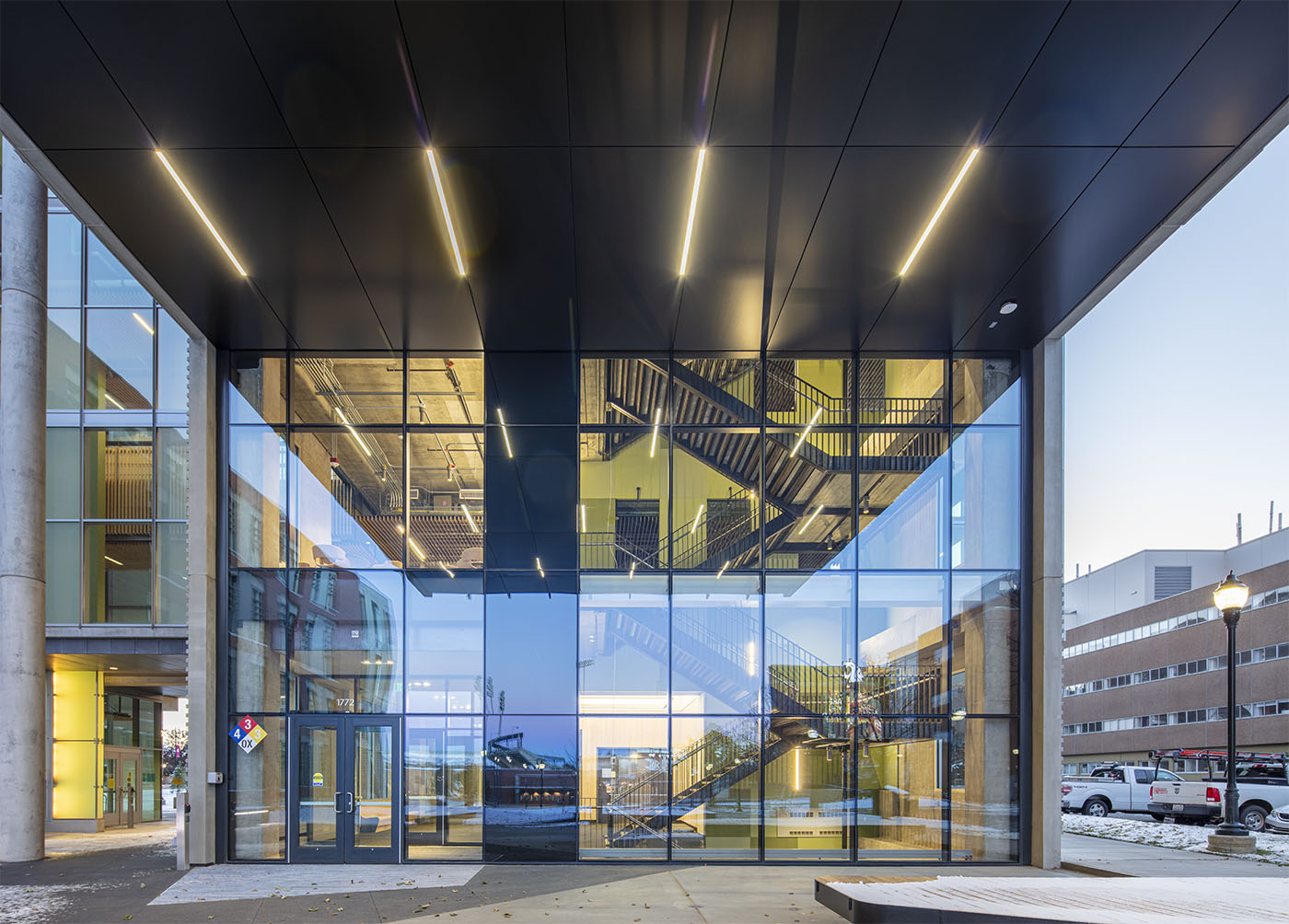
LMN said the plan configuration of the new building accommodates an existing utility tunnel to the south — an adjustment to the master plan which helped save in construction cost and schedule. At the western entry, the building's cantilevered composition frames a new grand entry to the whole complex, and features a two-floor cantilever facing west towards Martin Stadium. The new landscaped approach creates a multifunctional public space for the university.
The architect said the new facility will be a social and interdisciplinary heart for the research complex. Designed for flexibility, the building hosts infrastructure for research needs beyond the College of Agricultural, Human, and Natural Resource Sciences. A welcoming four-floor staircase encourages vertical circulation and provides visual connections between floors. At every level, centralized social spaces link circulation elements with the REC's central spine.
The interior arrangement of labs is designed to support efficient and flexible research over time. The modular labs can be easily rearranged to respond to the changing needs of research. Offices for principal investigators are interspersed with open work areas for graduate researchers. Modular support spaces accommodate specialized research equipment.
On the exterior, the building reimagines the red-brick campus vernacular in a new architectural approach; a high-performance precast concrete facade panel system is clad with a sculpted, red-brick veneer. LMN said the panels integrate structure, insulation, weather barrier, interior and exterior finishes within a single prefabricated component, accelerating construction sequencing and enabling a composition of organically inspired brick surfacing. The resulting building form presents an abstract composition culminating in the integration of the building's internal modular planning with the panelized facade components.
LMN said the building's prefabricated facade system sped construction and transformed architectural possibilities in the building. On the inside, the integrated concrete panels are left exposed to become the finished surface in many workspaces. On the exterior, the undulating brick pattern — made possible through CNC-driven formwork — casts shadows which animate the facade in the day in a play of light unique to the eastern Washington Palouse landscape.
The project team included Coughlin Porter Lundeen, civil engineer; Magnusson Klemencic Associates, structural engineer; Berger Partnership, landscape architect; and MW Consulting Engineers, lighting design and MEP engineer. Skanska USA Building was the contractor and construction manager.