|
Subscribe / Renew |
 |
Contact Us |
| ► Subscribe to our Free Weekly Newsletter | |

Construction Bids
| home | Welcome, sign in or click here to subscribe. | login |


 print print  email to a friend email to a friend  reprints add to mydjc reprints add to mydjc |  |
October 11, 2023
Between the towns of Winthrop and Mazama in the Methow Valley, a unique mixed-income housing community is taking shape.
The community sits in the foothills of the North Cascade Mountain Range and currently comprises eight permanently affordable single-family homes, which were completed in 2020, with an additional 10 market-rate homes planned for the future.
In spring, work was completed on the most unique structure at the site, the Berm House. Built with Cross-Laminated Timber (CLT) and burrowed into a meadow slope, this one-level approximately 3,300-square-foot building is the new communal heart of the development and serves as a common house for gatherings, as well as providing additional accommodations for visiting guests.
Berm House was designed by CAST architecture for the landowner, Lee Whittaker, a retired former physics and math teacher and tech entrepreneur.
CAST was also the architect for the completed homes which Whittaker developed in partnership with the Methow Housing Trust (MHT). The organization owns and operates those two to three-bedroom homes using a community land trust model.
Whittaker and his late wife Marilyn purchased the land for what is now called the McKinney Ridge Neighborhood in 2013 with the goal of creating a co-housing community for people of mixed incomes and ages, something the couple had talked about for many years.
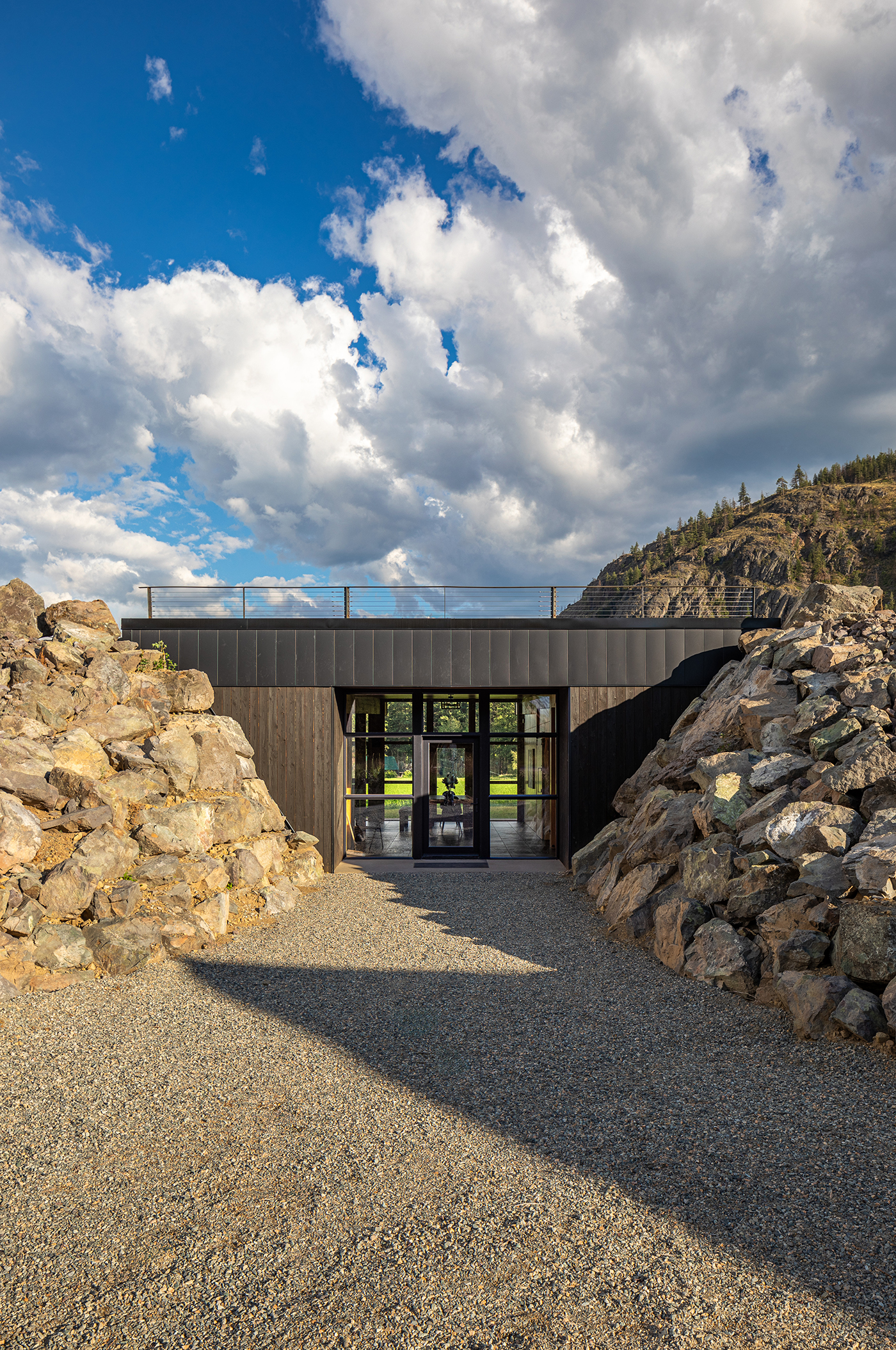
For what would become Berm House, Whittaker says the vision was to develop “an iconic building at the center of the neighborhood” where residents and guests would want to come together and connect. At the same time, it was imperative that the home did not detract from the natural beauty of the surrounding valley and mountains or stand out too visibly in that landscape.
Other key considerations for the common house were sustainability, a flexible floor plan that could accommodate diverse community needs and ensuring that the structure could expertly handle the weather extremes of the Methow Valley (the area has very hot dry summers and averages around 88 inches of snow a year).
CAST's response is a unique, low-profile house that expertly frames surrounding views and incorporates innovative sustainability solutions and technology, including CLT and passive house design principles.
The home has a glulam post and beam structural frame with a CLT roof system comprised of components prefabricated in northeastern Washington by Vaagen Timbers. The structure is built into a man-made meadow slope to create the bermed roof, which is covered with 12 inches of soil. This design innovation means the house is virtually invisible to the residential portion of the community, which is located to the north of the common house. The structure is also not visible from the highway, leaving valley views uninterrupted.
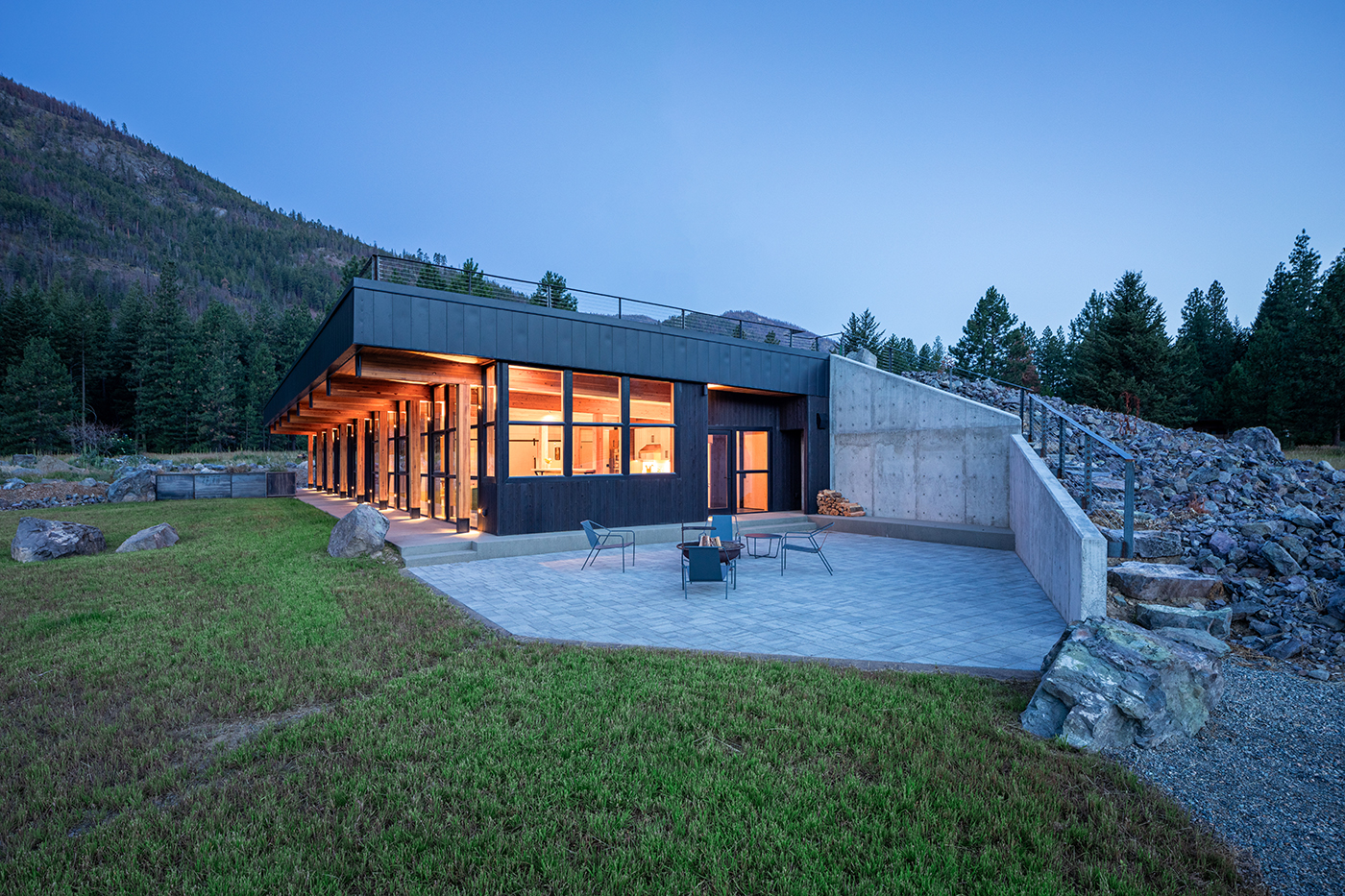
The southern elevation of the home peaks out from under the berm, facing the valley and its rolling agricultural fields. Swathes of glass define this portion and provide panoramic views across the fields and out to the mountains from inside the structure. A similar view is available atop the accessible bermed roof.
“We designed the house with an intentionally pure modular architectural expression, low in the horizon, to ensure it blended with the surrounding valley,” Matt Hutchins, CAST architecture co-founder and principal, explained. “From inside, the design maximizes views to highlight a landscape not always appreciated,” he continued.
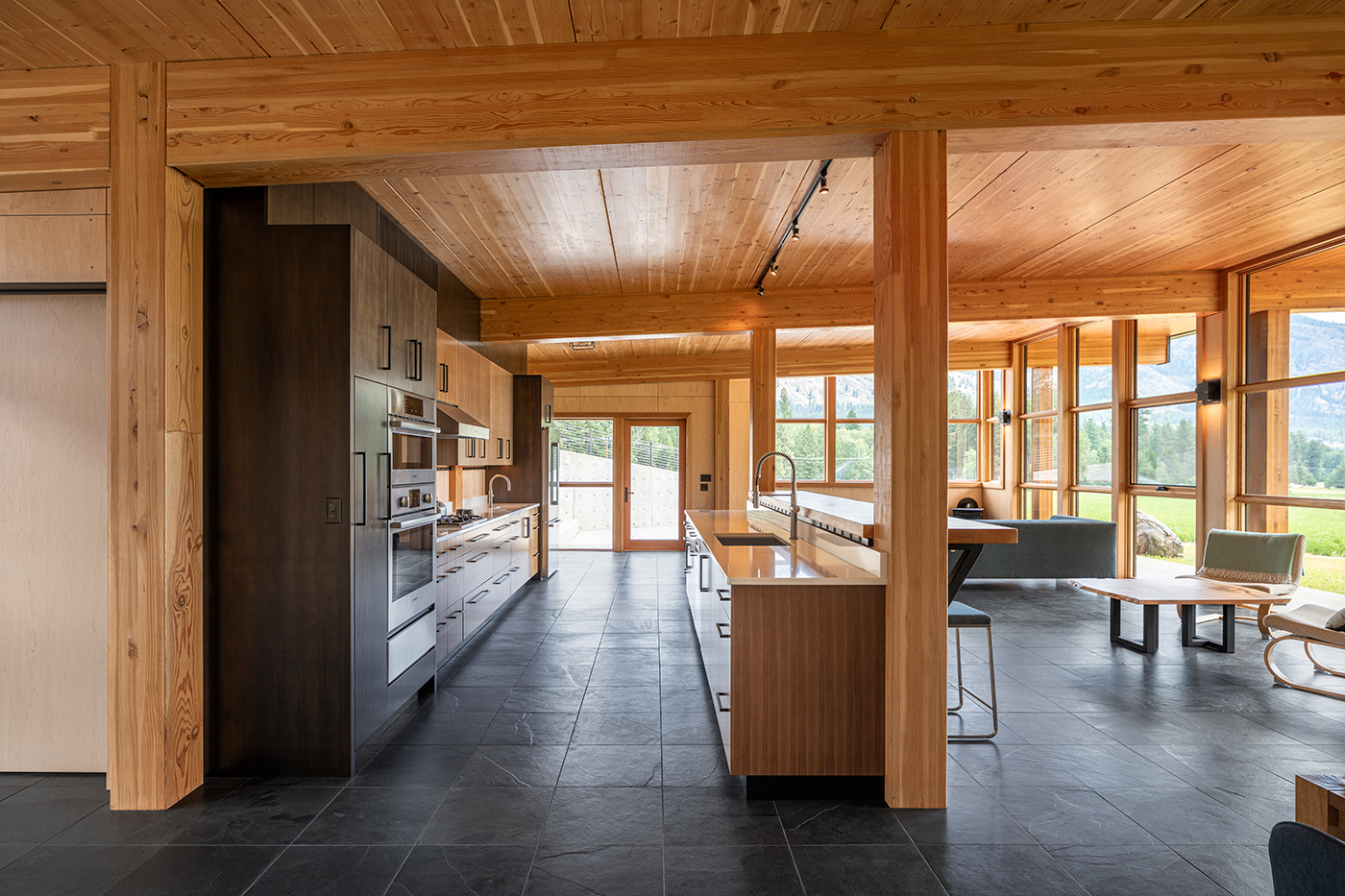
The south-facing side of the home is oriented to optimize passive heating and has a large overhang that protects the structure and its occupants from snowfall in the winter and intense sun in the summer. Moreover, CAST's design incorporates passive house principles including superinsulation and advanced air sealing. Thermal bridges are minimized by wrapping the house in continuous external insulation, including under the foundation, isolating the home from outdoor temperature swings. The bermed roof also has a green roof element that adds thermal mass and additional protection from extreme weather exposure. The shell of the home was completed by last winter and Hutchins said the team were really proud of how the house performed.
In addition to its energy saving efforts, the bermed roof creates a one-of-a-kind amphitheatre-type amenity for the community which, according to Whittaker, has already been a popular place for residents to lay out and commune in the warmer months. A patio area, adjacent to the home's second entry provides another outside gathering space.
The Berm House almost feels mysterious as it emerges from the earth,” Hutchins explained. “First you notice the berm and then the house quietly reveals itself,” he continued. “The experience is one of solidarity with the land.”
In the near future, Whittaker, a self-proclaimed history enthusiast, plans to place a repurposed historic schoolhouse, built in 1910, atop the bermed roof to be used as a ‘meditative' space for the community. “The McKinley Mountain School House was originally the center of a local community in the valley, and my vision is that it will become a new centerpiece for this community,” Whittaker reflected.
Inside, the Berm House has an open-plan layout that includes a large kitchen and dining/living area scaled for community events. There are also four-bedroom suites, each with its own bathroom, plus one additional bathroom located off from the main great room. A heated crawl space and climate conditioned storage area are located beneath the main level and passively heat the home.
“I am thrilled with how the Berm House has turned out and how the community have been using it so far,” Whittaker said.
“What Whittaker and the Methow Housing Trust have created is a real legacy project that has transformed a large section of the Methow Valley and we are really proud to be a part of that work,” Hutchins concluded.
Next to be developed at the McKinney Ridge site are 10 lots of land which Whittaker wants to sell to developers for market rate housing. He plans to start selling those lots early next year and estimates it will take five to 10 years to sell them all. The market rate homes would be for full-time homeowners.
The project team for Berm House also includes Methow Valley Builders, general contractor; JR's Five Star Concrete, concrete subcontractor; and GeoEngineers, geotechnical engineers.
Emma Hinchliffe can be
reached by email or by phone
at (206) 622-8272.