 |
Subscribe / Renew |
 |
Contact Us |
| ► Subscribe to our Free Weekly Newsletter | |

Construction Bids
| home | Welcome, sign in or click here to subscribe. | login |


 print print  email to a friend email to a friend  reprints add to mydjc reprints add to mydjc |  |
 |
August 29, 2024

DuHamel
|

Crawford
|
The first major new exhibit to be constructed at Seattle's Woodland Park Zoo in nearly a decade, Forest Trailhead establishes a new center of gravity at the zoo — one bringing conservation awareness to the forefront. As the final capital anchor of the zoo's Forests for All campaign, an ambitious seven-year, $110 million comprehensive fundraising effort to rally communities together to reimagine what a zoo can be and save the world's forests, Forest Trailhead brings the global movement to Seattle with immersive exhibits highlighting forest ecosystems and the animals and plants that call them home. With connection as its watchword, the new pavilion and 1-acre forested grounds signal the future of zoo experiences, where visitors are given agency to find their own paths, uncovering the inherent interconnectedness of the world's forests.
SHIFTING PERSPECTIVES
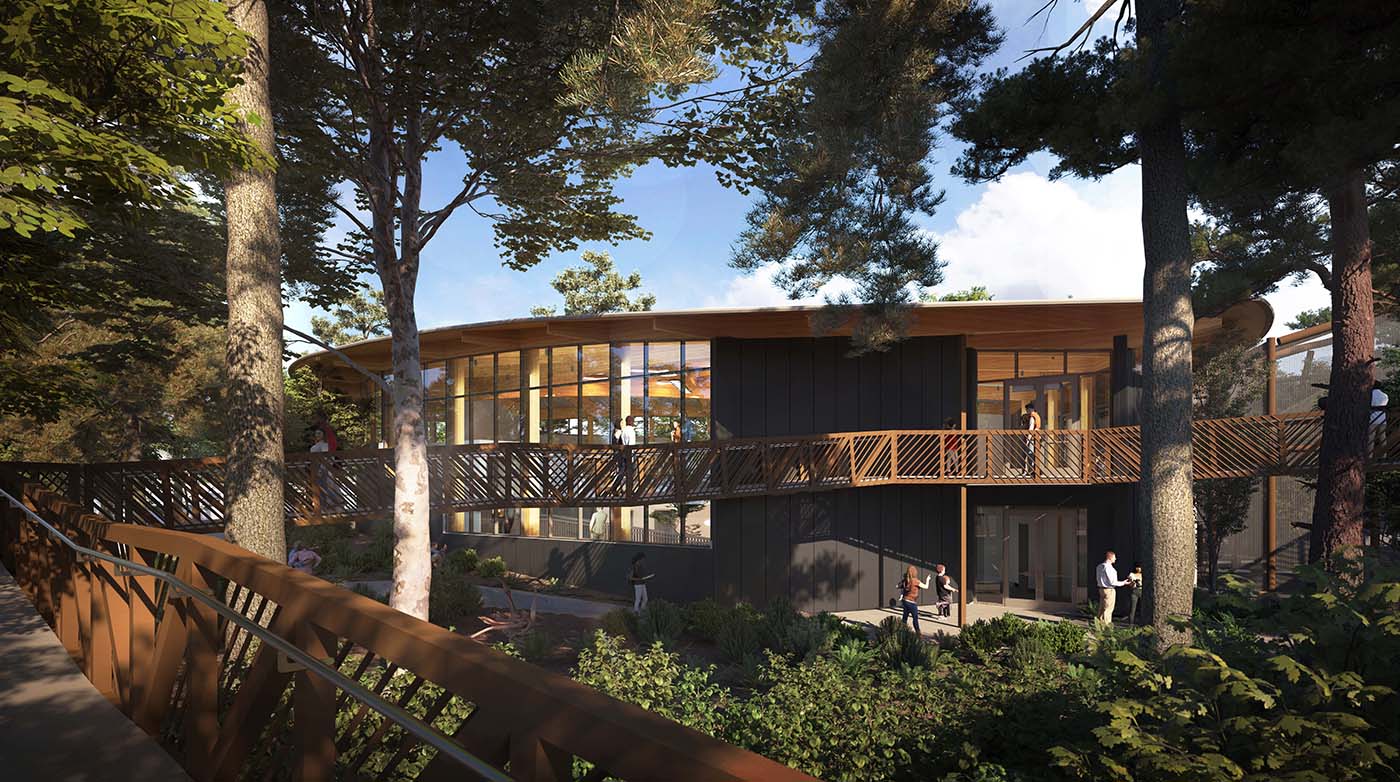
Situated adjacent to the zoo's main entrance at the West Plaza, Forest Trailhead is an immersive forest exhibit highlighting the wildlife of the world's forests alongside conservation efforts by the zoo and its partners to preserve those habitats. The exhibits are designed to present a hopeful perspective on the future of the world's forests by immersing visitors in the wildlife and plant habitats of these ecosystems, with interpretive exhibits spotlighting communities leading conservation efforts.
Global in its scope, the building's exhibits include habitats for tree kangaroos and red pandas—key animal populations for which the zoo supports conservation efforts, including a quarter century's investment in Papua New Guinea and emerging efforts in Nepal. With the success of this conservation work being its interconnected nature across scales, the design of Forest Trailhead sets up an experience where zoo visitors can see both the animals and their forested habitats from multiple shifting perspectives.
Beginning on an elevated Canopy Path winding through the trees, visitors experience the forest canopy from the perspective of the tree kangaroos and red pandas. Inside, the pavilion's upper level has additional viewing spaces for those animals, with a fully accessible path leading down to the mid-level housing another forest creature: kea parrots. The lower level includes tree-dwelling reptiles, colorful amphibians, fish, and invertebrates in mixed-species groups. Here, paths leading back out to the forest through the landscape highlight the critical role of the forest floor in the health of the ecosystem.
AN ACCESSIBLE PATH
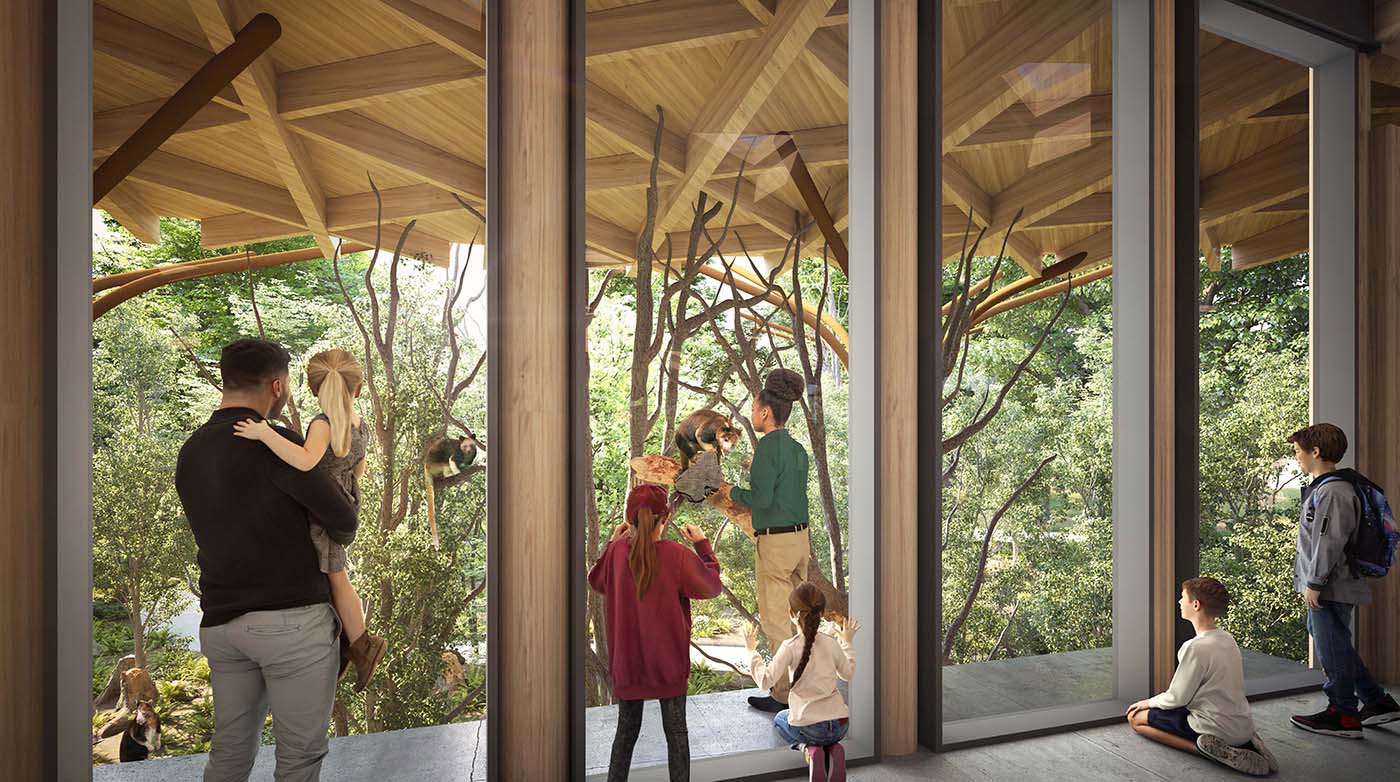
Just as the zoo's conservation mission functions globally across scales, Forest Trailhead was designed to encourage visitors to engage with the forest habitat on multiple levels. Unlike typical zoo exhibits, there is no single, linear pathway and instead, visitors are offered multiple access points to the building and the surrounding habitats. Weaving in and out of the pavilion, through the tree canopy and forest floor, visitors come to understand the interconnectedness of animals with their habitats, and humans with our environments. Similarly, instead of proposing one overarching biome narrative, the exhibits incorporate multiple points of view from different global perspectives.
In experiencing Forest Trailhead, visitors are invited to assemble their own story of the world's forests and find their personal place within it. This can be seen in its unique, fully accessible visitor path. Although the building has three levels inside with an upper Canopy Path and lower Forest Floor walkway outside, there are no elevators or stairs in the building. Instead, the accessible path unfolds inside via a series of gradually sloped walkways. Outside, the weathering steel of the Canopy Path will patina over time, blending into the trees. Much like the experience of arboreal animals that climb and fly through the forest, the building itself creates an experience of changing viewpoints.
A SUSTAINABLE BUILDING
Building on the zoo's conservation mission, the building is designed with environmental consciousness at the forefront. Inspired by organic shapes found in nature, the pavilion takes a fluid and dynamic form evoking naturally occurring fractal patterns. The pavilion's dark exterior cladding is made from Richlite, a sustainable material locally made from recycled FSC-certified (Forest Stewardship Council) paper composite, helping the building recede into the forested landscape. Circular skylights create dappled light over the interior plaza reminiscent of sunlight filtering through leaves.
The building is constructed from mass plywood, a veneer-based mass timber product supplied by local Oregon company Freres Wood. Made from trees sustainably sourced from regional forests, this innovative wood product generates minimal production waste. With the mass plywood structure visible inside, the building showcases the warmth and beauty of wood alongside sustainable forest management practices. Targeting LEED Gold, the building also includes a photovoltaic roof array and manages water via an onsite stormwater management system.
As Woodland Park Zoo marks its historic 125th anniversary in 2024, Forest Trailhead initiates the next chapter of the zoo's story with interactive and accessible experiences putting conservation awareness at the forefront. Ultimately, Forest Trailhead invites visitors to embark on a journey of discovery and stewardship in the world's forests, starting in their own Pacific Northwest backyard.
Scott Crawford is a partner at LMN Architects with a focus on computational design tools and a passion for civic projects. Jennifer DuHamel is a principal at LMN Architects with 16 years of experience across a range of project types.
Other Stories:


