 |
Subscribe / Renew |
 |
Contact Us |
| ► Subscribe to our Free Weekly Newsletter | |

Construction Bids
| home | Welcome, sign in or click here to subscribe. | login |


 print print  email to a friend email to a friend  reprints add to mydjc reprints add to mydjc |  |
September 30, 2024

Ground was broken Sept. 3 on the first phase of Switcher's Landing in Maple Valley.
The new mixed-use development is sited on 16.5 acres at 27264 Maple Valley Black Diamond Road S.E. That's across from state Route 169 and a Les Schwab Tires.
Switcher's Landing is being developed by landowner the Bitney and Bowden Family, which has owned the project site for over 60 years, in partnership with real estate developer Pallis Properties, which is based on Mercer Island. The city of Maple Valley is also a project partner.
Pallis Properties' website lists the project budget at $83 million.
At full build-out, the development will include multiple new retail buildings, including new locations for national retailers Chick-fil-A and 7-Eleven, and 216 apartment units, likewise split between multiple buildings. There will also be ample parking.
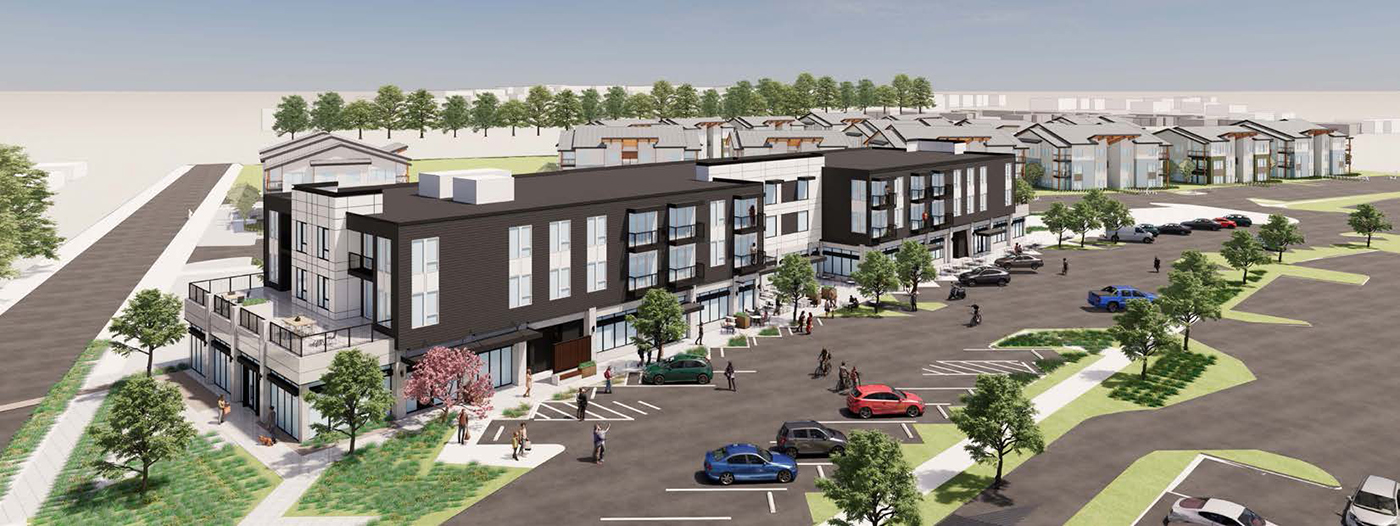
Most of the rental units will be in a series of three-story multifamily buildings comprising a garden-style community, but 36 will be in a new mixed-use building atop 13,000 square feet of ground-level retail space.
The unit mix at Switcher's Landing will stretch from one to three bedrooms. Most of those will be market rate. As per city of Maple Valley regulations, 21 units will be made affordable to families with incomes at or below 70% of the area's mean income.
Seattle architecture firm Studio Meng Strazzara designed Switcher's Landing.
The first phase of construction is focused on the development's retail elements and will include new buildings for Gravity Coffee, Chick-fil-A, 7-Eleven and Valvoline, as well as a new multi-tenant building with 6,500 square feet of commercial space. Space in the multi-tenant building will be leased to smaller community retailers.
Colvos Construction of Tacoma is the general contractor for phase one and will directly oversee the construction of all phase-one buildings as well as site development for the entire project. Colvos's phase one work scope also includes frontage improvements on SR-169 including a new two-lane roundabout for access to the development's commercial space, an additional northbound travel lane, bike lanes, and a planter strip and sidewalks to enhance the area's accessibility and traffic flow.
Construction of phase one is expected to be completed in nine to 12 months.
Phase two comprises the construction of the multi-building apartment complex in the back portion of the project site, as well as the new mixed-use retail/residential building. Colvos Construction and Sierra Construction will build phase two.
A timeline for that phase has not been publicly shared but in a press release celebrating the start of phase one, the city of Maple Valley said the estimated completion time for the entire project is 12-18 months.
The site is currently only partially developed with a single-family home that has long been vacant. The city and landowner say that dilapidated property has become a magnet for crime in recent years.
The development is called Switcher's Landing in honor of landowner Jo Bitney's father. He was a coal miner and was nicknamed “Switcher.” Jo Bitney and her sons, Randy and Kim Bowden, used to live on the property. Randy Bowden has developed and drawn a logo for Switcher's Landing, which will be displayed prominently throughout the development. It depicts a coal miner.
Devin Page, president of Colvos Construction, had the following to say about the project: “Partnerships have been critical in bringing this project to life. We've been fortunate to collaborate closely with the Bitney and Bowden families, who have long ties to this land, as well as our partners in design, engineering, and local government. Together, we are building a development that honors the past while looking ahead to the future of Maple Valley.”
The city says Switcher's Landing will bring much needed affordable housing units to Maple Valley.
The city passed a moratorium on new multifamily residential permits in 2017, which paused the vesting of all new mixed-used permits. After nearly five years of discussion at the Planning Commission and City Council level, the city adopted new zoning regulations for mixed-use properties in community business zones in 2021. The new regulations resulted in reduced residential densities, increased commercial requirements, reduced building heights, greater tree retention and replacement requirements, and greater perimeter buffers and screening. The most significant regulation change required new development to contain some housing that is affordable to low- and moderate-income families.
Emma Lapworth can be
reached by email or by phone
at (206) 622-8272.


