 |
Subscribe / Renew |
 |
Contact Us |
| ► Subscribe to our Free Weekly Newsletter | |

Construction Bids
| home | Welcome, sign in or click here to subscribe. | login |


 print print  email to a friend email to a friend  reprints add to mydjc reprints add to mydjc |  |
January 29, 2026
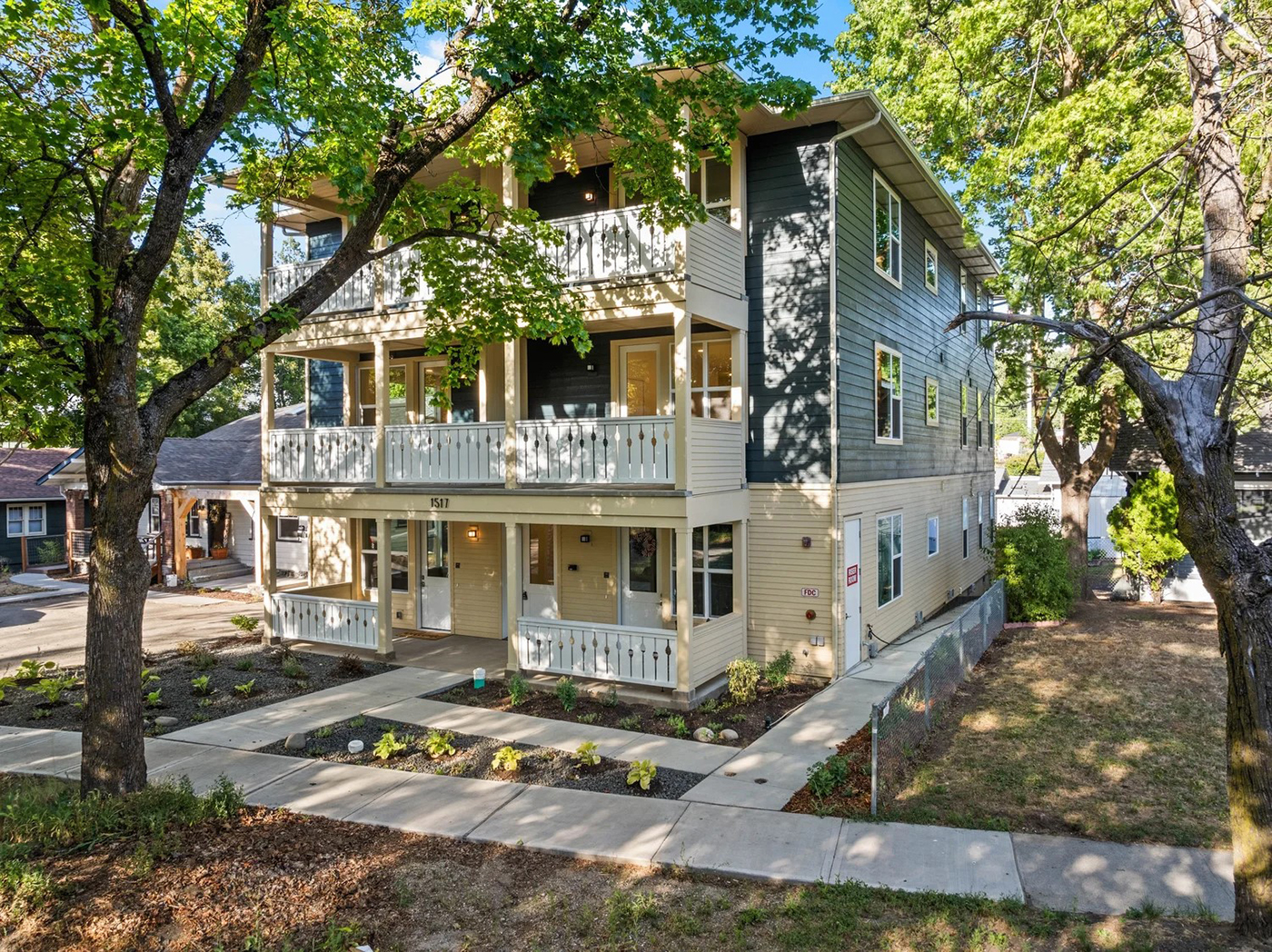
Spokane Six now sits on South Grand Boulevard, in Spokane's South Hill, providing a programmatic solution to new allowances for middle housing density.
It is sized to fit traditionally residential city lots, paving the way for this format of “middle housing” to proliferate around the city.
Matt Hutchins, principal at CAST architecture, explains the project's origins. “Our goal was to replace one old house with a higher-density project that felt neighborhood-friendly, was repeatable on any single-family lot, demonstrated the value of pragmatic simplicity with the building mass, and leveraged the sense of craft and detail from the historical tradition,” he said. “We wanted to show that if one can work once here, it can be deployed over and over to address the larger housing shortage Washington cities face.”
Spokane Six is a compact, conventionally framed structure, with a slab-on-grade foundation and trussed roof, features intended to lower per-square-foot construction costs. It has six same-sized, 1,000-square-foot two-bedroom, two-bath apartments and six onsite parking spaces with EV charging. Room-sized front porches line up geometrically along the street front, providing “eyes-on-the-street” and a traditional look that fits in with Spokane's historic neighborhoods. Two of the units are rent-restricted workforce housing.
Inspired by passive-house principles, Spokane Six was built to be certified Built Green 3-Star building, one of the first such developments in Eastern Washington. Extra attic insulation minimizes heat loss; ERVs enhance indoor air quality; windows on three sides provide daylighting and ventilation; and high-efficiency systems (including heat pump heating and cooling, and Energy Star appliances) all contribute to the certification.
The city of Spokane made denser housing permanently legal so that property owners could redevelop to six units, even on the smaller city lots. The new regulatory scheme went into effect in 2024 after a 16-month trial period. This brings Spokane beyond compliant with Washington state's House Bill 1110 (of 2023), which requires larger cities such as Spokane to allow up six units per lot in many residential areas. Spokane allows six units in all residential areas, except residential agriculture zones (RA).
Spokane's code definitions state middle housing is housing stacked or clustered in a way that is “compatible in scale, form, and characteristics with individual detached single-unit houses.” Middle housing developments by definition can have up to six units per structure.
“Often, the fear is that new density will be disruptive, but this stacked flat building feels familiar, as it borrows heavily from the tradition of single-parcel, small multiplexes (‘smallplexes') that had been the backbone of housing production before the car-centric detached single-family house became the paradigm,” explains Hutchins.
The project team includes: CAST architecture, architect; Hug Construction, general contractor; Facet, structural and civil engineer; Bolt & Key Electrical Engineering, electrical engineer; Kartchner Engineering, mechanical and plumbing engineer; SPVV Landscape Architects, landscape architect; ALLWEST, geotechnical engineer; Holt Surveying & Mapping, surveyor; and Heartland, development services.
Nina Milligan can be
reached by email or by phone
at (206) 219-6482.


