 |
Subscribe / Renew |
 |
Contact Us |
| ► Subscribe to our Free Weekly Newsletter | |

Construction Bids
| home | Welcome, sign in or click here to subscribe. | login |


 print print  email to a friend email to a friend  reprints add to mydjc reprints add to mydjc |  |

October 6, 2004

Joseph Greif
|
Firm: Joseph Greif Architects
Location: 921 N.E. Boat St.
Associates: Cynthia Nolting, Bragdon Shields
Years in business: 13
Q: Why are beach homes your favorite to design?
A: I like to design them as a gateway to a different emotional world, a restful weekend. When you go to the beach or an island, you're coming from the week environment to relax.
Everybody has a certain understanding of their emotions and what they want the beach house to be as a place of residence. Architecture has a direct effect on your nervous system and emotions. You can build a church, where you feel like kneeling down, even if you're not religious, and you can build a home where you can sit down and want to rest.
Q: Which non-residential design are you most proud of?
A: The Waldorf School renovation and addition. Everything inside and outside the classroom can be designed to teach lessons. We tried to capture the groundwater and bring it above-ground in a pond and creek that meanders through the site. They don't have clocks, so they're learning the whole aspect of cosmic timing.
|
Q: How did early experiences affect your design approach?
A: I graduated from University of Idaho and one person who frequently visited was Jim Turrell, the light artist. He really instilled a huge respect for light. The core of good architecture is the play of light and space, and how you manipulate that light adds to the quality of the space.
Q: How do you handle the need for artificial light?
A: We're now using a lot of low voltage lighting, which is very environmentally friendly. We don't light up spaces — we light objects or walls. We work with lighting consultants to fine tune that.
Q: Do you subscribe to any design style?
A: I see beauty in modern architecture and that's a guiding force, but if you look at my work I don't do a lot of modern. If it's a remodel, the home comes with a biography and I use that so there's a continuity there. Every owner, when they're building a home, comes with a certain wish list. I really search for that. An older client might feel comfortable in a traditional house, while a younger client is much more open to shapes they haven't seen.

Photo by Kate Baldwin
Joseph Greif’s house at Three Tree Point is a study of the play of modern curves against classical lines.
|
We have clients who bought a home from their parents on Queen Anne. Initially, what they showed me (for the remodel) was very traditional, but their space planning is somewhat modern. We developed a dialogue for a more flat roof or shed-roof home, because it is more practical. It makes more sense to have a relationship between the inside and the outside, versus a self-contained box of the craftsman style.
Q: How did you get into home design?
A: At Callison, I did a lot of residential work, along with custom commercial projects. Since Callison was the architect for the Nordstrom stores, we had the opportunity of some of the family members also looking to us to design their homes. I realize now that I was quite fortunate to get my start on residential design with the Nordstrom family.
Q: What's your favorite building in Seattle?
A: Stephen Holl's chapel. I like his use of light and texture and his intellectual dialogue. The idea of "thinking" architecture is very appealing.
Q: Do you like his Bellevue Art Museum?
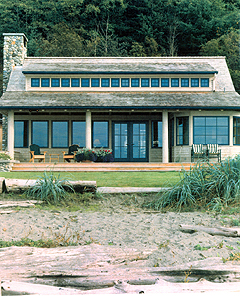
Photo by Michael Shopen
This Whidbey Island beach house uses clerestory windows to flood living spaces with light.
|
A: As a piece of art it's very interesting. I loved the old (Bellevue) Art Museum. It was an imaginative opportunity to create an environment that, literally, transcended the blatant commercialism it was built above.
Q: Who was an early influence on you?
A: Bill Bowler, a professor and artist. I consider him the whole reason I stayed in architecture. The first thing he told us was, "I'm not going to tell you how to do architecture. I'm not going to do your thinking for you."
Q: What excites you about going to work?
A: I have found my niche and now I'm kind of embellishing on it. Every client is a new opportunity. Every project is a study in art.
Previous columns:


