 |
Subscribe / Renew |
 |
Contact Us |
| ► Subscribe to our Free Weekly Newsletter | |

Construction Bids
| home | Welcome, sign in or click here to subscribe. | login |


 print print  email to a friend email to a friend  reprints add to mydjc reprints add to mydjc |  |
March 17, 2021
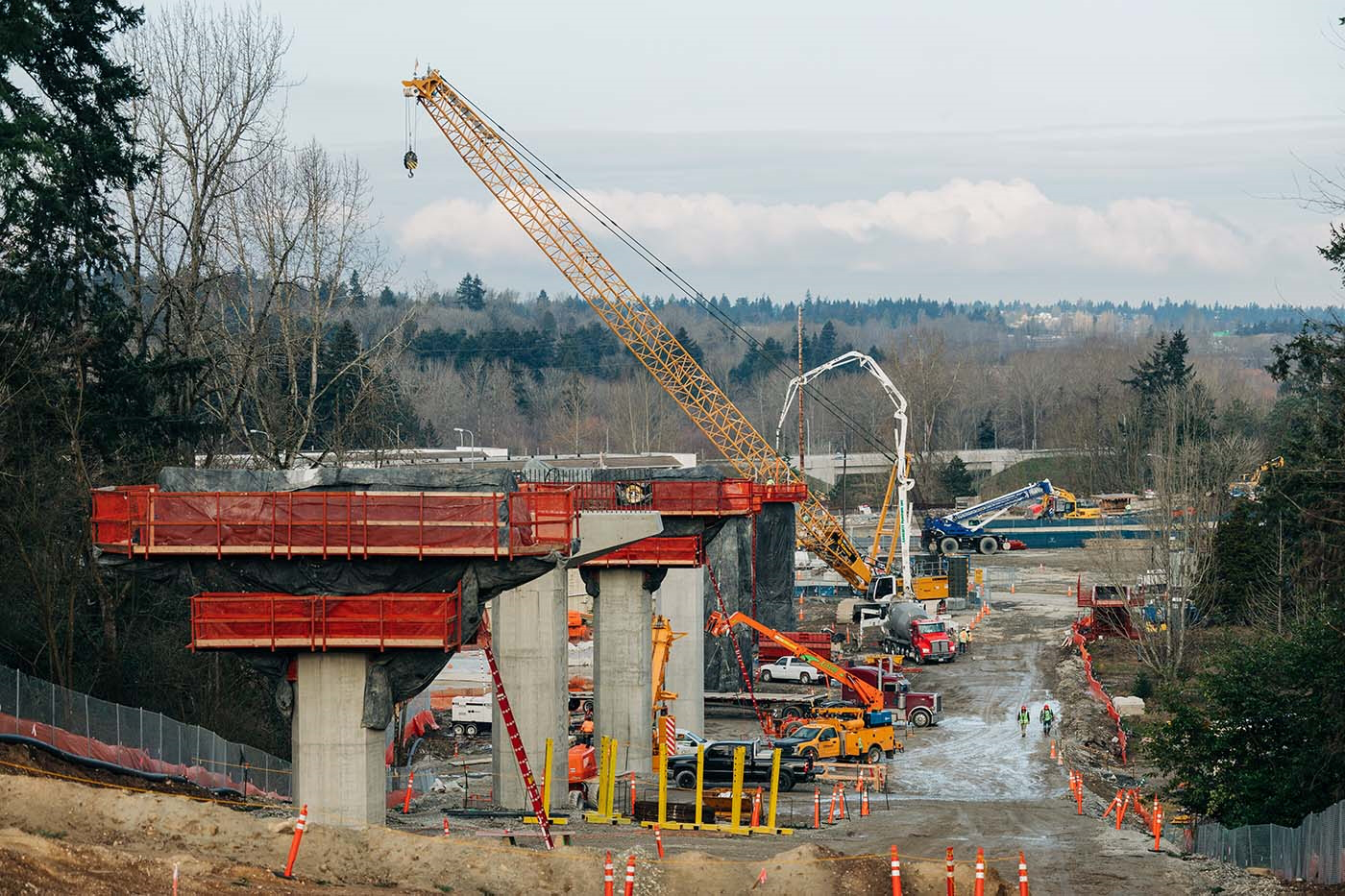
Sound Transit has released the draft environmental impact statement for its south end operations and maintenance facility (OMF) and the price could top $2.8 billion, depending on which of three alternatives are picked. The document also details how each alternative would be built.
The OMF is where light rail trains go for cleaning, storage and maintenance. Sound Transit operates one in the Sodo area of Seattle, is building a second OMF in Bellevue, and has plans for one north of Seattle in addition to this one in the south end. All four OMFs would operate around the clock. OMF South would service about 144 light rail vehicles.
Three locations have been narrowed where OMF South could be built: the Midway Landfill in Kent, and South 336th Street and South 344th Street in Federal Way. Each would support a two-story OMF building, a single-story maintenance-of-way building, a single-story Link system-wide storage building, storage tracks, parking and yard areas.
The most expensive alternative is the Midway Landfill site, which lies on 68 acres between South 246th and 252nd streets, and between Interstate 5 and state Route 99. This site is adjacent to where the Federal Way Link Extension will run starting in 2024, so it wouldn't require additional mainline track to connect to the system like the other two alternatives.
Cost estimates for Midway vary greatly and are dependent upon what type of construction is used. Sound Transit is looking at three ways to build on the former landfill: platform, hybrid and full excavation.
Under the platform option, the OMF would be built atop a 3.5-foot-thick concrete slab platform supported by 700 concrete-filled drilled shafts. The shafts would be 10 feet in diameter and placed 120 to 180 feet below grade. The landfill's soil and geomembrane cap system would be removed and then replaced after shaft installation. The platform would then be built on top of the new cap. Cost: $2.2 billion-$2.8 billion.
The hybrid option would also replace the entire landfill cap system. After the old cap is removed, about 4.3 million cubic yards of landfill material would be excavated and the remaining fill would get deep dynamic compaction to prepare the site for construction. Some excavated material could be reused and 1.2 million cubic yards of loose material would be imported to the site. OMF facilities sensitive to settlement, such as tracks and roads, would be supported by a 1-foot-thick concrete slab over a 3-foot-thick beam system. About 110 concrete-filled drilled shafts would be installed for support under buildings. Cost: $1.8 billion-$2.3 billion.
The full excavation option would dig out the landfill, screen removed material for reuse, and then backfill it with soil that the OMF would be built on. About 4.9 million cubic yards of solid waste and loose soil would be excavated, with about 3 million cubic yards of that sent off site and 1.6 million cubic yards of new soil imported. Sound Transit says the material that would be hauled off would take up to 554 daily dump truck loads (similar to the hybrid option) and could fill 920 Olympic-sized swimming pools. Cost: $1.7 billion-$2.1 billion.
Building the OMF at South 336th Street would require 1.4 miles of connecting track from the future Federal Way Transit Center. This site is about 59 acres between 336th and South 341st Place, and between I-5 and SR 99. It would displace the massive 200,000-square-foot Christian Faith Center church and its school and daycare.
The South 344th Street site would require about 1.8 miles of connecting track to the future transit center. This site is about 65 acres between South 336th and 344th streets, between I-5 and 18th Place South. It is south and east of Christian Faith Center, but would displace three smaller churches and more businesses, including the Ellenos Yogurt plant and GarageTown.
Both the 336th Street and 344th Street alternatives are estimated at $1.1 billion-$1.4 billion.
Cost estimates at this stage are conceptual because engineering designs are at the 10% level. They include construction and demolition; property acquisition and relocation assistance; design, permitting, and program management; and construction contingency allowances.
Another factor weighing on this project is it's part of the Sound Transit 3 ballot measure, which is facing an $11.5 billion “affordability gap” due to reduced revenues associated with the pandemic, as well as increased real estate and construction cost estimates.
A Sound Transit spokesman said cost estimates for the Midway Landfill alternative are 35%-77% higher, based on the option picked. Costs have also jumped for the other two alternatives, with South 336th up 56% and South 344th up 46%.
The DJC reported last month that Sound Transit's board is addressing the budget shortfall and trying to keep ST3 projects on schedule through a realignment process with a “two-pronged approach.” The first prong seeks new federal and state funding, while the second could include delaying projects, delivering projects in phases, reducing project scopes, and suspending or dropping projects altogether.
Sound Transit plans to publish the final EIS for OMF South in mid-2022, after which its board will pick a location. The current schedule calls for construction to start by 2024. Building the platform option at the landfill is expected to take just over six years, while the hybrid option would take over eight and half years and the full excavation option would take just over seven years. Building on the other two sites would take about three and a half years.
The OMF could open between 2029 and 2034, depending on which alternative is picked, but the ST3 realignment could delay the opening or cause the project to be built in phases. When it does open, the OMF is expected to create 470 living-wage jobs.
Comments on the draft EIS can be submitted until April 19 to OMFSouthDEIS@soundtransit.org, or (206)257-2135, or in writing to: Sound Transit, c/o Hussein Rehmat, 401 S. Jackson St., Seattle, WA 98104-2826. Sound Transit is also holding two online public meetings: 5:30–7:30 p.m. on March 24 and 11 a.m.-1 p.m. on March 30. An online open house is available until April 19 at https://omfsouth.participate.online.
Sound Transit prepared the draft EIS with the help pf HDR, Parametrix, Aqua Terra Cultural Resource Consultants, Historical Research Associates, Cross-Spectrum Acoustics, ECONorthwest, EnviroIssues and Two Hundred.
Benjamin Minnick can be
reached by email or by phone
at (206) 622-8272.


