 |
Subscribe / Renew |
 |
Contact Us |
| ► Subscribe to our Free Weekly Newsletter | |

Construction Bids
| home | Welcome, sign in or click here to subscribe. | login |


 print print  email to a friend email to a friend  reprints add to mydjc reprints add to mydjc |  |
February 22, 2022
It's been a month since the two sides in the concrete strike last met and the fray is taking an increasing toll on Local 174 members, as well as multitudes of construction projects around King County.
Over 300 sand and gravel workers with Local 174 went on strike Dec. 3 over wages and benefits. They are striking against Gary Merlino Construction Co. and five concrete suppliers: Glacier Northwest/CalPortland, Stoneway Concrete, Salmon Bay Sand & Gravel Co., Cadman and Lehigh Cement. And earlier this month, another 37 drivers with Teamsters Local 38 in Snohomish County began picketing Cadman plants in Woodinville and Everett. Their contract, just with Cadman, expired on Dec. 1.
“There are people that have gone into hardships because of this,” said Local 174 member Todd Parker, who has driven ready-mix trucks for Cadman for 25 years and is a member of the union's bargaining committee. “The companies don't seem to care. We don't understand.”
Two members of Local 174 have lost their lives during the strike. One worker at Salmon Bay took his own life after dealing with the strike and a divorce, according to Parker. The other worker, at Cadman, died on the same day in January that the last mediation meeting was held. This worker had substance abuse issues that were cleaned up but “all that time off led him back to that path,” Parker said.
Parker said some workers are struggling to pay bills and make their mortgages, but didn't know of any that have lost their housing. Striking workers get about half a standard week's pay and on Feb. 1 lost their health insurance.
Health insurance is a big deal for 50-year-old Parker, who said he's nervous about losing coverage for the first time in his life. He said some members were able to get on their spouse's insurance, others chose to get COBRA and some went without. Parker said COBRA is about $1,300 a month but he thought it could be backdated due to the pandemic and went without for that reason.
Parker said the companies have recently avoided negotiations in order to let the health insurance expire.
“The companies are doing this intentionally to put people into a hardship to take a bad deal,” he said.
THE BOTTOM LINE
Four of the companies — Glacier, Stoneway, Salmon Bay and Cadman — have been posting strike updates on the Associated General Contractors of Washington's website. The AGC is not negotiating this contract but most of its members are affected by the concrete strike.
In a Feb. 15 post, the companies said negotiations started on July 20 and included over 16 meetings, with the union rejecting “significant” offers.
The companies say they are offering a 17.6% raise over three years that equates to $6.65 an hour after three years, in increments of $2.25 for the first year and $2.20 for each of the remaining years. Calculating from those numbers gives a current hourly wage of $37.78.
The companies say their current offer is a higher increase than what other construction trades negotiated last summer with the AGC. Those contracts were negotiated before the federal government reported the consumer inflation rate at 7.5%, the highest in 40 years.
The current offer includes pay premiums for work that starts in off-hours, guaranteed eight-hour pay, up to four weeks of paid vacation, seven paid holidays and paid jury duty.
Last month, the companies posted a graphic showing yearly compensation (combined working and non-working hours) going from about $95,000 in 2020 to about $110,000 in 2023. Another graphic showed the annual total wage and fringe package going from about $136,000 in 2020 to about $156,000 in 2023.
Jamie Fleming, director of communications and research at Local 174, said drivers would “laugh” at the notion of them making $100,000 or more a year.
But those drivers often put in a lot of overtime, which can bump their pay up considerably. Parker said he worked a whopping 2,900 total hours in 2020. Using the $37.78 an hour number and time-and-a-half for overtime, a good guess of Parker's pay for 2020 would be about $78,000 for regular time and another $45,000-$50,000 in overtime. (Working all of that overtime likely put him into shift pay premiums, and at the same time, the base hourly pay rate would likely have been slightly less in 2020.)
Fleming said the two sides aren't that far apart on their proposals, but the real cost has been the economic impact from the strike.
Versatile Drilling Contractors of Seattle has felt that impact, laying off 10 of its 17 employees.
“We are totally shut down in King County,” wrote John Marth of Versatile in an email. “(We) can't drill holes if we can't fill them with concrete.”
For now, Versatile finished a job earlier this month in Skagit County and has one crew working in Snohomish.
“We are a union contractor,” Marth wrote. “Our equipment operators, laborers and carpenters signed the AGC contract last year for just over 14% increase for three years.”
Both Sound Transit and the Washington State Department of Transportation have been posting regular updates on how their projects have been affected by the strike.
A Feb. 17 update by Sound Transit shows there have been 2,855 missed deliveries of concrete since Dec. 3 on its four Link light rail extension projects. That equates to about 28,553 cubic yards of concrete. The report says another 7,923 cubic yards are scheduled for the next two weeks. It also says 266 workers have been laid off, with another 142 projected to be laid off.
WSDOT's latest update, on Feb. 11, shows there have been 800 missed truckloads of concrete, equating to 8,000 cubic yards of concrete, since Dec. 3. In the next two weeks, about 1,200-1,500 cubic yards of concrete are planned that could be canceled. WSDOT estimates over 150 workers have been laid off and 45 hires have been delayed.
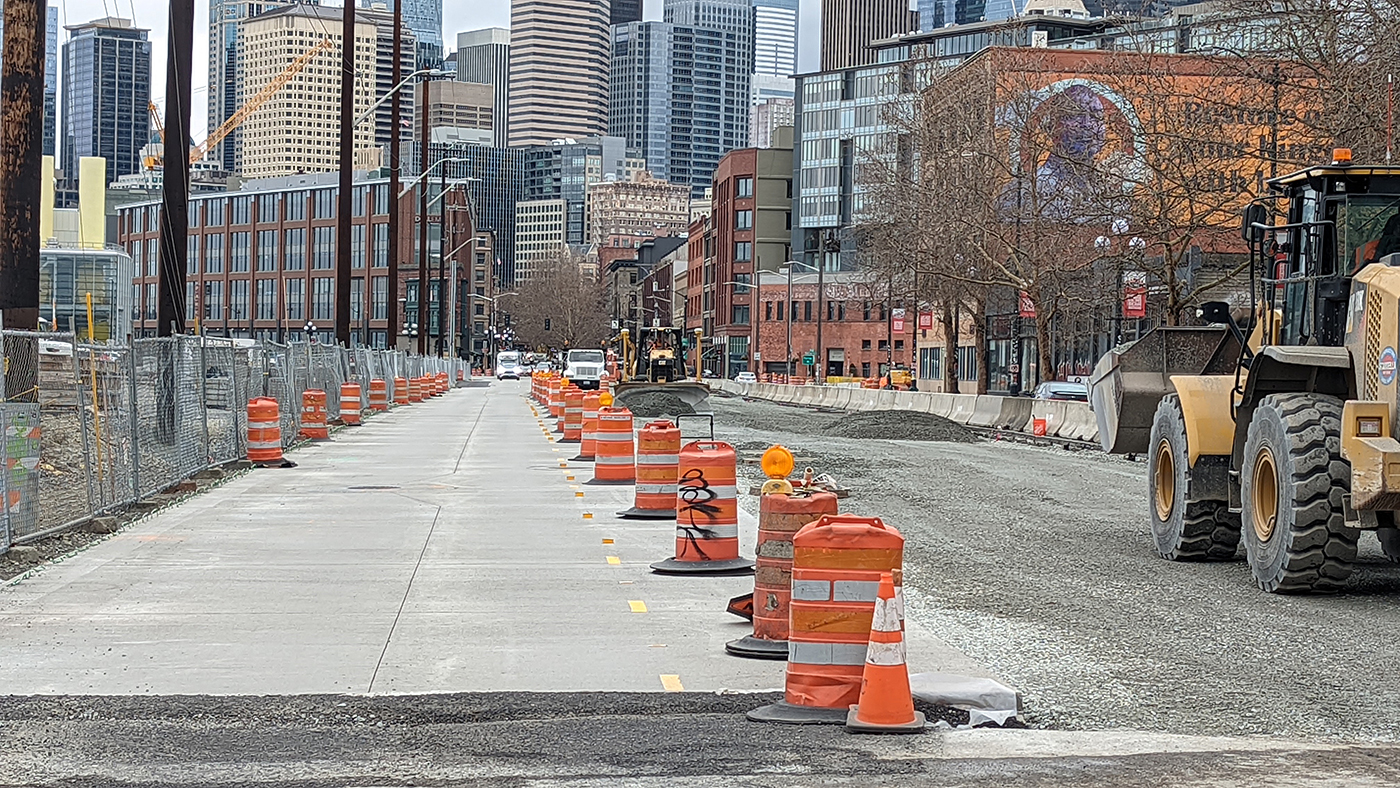
On one WSDOT project, Scarsella Brothers ran out of concrete in the middle of paving new lanes for First Avenue South near the stadiums in Seattle. After sitting for weeks, Scarsella has resequenced the work, opting to lay down temporary asphalt where concrete was planned. This will help keep the project on schedule, open a closed lane to traffic and keep workers busy while waiting for concrete to return. The project is part of the final roadway work around the south portal of the new state Route 99 tunnel.
A WSDOT spokesman said crews will later dig up the asphalt and reuse the gravel on other parts of the project. He said the cost of the asphalt versus extending the project's schedule saves money.
WORKER SHORTAGE
Like the rest of the construction industry, finding qualified workers to drive concrete trucks is difficult.
“We don't just get into a truck and drive it,” Parker said. Drivers have to know how to run the truck, as well as the characteristics of the concrete in the mixer and how to place it. Parker said this can differ at every jobsite.
Parker added that drivers don't know what time they start and when they get off, and they have to call in for work every day. “Essentially every night you're laid off,” he said.
Parker said he has been involved in a few strikes in the past, but none like this one. He was part of two strikes about a dozen years ago against Cadman, each lasting less than a day.
The current strike started in November with 34 union dump truck drivers walking off the job against Gary Merlino Construction over wages and retirement benefits. Then, on Dec. 3, about 300 other Local 174 members joined to picket the five additional concrete companies.
Parker said the two sides started talks two weeks prior to expiration of the contract, but couldn't agree to terms. He said they met sporadically a few times after that, with little to no movement at all. Fleming said the companies didn't bring a proposal to the last mediation meeting, on Jan. 20.
Parker said the companies didn't even speak to union representatives at that meeting. “We can't bargain by ourselves,” he said. “We want to deal; we need the companies to come to the table.”
In the most recent post on the AGC website, Feb. 15, the companies say they have been falsely accused of refusing to bargain, and want to settle the strike through mediation.
AGC Executive Director David D'Hondt last month wrote in a letter to Rick Hicks, the union's secretary-treasurer, that the Teamsters have “repeatedly refused mediation.”
The Teamsters say they are ready to meet at a moment's notice. “The current situation is untenable, they have to talk to us,” Fleming said.
No meetings had been scheduled as of last Friday.
Benjamin Minnick can be
reached by email or by phone
at (206) 622-8272.


