 |
Subscribe / Renew |
 |
Contact Us |
| ► Subscribe to our Free Weekly Newsletter | |

Construction Bids
| home | Welcome, sign in or click here to subscribe. | login |


 print print  email to a friend email to a friend  reprints add to mydjc reprints add to mydjc |  |
October 8, 2024

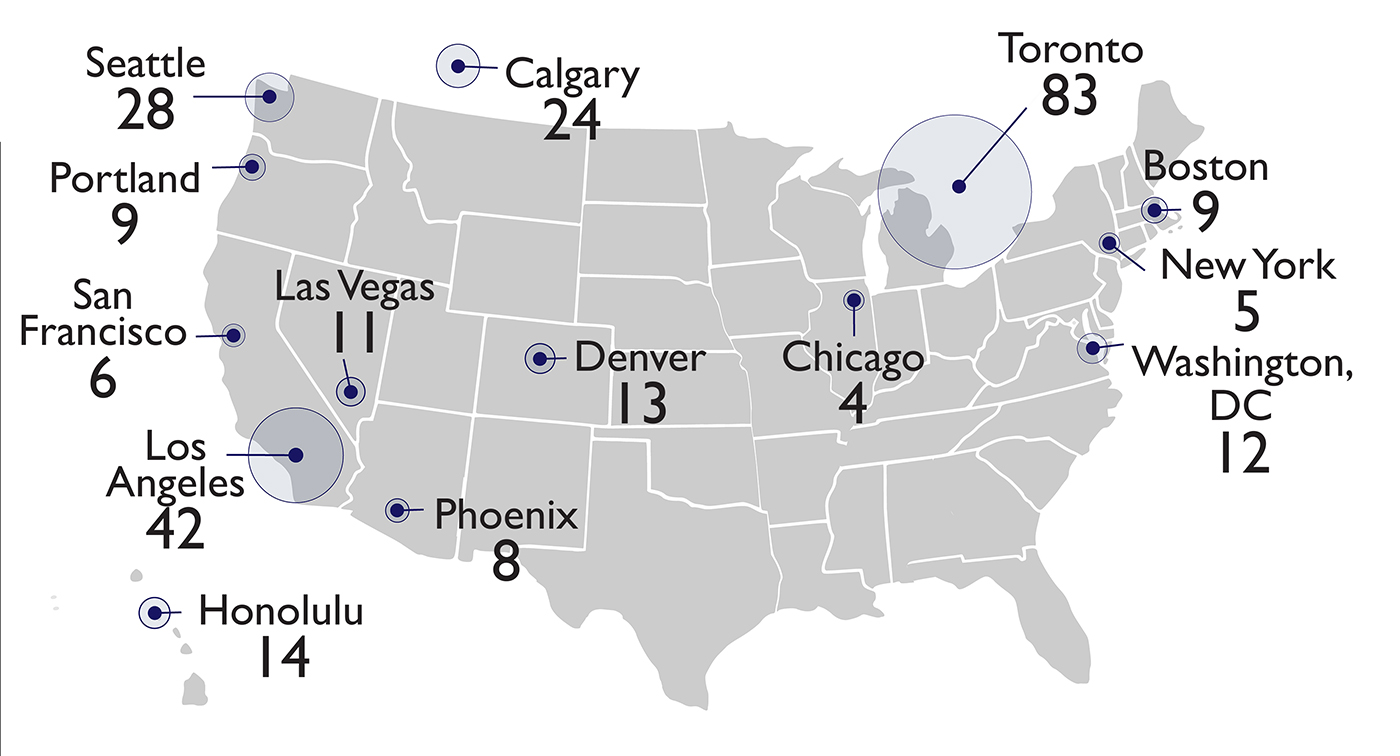
Seattle shed 10 cranes from the second quarter to the third quarter of 2024, according to construction consultant Rider Levett Bucknall.
RLB released its latest Crane Index and Quarterly Cost Report this week, offering a perspective on the North American construction industry in 14 major cities across the U.S. and Canada.
The report shows that Seattle went from 38 to 28 cranes last quarter. At this time last year, the crane count was 45.
The area still has the second highest crane count in the nation, with the Los Angeles area coming in on top at 42. Los Angeles shed eight cranes from the last count. Toronto, Canada, lost the most cranes — 221 to 83 — but still came in with the most cranes in the North American count.
Overall, seven areas have seen an increase in crane counts, four saw a drop, and three areas held steady.
It its quarterly cost report, RLB found the national average increase in construction costs was 1.07% — the lowest increase in the last three years. It found that Seattle, Boston, Denver, Honolulu, New York and Washington, D.C., all experienced increases over the national average this quarter. Seattle construction costs were up 4.91%.
Chicago, Las Vegas, Los Angeles, Phoenix, Portland and San Francisco experienced gains that were below the national average.
“Our research shows that the trend of construction cost inflation continues declining and is the lowest it's been in three years,” says Paul Brussow, president of RLB North America, in the report. “The recent interest rate cut is good news for the construction industry, particularly the private sector. While we won't see an immediate impact, this move is likely to encourage investment in new projects as we head into 2025.”
The construction unemployment rate is 3.2%, which is down 0.7% from this time last year. And the Architectural Billings Index was 45.7 in August, a decrease from 48.2 in July.
Brussow said in the report that the Federal Reserve's move to cut interest rates by .5% last month “signals the start of broader economic easing that will likely stimulate new construction projects, especially in the private sector.”
He called the Fed's interest rate cut “essential” to the industry. “It signals an effort to avert further cooling of the labor market, and new construction will be in demand. As a result, the current soft readings for construction labor will likely reverse in the upcoming quarters, indicating that the underlying lack of skilled labor will probably continue.”
Brussow noted several signs of an economic slowdown this year, such as a continuing softness in architectural billings, a difficult lending environment for construction projects, and persistent weakness in commercial property values. On a positive note, he said that manufacturing-related construction continues to be an exception, with massive investments in chip manufacturing facilities and other industrial projects.
Lisa Lannigan can be
reached by email or by phone
at (206) 622-8272.


