 |
Subscribe / Renew |
 |
Contact Us |
| ► Subscribe to our Free Weekly Newsletter | |

Construction Bids
| home | Welcome, sign in or click here to subscribe. | login |


 print print  email to a friend email to a friend  reprints add to mydjc reprints add to mydjc |  |
January 20, 2026

Washington's historic December flooding also brought a rush of emergency work to area contractors, including more jobs requiring crews to work 24 hours a day, seven days a week.
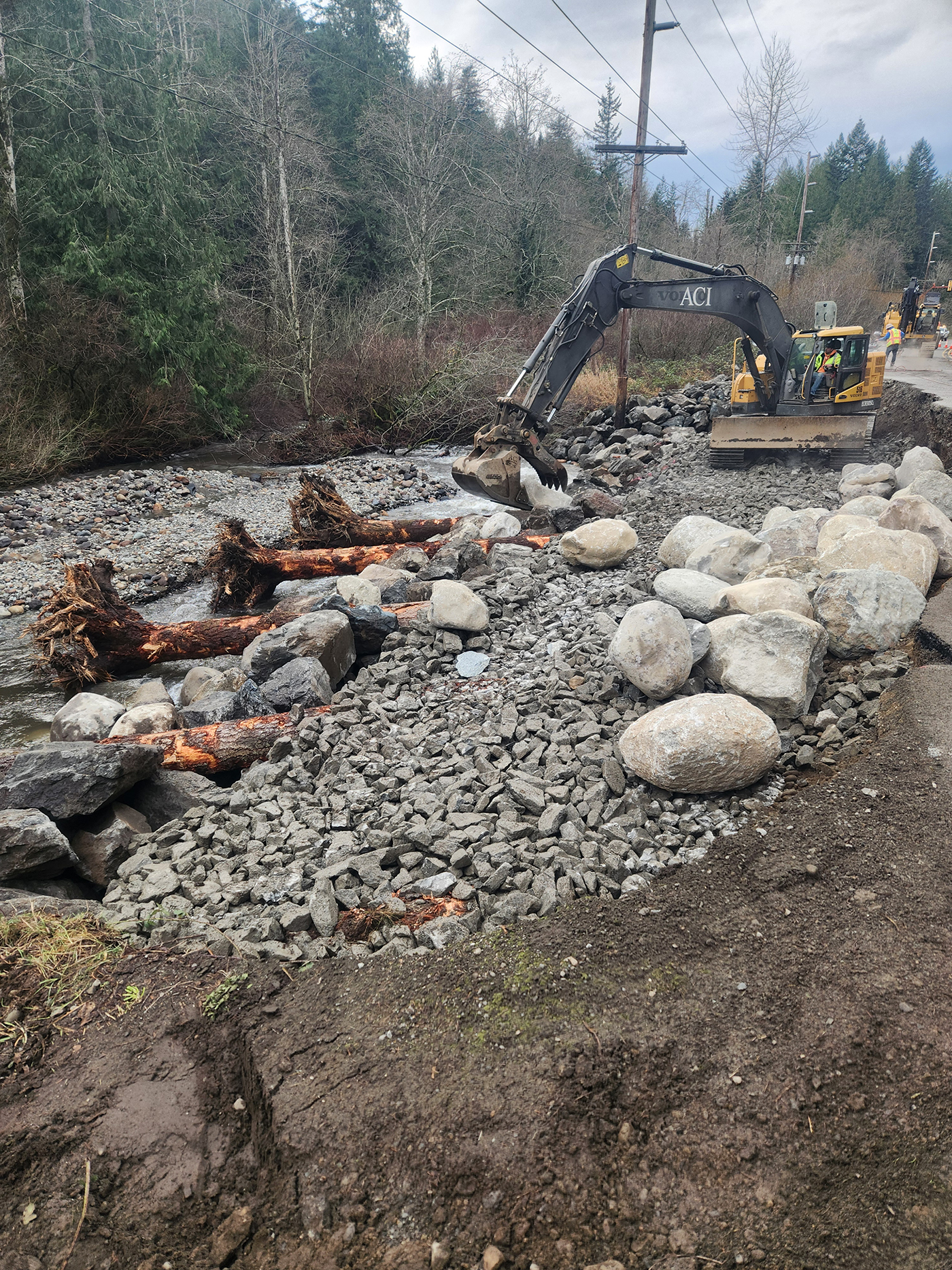
One of those projects involved repairing a section of state Route 410 closed Dec. 10, between Enumclaw and Greenwater, when floodwaters along Boise Creek washed out the eastbound lane of the essential route to Crystal Mountain near milepost 26.6.
WSDOT crews constructed a single-lane, temporary gravel bypass on the westbound shoulder, allowing the road to partially reopen on Dec. 16. But they needed an emergency contractor to make quick work of stream mitigation, and rebuilding the roadway foundation and repaving.
That work started Dec. 22 and ended before Dec. 23 was through, completed over 37 hours straight by Puyallup's Active Construction Inc., allowing the highway and full access to Crystal Mountain to reopen days ahead of schedule.
“Good weather, strong coordination between WSDOT groups and a dedicated contractor allowed us to reopen SR-410 sooner than expected,” Steve Strand, WSDOT engineering manager for Snohomish and King counties, said in a press release announcing the early road reopening.
COORDINATION, PLANNING AND STRONG SUBS
Ryan Heathers, ACI vice president and estimator, said such emergency contracts requiring crews to work continuously mean more advance planning, staffing and coordination with agencies and subcontractors. He said in preparing for jobs like these, the company draws from similar experience working on fish passages within a limited timeframe.
“Every hour of the work has to be well-planned and executed, so you hit those windows and finish in the least amount of time, and traffic is impacted the least amount possible,” Heathers said. “This was one WSDOT pushed hard on to get the highway open as quickly as possible, and they were great in working with us.”
Stream mitigation work included bringing in nine rootwad logs for fish habitat. Crews built the embankment back up using the more fish-friendly round boulders and thousands of tons of fractured rock rip rap. The work slowed water flows and pushed the creek back to its original channel. Then they repaved, added the guardrail, and striped the road.
Completing all of that in less than two days was already a challenge, but ACI was also simultaneously working another 24/7 emergency contract for WSDOT on state Route 162, stabilizing a washed-out embankment between Orting and South Prairie. That work also wrapped on Dec. 23.
Additionally, the company that averaged about 250 to 300 employees in 2025 was working on multiple other smaller flood-related quick-response emergency projects that required crews to work seven days a week, though not 24 hours a day. Heathers said those additional emergency projects were using up a combined roughly six crews at any given time over those three weeks.
Because of its 24/7 work requirement, Heathers said the SR-410 job required three crews plus traffic control, taken from the company's 33 total crews.
“To pull three crews from everything else is a lot to facilitate,” Heathers said. “Our subcontractors and vendors play a huge part in making these jobs successful.”
ACI's SR-410 project team and suppliers and subs included Silverstreak Trucking; HCPA Construction, trucking; JJH, trucking and rootwad log supply; Silers Sawcutting; Lakeside Industries, paving; NW Traffic, striping; Peterson, guardrail; Washington Rock Quarries, aggregate supply; CalPortland, aggregate supply.
While Heathers wasn't the PM on the SR-410 job (that was Tyler Ceccanti), he spent a lot of time on site, and he noticed something crews don't usually see working on highway jobs. Usually, the traveling public is not happy about being held up due to roadwork, and they sometimes let that be known in rude and dangerous ways. This job was different.
“In this case, almost everyone that went by had their windows down, taking pictures, cheering, thanking us,” he said. “People are happy at getting their highway open and at just being at Crystal Mountain.”
MORE EMERGENCY CONTRACTS IN 2026?
Multiple WSDOT representatives said at the AGC-WSDOT Annual Meeting last week in Tukwila that they'd dealt with more emergency contracts in 2025 than before.
In addition to the rush of work stemming from the December floods, last year's deluge of emergency repairs also sprung from deferred maintenance and bridge strike damage. Increasingly, emergency contracts require 24/7 work schedules, representatives said, meaning contractors must be ready with additional crews and planning.
And with more extreme weather events, a growing backlog of deferred preservation (even with Gov. Bob Ferguson's big bridge and roadway ask to address some of that), the AEC community can expect more of these contracts in 2026.
Heathers with ACI agreed.
“We are seeing more emergency work, and expect to see more emergency work,” he said.
Shawna Gamache can be
reached by email or by phone
at (206) 219-6518.


