 |
Subscribe / Renew |
 |
Contact Us |
| ► Subscribe to our Free Weekly Newsletter | |

Construction Bids
| home | Welcome, sign in or click here to subscribe. | login |


 print print  email to a friend email to a friend  reprints add to mydjc reprints add to mydjc |  |
February 5, 2026
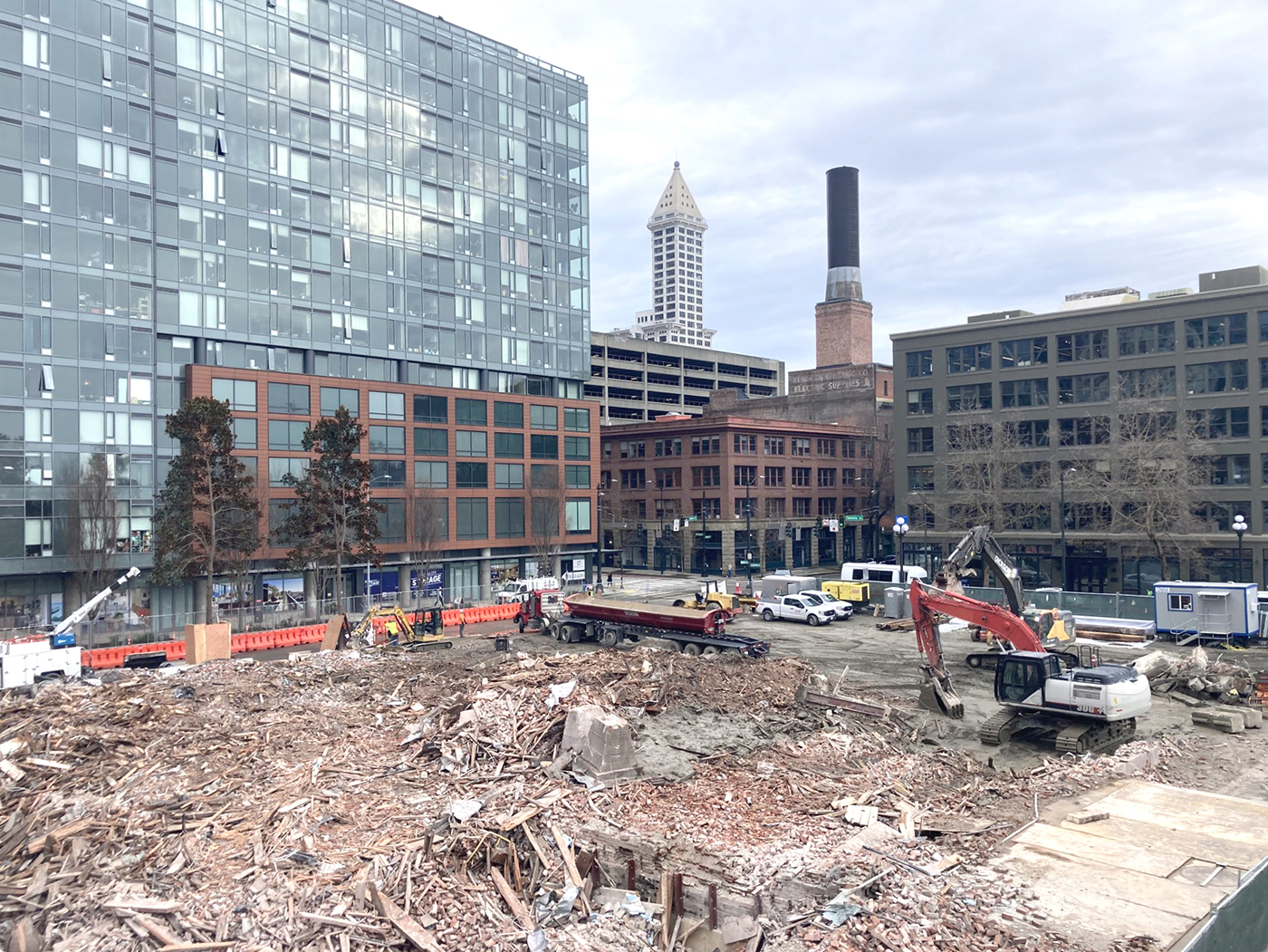
The Commuter Building complex's teardown is complete, leaving a square-block gap in the waterfront where there hasn't been one for 120 years.
What's more, the many new sightlines the demo opened up between Alaskan Way and Pioneer Square and downtown won't be closing anytime soon.
With the complex spanning Columbia to Marion streets reduced to rubble earlier this week, the site is well on its way toward owner (and former Martin Selig Real Estate lender) Acore Capitol's immediate plans for a 102-stall surface parking lot there.
Urban Renaissance Group is in charge of the demolition, working with BNBuilders; architect Perkins&Will; Dickson Demolition and Abatement of Tacoma; and Coughlin Porter Lundeen, the civil engineer.
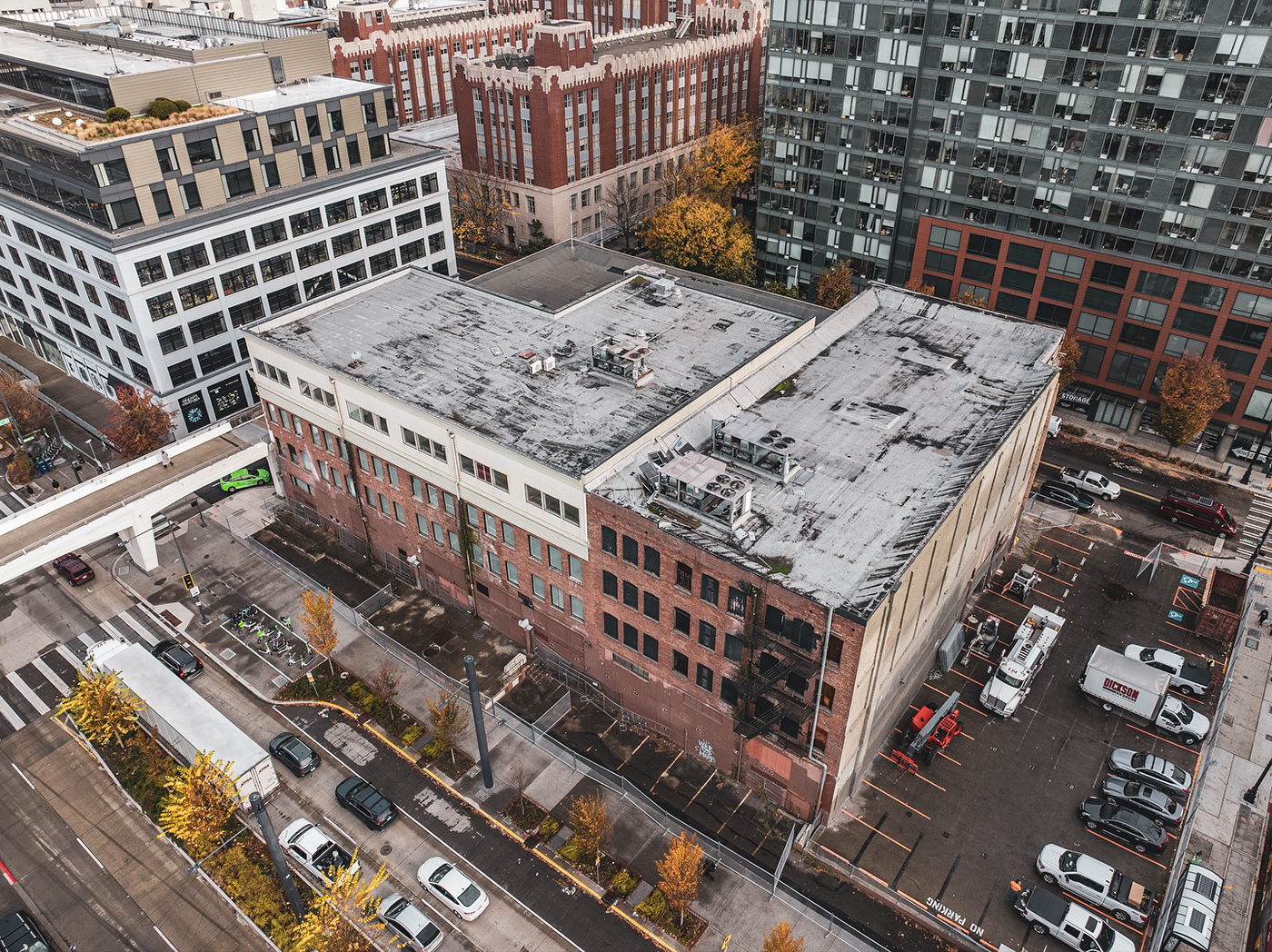
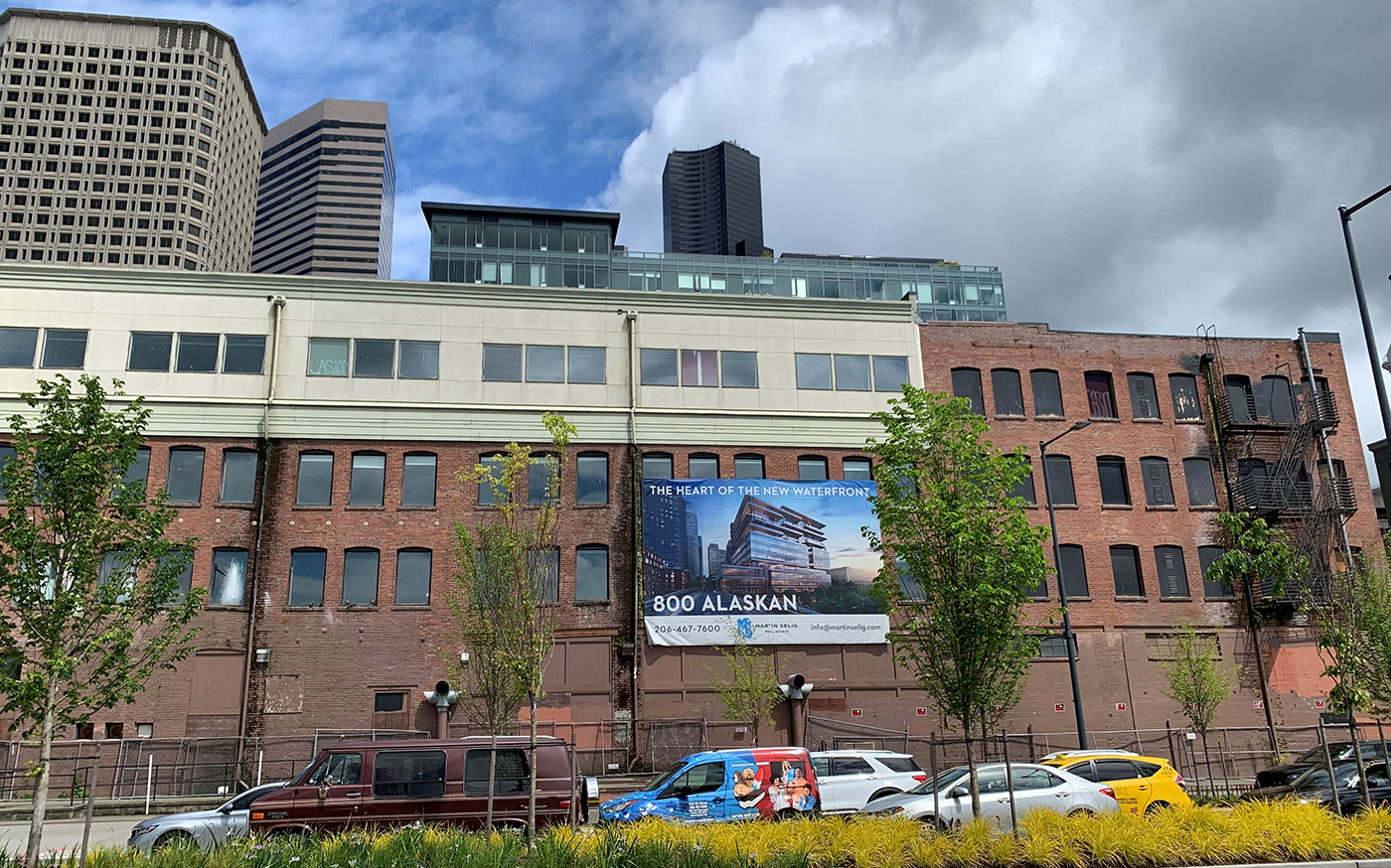
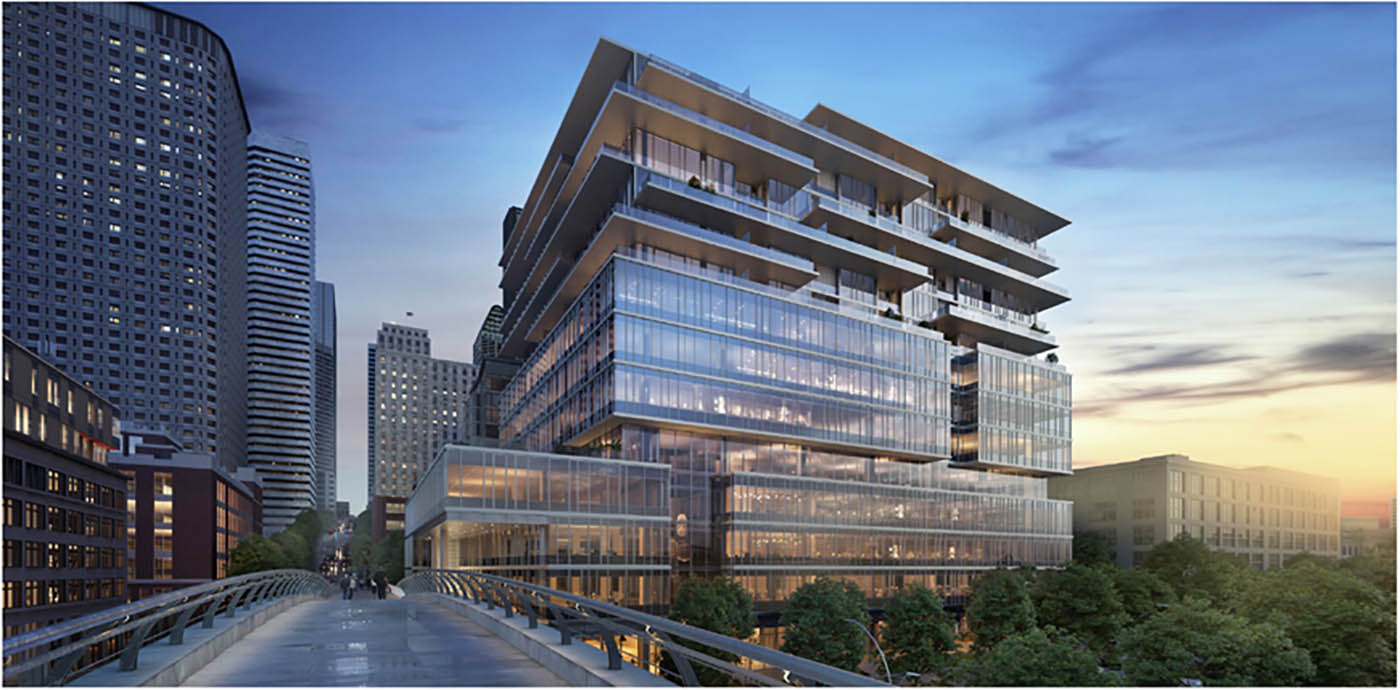
October's demolition permits for the two turn-of-the-century structures at 800 Alaskan Way were originally initiated five years ago, back when Selig planned a 14-story office and apartment tower there.
But the swerve from glass-front tower to humble parking lot is only the most recent twist in the block's story.
A BURIED SHIPWRECK?
Early this week, the two buildings came down, the Marion Street pedestrian bridge reopened after a planned four-week closure during demo, and Dickson's high-reach excavators left the site.
The last highly visible month of demo attracted lots of attention as tourists, neighboring workers (including me) and longtime Seattleites stopped to take pictures of the final frames of the 1906-era building.
But some people were peering at the site itself, looking for the remains of a much-older shipwreck among the piled bricks, cement and beams.
After the three-masted Windward sunk just off Bainbridge Island in Useless Bay in 1875, millman and railroad director James Colman bought it and towed it to the then-edge of the Seattle waterfront to act as a breakwater, according to HistoryLink.
Later, railroad workers reportedly drove piles through its hull to build a trestle (HistoryLink again), which was then filled in as part of the construction of Railroad Avenue — Alaskan Way's planked roadway predecessor.
The Windward “had a land burial, under roaring city streets,” Archie Binns waxed dramatically in his 1946 book “Northwest Gateway.” “Seattle has a clipper ship buried in her heart.”
The location of the wreck isn't precisely known, but HistoryLink's Central Waterfront tour site tracks it near the Commuter complex.
“Popular lore holds that the ship remains buried under fill just north of Columbia, east of Western Avenue,” the site reads.
Following a tip from a curious reader about the ship's location, I reached out to Jennifer Ott, executive director of HistoryLink and the recent author of “Where the City Meets the Sound,” which chronicles the history of Seattle's waterfront.
Ott said she heard from the property owners that the Commuter demolition wouldn't go beyond the building's footprint, but she's still been lurking around the site to see what might be uncovered there.
“As sad as I am to see a historic waterfront building being demolished, I am waiting with bated breath to see if the Windward will be uncovered,” Ott said. “It's a fascinating relic from when non-Native settlers wrestled the beach into a working waterfront.”
A representative for Urban Renaissance Group said they were unable to comment about the project. BNBuilders and Dickson representatives also said they couldn't comment on the project.
But a possible land burial of a sailing ship isn't the only interesting thing to ever happen to this square block.
WATCHING THE VIADUCT RISE AND FALL
The Commuter Building sat in the shadow of the Alaskan Way Viaduct for nearly 70 years, from its early construction in 1949, until the viaduct was torn down in early 2019.
The complex also held steady as the state Route 99 tunnel was bored underneath it — thanks to some efforts by the Washington State Department of Transportation.
Civil engineer David Sowers, who served as WSDOT's Deputy Program Administrator for the Alaskan Way Viaduct Replacement Program, said he well remembers the precautions required to protect the building during construction.
“Digging the SR-99 bored tunnel directly beneath the Commuter Building was particularly challenging, particularly along the south wall where earlier ground settlement had damaged the building, and the exterior wall required tie-rods through the building to hold it in one piece,” he said.
Several years later, WSDOT again took measures to protect the building during the viaduct's “surgical” removal just feet away in early 2019, Sowers recalled.
FROM MEAT-PACKING TO PARKING
The Commuter is surrounded by multiple much-better known Pioneer Square buildings, and the waterfront. It was originally built as a freezer warehouse, used as a meat-packing factory in the 1920s, and later, served as a grocery store.
In more recent memory, the complex's south structure, next to the small lot on Columbia Street, was used for parking.
Rafn Company renovated the Commuter Building in 2000, reconstructing over half of the timber-framed floors and adding a new floor of penthouse offices along with a seismic retrofit.
The north Commuter Building was for years office space for Windermere Real Estate, with Dania selling furniture below. Windermere is run by the Jacobi family, which the DJC then reported sold the block to Selig in 2018 for $44 million.
Crews will be busy sorting and hauling materials off the site over the next few months.
The parking lot work is slated to be complete before the FIFA World Cup moratorium in June, a representative for Urban Renaissance Group said.
After that, who knows what will come next for this block? For now, nearby workers (again, me) have unobstructed office views of the Olympic Mountains and the ferries making their way across the sound. Visitors to our sparkly new waterfront can see more of the Smith Tower. And curious souls can walk across the Marion Street pedestrian bridge, peer into the great morass of building materials, and wonder.
Shawna Gamache can be
reached by email or by phone
at (206) 219-6518.


