 |
Subscribe / Renew |
 |
Contact Us |
| ► Subscribe to our Free Weekly Newsletter | |

Construction Bids
| home | Welcome, sign in or click here to subscribe. | login |


 print print  email to a friend email to a friend  reprints add to mydjc reprints add to mydjc |  |

September 15, 1999

By SAM BENNETT
Journal Staff reporter
|
|
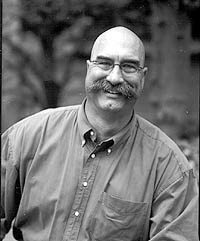
Alexander Kimball |
Q: What do you do?
A: Basically I've been called on to be a visionary, a planner and an orchestrator of mixed-use urban projects. Assembling teams of developers, landowners, businesses and communities and assisting in their cooperative interaction allows the creation of wonderful high energy people-places that are socially viable, economically feasible and safe places for the community to gather.
Q: What are a few projects you're particularly proud of?
The new Uwajimaya Village, which is presently under construction. I was able to plant seeds with visions and designs to help the Moriguchi family to build housing on top and parking underneath.
It's a leading edge project that enables the market to be able to stay downtown. By creating air rights and planning a project with the community, the new Uwajimaya Village will energize life into the International District. Helping them with their vision is really what I did. I enjoyed assisting them in their vision of giving back to the community.
|
|
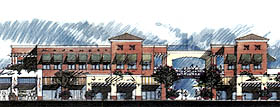
This Ontario, Calif., project, called Ontario Center, includes 150,000 square feet of retail shops and an 80-unit senior housing facility. |
With the positive reaction of the community and the success of the project, I am proud to have been asked to vision, program and design a more advanced mixed-use project for Ontario.
Q: How much of what you do is actually designing buildings?
A: Forty to 50 percent of what I do is drawing. I love that, but now I'm being asked to do a different role as the visionary who orchestrates the process. I'm working with the city of Lynnwood and its chamber of commerce task force to look at opportunities for a master plan of a new central business district. We are at the beginning stages of orchestrating the gathering of community input.
In Colville, Wash., and Chewelah, Wash., I believe I was instrumental in energizing their communities to make their downtowns vital. I've also been gifted with the opportunity to originally design Bellevue Square as we know it today, and to watch and assist our visions and ideas of 20 years ago come to realization by externalizing the typical mall onto the streets. This new street-front retail was designed and will be built shortly as a continuation of the original design concepts, which was completed while I was a partner at Sclater Kimball Architects.
Q: What is the appeal of revitalizing dead or dying urban shopping centers?
A: It's a challenge of the concepts I believe in and know work. If you take an old shopping center it's usually on direct bus lines and close access to the community it was built for. If you introduce densities and uses needed by the community, such as senior housing, community centers, offices and the right mixture of retail, you can create a project that is supported by the community and is economically feasible.
These ideas are parallel to the urban growth management concepts. We must still include excellent visibility, easy access, natural light, ventilation and public safety. The whole idea is to create the synergy of what the community wants it to be.
Q: By requirement, many buildings have ground floor retail. How can you ensure that the retail component succeeds?
A: Over the years we have learned what it takes to make successful projects. It's a matter of not only designing the spaces correctly, but ensuring the mix of tenants and their relationships are correct. To make successful retail, you need people. So we ask questions. What are the relationships between the tenants? What's the pedestrian space like? Does it encourage people to linger? Is there something happening? What is the draw? Is it a comfortable place to be? It's all subconscious design, and if you do it, it works.
Q: But how can you design retail or commercial spaces to be more appealing?
|
|
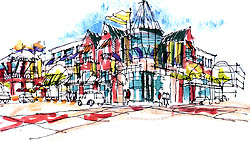
The Alaska and California, a mixed-use project in West Seattle features retail, office space, restaurants and existing housing. |
Q: How did you manage to get where you are in your career?
A: By working with incredible people, Ernie Hahn, Jon Jerde and my old partner, Alan Sclater, to name a few, I've been very fortunate to learn to think outside the box. It has evolved into the place where I am today by experiencing all that I designed and built and teamed with, to enable me to give back.
The merger this summer of Kimball P.C. with Mulvanny Architects, and now more recently the merger of Mulvanny with G2 Architects finalizes the assemblage of architectural design talent parallel to none. This gives us the opportunity to have a workforce and technical expertise to pull off our incredible visions and projects we have in front of us. We're at a very exciting beginning.
Q: What keeps you interested in the profession?
A: I live, breath and sleep with the excitement of all that we're working on. I haven't worked a day in my life. This is fun.
Previous columns:


