 |
Subscribe / Renew |
 |
Contact Us |
| ► Subscribe to our Free Weekly Newsletter | |

Construction Bids
| home | Welcome, sign in or click here to subscribe. | login |


 print print  email to a friend email to a friend  reprints add to mydjc reprints add to mydjc |  |

December 22, 1999
|
Q: How long have you been with Mulvanny Architects?
A: About one year. My firm, ZGA Architecture, which was based in Seattle, did a majority of design work in the Far East. I merged the firm with Mulvanny earlier this year. Before that, I was with Callison Architects.
Q: What kind of projects do you specialize in?
A: As a design architect, I have designed projects both domestic and overseas. I specialize in corporate headquarters, high-rise buildings and mixed-use projects that combine office and retail. The tallest building I have designed is 80 stories. The largest project I have designed is a city center that is more than 4 million square feet.
Q: How does Seattle architecture compare with Asian projects?
A: Seattle has in the last three or four years experienced the best time for new architecture. There's a lot of work, but the scale of buildings is totally different. There's no comparison with international projects. Here people pay much attention to comfort and practical and economic solutions versus Asian clients, who are more in favor of grand scale and visual aesthetics.
In China, the population is so dense that high-rises are the direct solution. Here in the U.S., there are more suburbs and horizontal development. China has experienced vast development in the past 20 years. The tallest building in the country was just 37 stories 20 years ago; now just in Shanghai alone there are more than 1,000 high-rise buildings, with the tallest one at 88 stories.
The design selection process is different. In China, the clients usually hold an international design competition first. They want to see the design solution up front. It's a smart way for them to do business, though for the architects, it's harder. Competitions are big risk-taking efforts and can take two months of your time; it's an exhausting process and takes a lot of passion.
Young architects in China have much more opportunity to get to the top than in most companies here. Mulvanny Architects is different, though. They really accept your capabilities rather than your age.
Q: What are some of your design influences?

|
Q: What's one project you're particularly proud of?
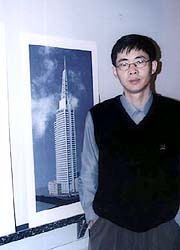
A: The Jiangsu Power Co. headquarters in Nanjing, a city of 6 million people. It's a 40-story office building that had very special technical requirements. It needed a 200-foot telecommunications tower to serve 30 satellite /microwave dishes. How to integrate this major element into design is very challenging. It's also a very tough site because it's so narrow. Despite that, I turned these limits into a unique opportunity to express the building. The whole image is simple and reflects the owner's high-tech business and their needs.
Q: Do political relations between the U.S. and China affect your work?
A: Yes. You have to be very careful. The Chinese pay attention to the quality of your work and your relationship with them. This relationship is not just between you and the client but, indirectly, with this country and that one. Though architecture is a relatively small business, it does reflect the political relationship.
Q: What do you like best about your job?
A: I always wanted to work with larger-scale buildings like high-rises. Thanks to vast development in China and other Asian countries, I have the opportunity to expand my experience. Another important reason for me to enjoy work in China is that it is my mother country. I feel proud when I work with people there.

|
A: Their code is very restrictive these days. They adopted western countries' codes and combined with their existing codes. Sometimes, it can be very conservative. I am more concerned by some of the Chinese consultants, especially the structural and mechanical engineers. Some of them are very conservative and afraid to adopt new technology. You have to constantly negotiate with them.
Q: What are some of the biggest challenges to working in China?
A: For a lot of American firms, it's not practical to do business in China. Because it takes time to see results, firms have to be aware that it could be very costly if you are not familiar. It's a good idea to have a long-term partnership with architects there to get information and save money.
You also have to be an insider. There are cultural differences. In China, clients expect respect and hospitality. They throw big banquets for visiting architects and top guests; they expect the same when they visit here.
Q: Has the Asian financial crisis affected your work?
A: Of course, as far as architecture relates to the general economy. But never to the degree most large firms experienced. Because China was fairly stable during the crisis, how to pick the right client was another important factor. We're not looking for amount; we're looking for a few meaningful, high-quality, large projects so I can dedicate my design effort to it. China is such a big country that there are always things happening.
Previous columns:


