 |
Subscribe / Renew |
 |
Contact Us |
| ► Subscribe to our Free Weekly Newsletter | |

Construction Bids
| home | Welcome, sign in or click here to subscribe. | login |


 print print  email to a friend email to a friend  reprints add to mydjc reprints add to mydjc |  |
May 10, 2011
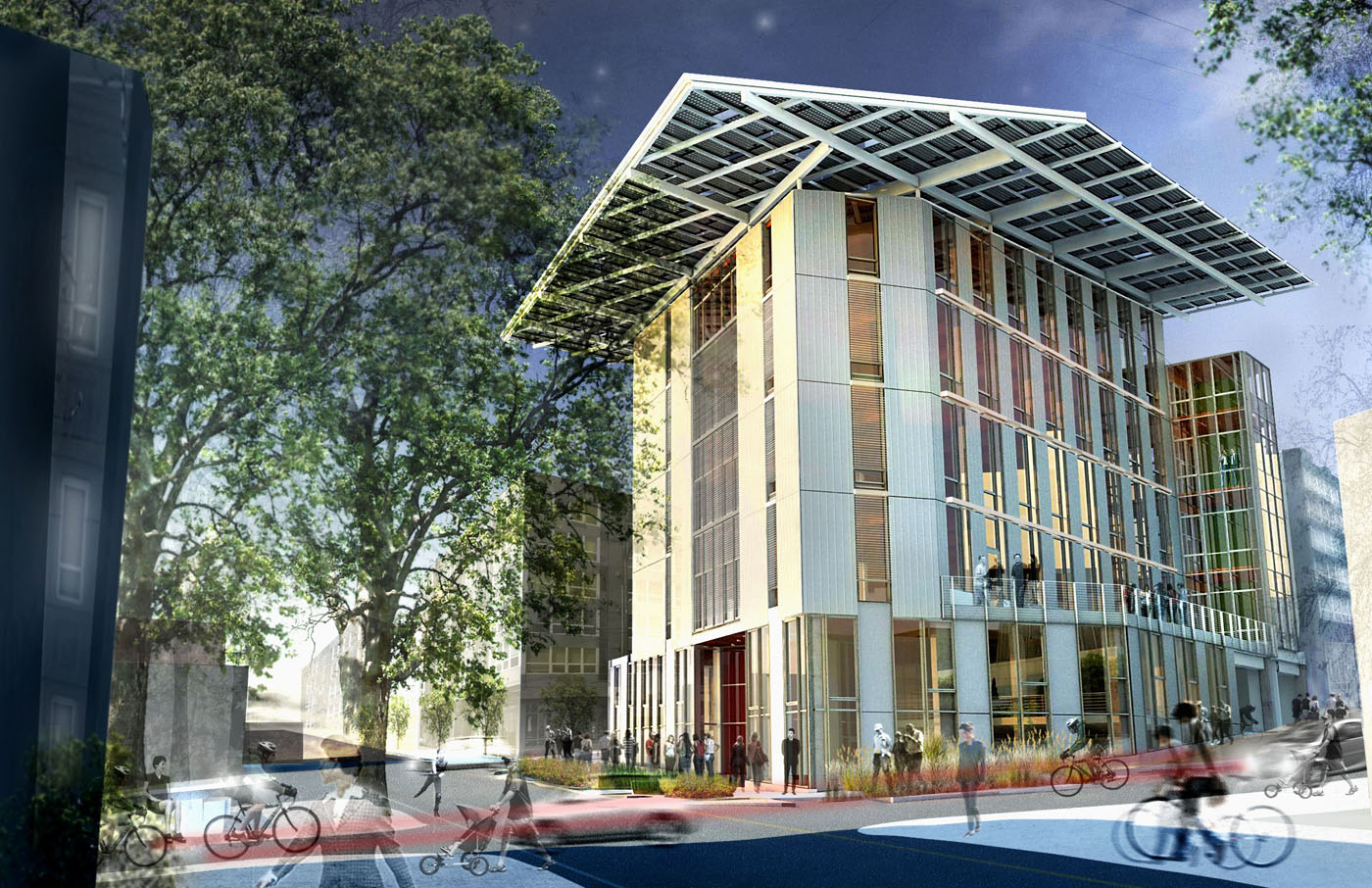
The team designing the Bullitt Foundation's new headquarters — the Cascadia Center for Sustainable Design and Construction — recently showed the public its plans for creating the most sustainable office building in the world.
Denis Hayes, CEO and president of Bullitt, said The Cascadia Center should use 40 percent less energy than the next most efficient office project: “With what I hope is going to turn out to be no hyperbole at all, we set out to build the greenest office building by far in the world.”
The 52,000-square-foot project at 1501 E. Madison St. on Capitol Hill will have six stories with a basement. Bullitt's headquarters will occupy half a floor, and the rest will be leased to others that are involved with green building and sustainability issues. The Cascadia Green Building Council will be a tenant.
Cascadia CEO Jason McLennan created the Living Building Challenge, which is regarded as the most rigorous green building standard. Living buildings must generate all the energy they need through renewable resources, and provide and treat all the water they use. They must operate for a year and meet all the performance requirements to get certified.
Point32 is Bullitt's development partner, the Miller Hull Partnership is the architect and Schuchart is general contractor.
Four living buildings have been certified, though others are in the process.
McLennan said Bullitt's project is exciting because most living buildings are small and not in cities.
“I think this is the most important building being built in the country today,” he said. “It's going to open up a whole new set of eyes.”
Site work has started and construction should take about a year, with completion planned for next summer.
Bullitt chose to do a living building because it reflects the nonprofit's commitment to sustainability, but Hayes said the ultimate goal is to teach and inspire others.
“We will be entirely open with the world about our performance and if it doesn't perform, it will be a great embarrassment,” Hayes said. “Ultimately, it's our dream that cities will embody these same lessons.”
Design changes
Marc Brune of PAE Consulting Engineers in Portland, said Cascadia Center will be 75 percent more efficient than a standard building of its size. Geothermal will provide heat and a 230,000-kilowatt solar array will provide other energy needs. Excess energy will be fed into the grid in the summer and the building will draw from the grid during darker months, making it a net-zero-energy building.
Brian Court of Miller Hull said meeting the net-zero-energy requirement has been the biggest hurdle during design. He said he expects meeting the material requirements will be the biggest hurdle during construction.
Solar panels had been planned along the southwest side of the building in earlier designs, but the wall panels have been removed. A neighbor had appealed parts of the design to the Seattle Hearing Examiner, including the solar wall. The hearing examiner rejected most of the neighbor's appeal.
Hayes said Bullitt was trying to be responsive to the community, but he said the wall was ultimately removed because it was not something other buildings would likely repeat.
To make up for having fewer solar panels the team reduced the building's energy load and added more panels to the roof. Roof panels were always planned to be more efficient than those on the wall. Brune said the team is rewriting the lease agreements for tenants to save energy, such as encouraging laptops rather than desktop computers.
The building is designed to gather and treat water for drinking, but whether that will be allowed is still being determined. A 50,000-gallon cistern will capture rainwater from the roof and treat it to meet water quality standards. The water system will need approval from King County and the state Department of Health or else tenants will use municipal water, but eventually, Hayes said, occupants will drink water that is gathered and treated on site.
The building will connect to the municipal supply for fire prevention.
Seattle City Council Member Sally Clark said she is hoping King County and other partners can embrace some of the challenges of this project. To support living buildings, she said governments need to change how water systems get funded and who has to be connected. “We look forward to figuring out how else we need to be flexible, and to convincing our other partners of the need for that flexibility.”
The Seattle City Council created the Living Building Pilot Program partly for the Bullitt project, and it has helped move the building forward.
All graywater in Cascadia Center will be stored in a tank and piped to a green roof, which will be a constructed wetland. Excess water not treated by the roof will be infiltrated through planting beds on the ground floor. Composting foam toilets will be stacked above a central composting room in the basement to treat waste.
The building envelope will be high performance, with triple-glazed windows and shades that automatically adjust based on glare and heat.
Court said this “dream project” has been extraordinarily complex, and requires a new way to practice architecture.
Hayes said another important partner is U.S. Bank, which is financing the project.
Katie Zemtseff can be
reached by email or by phone
at (206) 622-8272.


