 |
Subscribe / Renew |
 |
Contact Us |
| ► Subscribe to our Free Weekly Newsletter | |

Construction Bids
| home | Welcome, sign in or click here to subscribe. | login |


 print print  email to a friend email to a friend  reprints add to mydjc reprints add to mydjc |  |
May 1, 2001
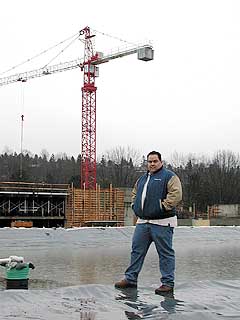
Photo by Terry Stephens |
One Monroe company -- Water Tectonics Inc. -- says it has devised an economical new process for treating surface-water runoff so it doesn't harm sensitive aquatic life.
Company president and chemist Jim Mothersbaugh and Robert Schwindt, vice president of operations, have created a simple process that can treat large volumes of water, meet Department of Ecology standards and still be easy to operate.
"Until recently, there were no alternatives to the chemical treatment that DOE accepted," Mothersbaugh said. "DOE has given us great support in the development of our electrocoagulation process."
"People don’t know yet that there are alternatives out there," Schwindt said. "We want to get word out that there is a feasible solution to a tough problem that affects residential and commercial contractors throughout Snohomish County and the Northwest."
Commercial construction sites are a major target for marketing the new process, but Schwindt said the company particularly wants to reach residential developers because housing often is sited in rural areas where runoff water affects salmon-bearing streams.
Although Water Tectonics’ process is new, the "electrocoagulation" technology that is the core of the cleansing operation was known in the early 1900s, Mothersbaugh said. He and Schwindt have just developed a modern application that works simply and effectively.
Basically, the success of the process depends on the fact that floating particles in surface runoff water are charged, which keeps them separated from each other and suspended in water almost indefinitely because they are very fine and weigh almost nothing.
Water Tectonics’ process consists of passing runoff water through electrical cells that apply a positive and negative charge to the water, which makes the particles cling together, gather weight and settle to the bottom of catch basins.
| Seco using process on big Renton project |
|
Water Tectonics is using the application on its first large-scale project, Seco Development Co.’s building of 500 apartment units, a hotel/restaurant and 750,000 square feet of office space at the south end of Lake Washington. The 17-acre site was previously the site of a steam plant operated by Puget Sound Energy, which has closed the plant and sold the property.
Runoff water is captured in a settling pond, then run through the Water Tectonics process before it is released into Lake Washington, which has a turbidity rating of one. Turbidity is the measurement of the clarity of water. Suspended clay,silt, finely divided organic matter, algae and other microorganisms add to the turbidity of water, which is measured in NTUs (nephelometric turbidity units). DOE standards require water dumped into the lake to have a turbidity rating of no more than five NTUs higher than the receiving water. Water Tectonics has been discharging treated water at levels well within that limit, Mothersbaugh said. "Water Tectonics takes samples regularly, daily, of the site water and the receiving water," Schwindt said. "We believe that our (treated) water isn’t adversely affecting the environment. And we can provide the process at an affordable price." "Schwindt Enterprises has worked with us before as an earthworks subcontractor, and Robert alerted us to this new capability," said Seco’s development manager, Rex Allen. "It's working really well. We were interested because the best management practices we used before weren’t going to meet the new DOE requirements for construction-site water quality." |
"The principles of electrocoagulation -- EC as we call it -- are well known," Mothersbaugh said. "What we accomplished was to establish an effective system that has a reliable power supply that can run for extended periods of time."
He and Schwindt think they have a marketable process that will win big with contractors, solving runoff-water problems without chemical applications.
"With chemicals, there’s always the danger of overtreatment. With this process, we could treat water for 100 years with no difference in the water characteristics," Mothersbaugh said.
First attempts to prove their process weren’t as successful. But, over the past two years, a series of pilot projects, site tests and adjustments have been completed. The state Department of Ecology now accepts the process as an alternative to the chemical applications on its approved list.
Ron Devitt, with the Northwest regional office of the DOE in Bellevue, said the Water Tectonics process has advantages over chemical treatment because it works with less danger of harming the environment.
"Control by chemicals is fine if everyone is doing it properly, but when you start adding chemicals to the water, you have to monitor that process to make sure everything is done responsibly. Water Tectonics’ process is doing the same thing without chemicals, which simplifies it bureaucratically and practically," Devitt said.
"From our point of view, turbidity and sediment are a big deal," he said. "In a normal wet year, ensuring water quality is a big problem for contractors. It’s easy to get stuck in the middle of a project. (Water Tectonics') process is like an insurance policy. It’s there if you need it."
Because phosphorus and bacteria in the water also drop out with the particles treated by Water Tectonics’ electrocoagulation process, the company’s application meets DOE standards for phosphorous reduction and has real potential to address bacterial problems. Both men see the possibility of also using the process in sewage treatment facilities, another major market for them.
"Another advantage of EC is that a chemical treatment for site water runoff has to be approved as part of a contractor’s SEPA review," Schwindt said, "whereas our process can be brought to a site with local site inspector approval."
The company’s process was used on the Microsoft campus in Redmond, where Sellen Construction Co., the general contractor, has completed the site development phase of the St. Andrews project. Also, an earlier small-site project tested in Bellevue impressed Guy Oliver, the city of Redmond’s lead construction inspector.
"We've been working with DOE since 1994 trying to get some technology to clean surface water. Then, Water Tectonics came to me and we began tests on several Redmond projects and then the one in Bellevue," Oliver said. "We were quite pleased with what we saw. Of all the treatment processes out there, I believe their process to be the safest. We’re very much in favor of it, and we’re working with them to get it turned loose on the construction industry."
Just how important is the Water Tectonics process?
Oliver said he believes "if you want to protect (water resources), you need this technology or you’re going to have to shut (construction) down nine months of the year. We can’t afford not to have this technology."
|
Filters alone can’t handle the problem because of the sub-micron size of the particles, Mothersbaugh said. Even if filters could stop the particles, he said, they would quickly clog, becoming useless. Water Tectonics’ system has the ability to process up to 200,000 gallons a day.
Water Tectonics leases its system, which can be another economic advantage for clients.
"Now that we’re a proven operation, we’re trying to get the word out that there is a reliable, nonchemical process for treating surface water problems," Schwindt said. "This is a market we expect to excel in Snohomish County and the Puget Sound area."
But the potential market stretches far beyond the area and beyond commercial and residential construction sites. The Washington State Department of Transportation and other public agencies have the same surface-water turbidity problems when they build highways and public projects, Mothersbaugh said.
For more information, contact Water Tectonics at 17334 Beaton Road S.E., Suite 200, Monroe, WA 98272, call (360) 794-1071 or (206) 947-5922 (mobile) or send e-mail to Jim Mothersbaugh at jianm@aol.com.


