 |
Subscribe / Renew |
 |
Contact Us |
| ► Subscribe to our Free Weekly Newsletter | |

Construction Bids
| home | Welcome, sign in or click here to subscribe. | login |


 print print  email to a friend email to a friend  reprints add to mydjc reprints add to mydjc |  |
November 15, 1999
By JON SAVELLE
Journal Environmental editor
In the century since Rudolph Diesel invented his now ubiquitous engine, its design has changed little. But a new century is dawning, and so is a new approach to diesel engine design - one that its inventor says could put his little Puyallup company in the ring with industry heavyweights Caterpillar, Cum-mins and Detroit Diesel.
The upstart is Rodi Power Systems. Founded by Byron Spain, a longtime Boeing development engineer, the company aims to carve itself a niche with new technology.
And what, you may ask, could be new about a diesel engine?
Ask Spain that question, and he'll talk about everything from fuel to exhaust. For starters, he said, the 450-hp engine is a two-stroke design, not a four-stroke. That means the intake charge and compression occur on the piston's upstroke, with ignition and exhaust on the downstroke.
This contrasts with the standard four-stroke design, in which the piston travels through its stroke once for each of the four cycles.
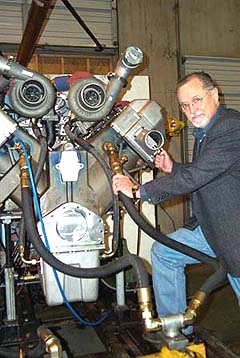
Photo by Ben Minnick |
The result is a cool-running engine - so cool, in fact, that Spain says you can comfortably put your hand on it while it's running.
With the heat under control, Spain was able to chuck the conventional cooling system. His engine uses its own lubricating oil as the coolant.
All of these innovations make for a smaller, simpler and lighter engine compared to others of the same horsepower. Spain said his baby has 40 percent fewer parts and weighs about 1,000 pounds less than the equivalent models from Caterpillar, Cummins and Detroit Diesel.
Those engines, he said, weigh 2,700 to 3,000 pounds apiece, whereas his tips the scales at a mere 1,800.
"It's made of conventional, heavy-duty diesel materials," Spain said. "Cast iron. It's light weight simply because it's less complex and smaller."
But Spain's inventions didn't stop the engine design. He also devised an entirely new type of fuel injection system - one that has no moving parts.
Based on the principle of "magnetostriction," the device essentially squeezes fuel into the engine. Spain explained that a variable magnetic field can be employed to cause the orbits of electrons in the injector to grow or contract. As the injector changes size - by minute amounts - it can be made to pump fuel.
Computer control allows this solid-state molecular pump to deliver precisely measured amounts of fuel to the engine's cylinders.
"We've been working on this one for a while," Spain said. "About three weeks ago we made the major breakthrough where it will run under lab conditions."
Besides reducing the complexity of the injectors, Spain said the new technology also does away with pressurized fuel lines, which tend to leak.
There are other innovations. The engine, called an HT1-450, is designed to be installed or removed in only two hours. It uses only two sizes of bolts. Its camshaft is reversible for marine applications. An electronic diagnostic system links the engine to a service center via cellular phone.
The engine can run on diesel or natural gas fuel. It employs "turbo superchargers" to eliminate turbo lag and to drive electric generators (instead of a belt-driven alternator), which saves 65 hp in parasitic friction losses. And the V-4 can run on four or two cylinders, depending on the load.
Spain said the engine is not yet in production. It is undergoing emissions testing now, and will enter the emissions-certification phase early next year.
"We intend to have 25 beta test engines in the March/April timeframe," Spain said. "As soon as we get positive feedback, we will begin to ship 20 per day from our local Puyallup plant, then from the Louisiana plant."
Rodi Power Systems has just moved into its 50,000-square-foot Puyallup facility, where it will assemble engines from components made elsewhere. The Louisiana assembly plant will be larger, at 150,000 square feet.
The first engines will not use the new fuel injectors, which Spain said are a year away from production. However, their other components come from well-known suppliers, who build them to Rodi's specifications.
Crankshafts, for example, are made by Kellogg - a Detroit manufacturer whose work includes, among other things, all the crankshafts for Ford Taurus autos. Cylinder blocks and pistons are made in Mexico, by the same company that supplies Detroit Diesel.
With the approach of full-scale production of his engine, Spain said Rodi's research at the moment is in control-software improvements. The diagnostic system, for example, which can call a service center for help, also uses a Global Positioning System satellite link to pinpoint a vehicle's position.
This isn't just a convenience for the operators. Spain said finance companies can use it too - to turn off the engine for nonpayment, and to repossess the vehicle.


