|
Subscribe / Renew |
 |
Contact Us |
| ► Subscribe to our Free Weekly Newsletter | |

Construction Bids
| home | Welcome, sign in or click here to subscribe. | login |


 print print  email to a friend email to a friend  reprints add to mydjc reprints add to mydjc |  |
April 20, 2023
The old Executive Inn and random industrial/office buildings have now been scraped off the full block where BioMed Realty is planning its T6 Innovation Center.
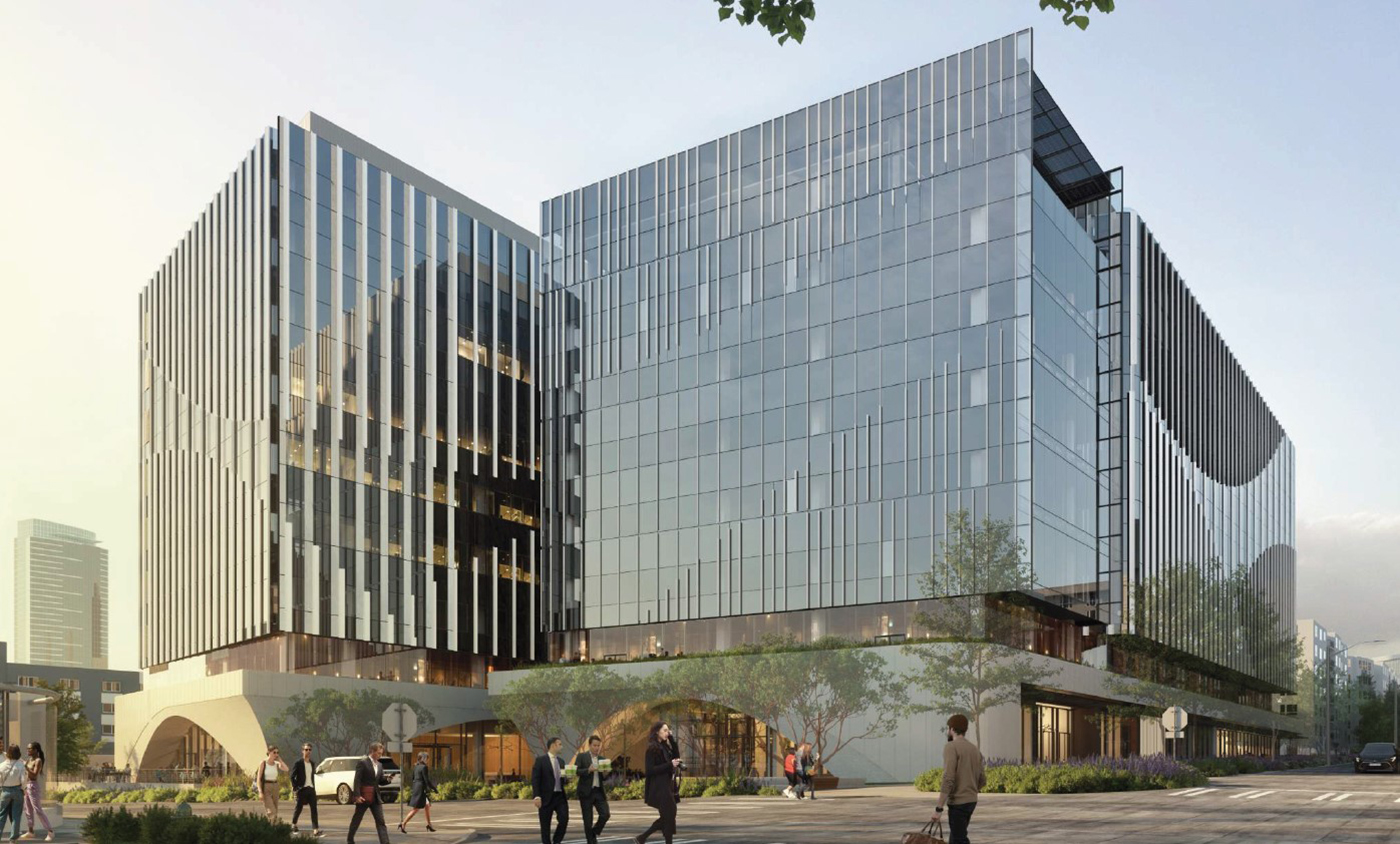
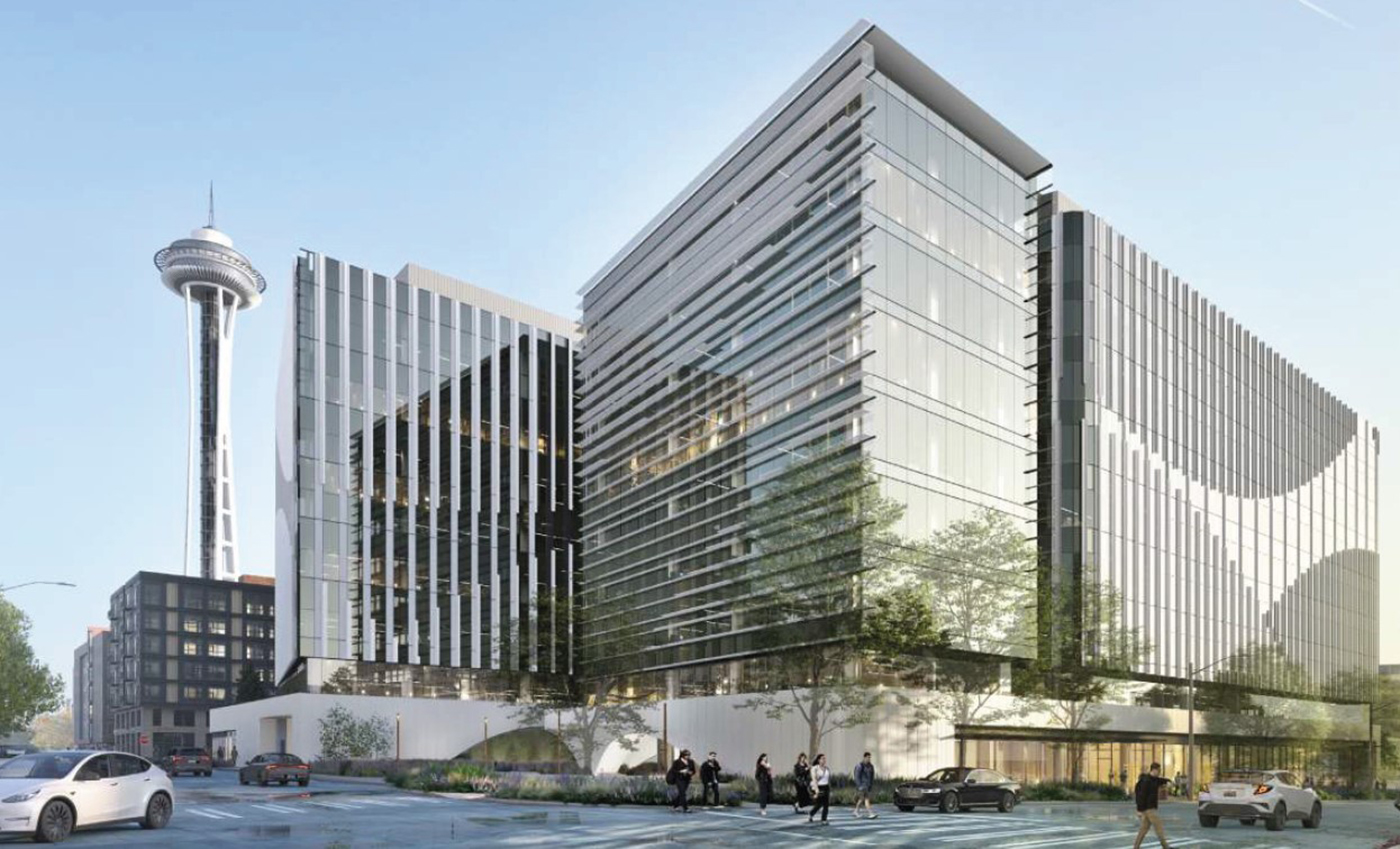
That life-science project, designed by Perkins & Will, has its likely final design review on May 3.
Two buildings are planned: east, facing Sixth Avenue North, and west, at 200 Taylor Ave. N. The block lies between Seattle Center and South Lake Union, and is also bounded by Thomas and John streets.
Numbers are all about the same for the two eight-story buildings: some 504,700 square feet of offices and lab space; about 505 underground parking stalls, on three levels; and a Mandatory Housing Affordability fee of around $4.5 million.
No start date has been formally announced, and there's no sign yet of a broker. BioMed has often built before on a speculative basis, and the life-science sector remains a bright spot in an otherwise depressed market.
The architect says the west building will go first, ideally in the second quarter of next year, followed a year later by the east building. Completion is then projected for 2027 (west) and 2028 (east).
The T6 team also includes Turner Construction; KPFF, civil and structural engineer; Berger Partnership, landscape architect; Bush Roed & Hitchings, surveyor; OAC Services, owner's rep; McCullough Hill Leary, legal; MacDonald-Miller, mechanical and plumbing; Graelic, parking consultant; TenW, traffic consultant; EA Engineering, SEPA consultant; Lerch Bates, elevators; Rushing, LEED consultant; and Hargis Engineers, electrical.
Amenities are to include a gym, conference center, terraces, arcade/lounge area, ample bike parking at grade, a central plaza (or woonerf) and two small restaurants (or cafes) — one possibly to be a sushi joint.
An alley vacation with the city is still pending.
Perkins & Will employs different window patterns and protruding fins, with contrasting arrangements, to create swooping, scalloping facades that delineate the two buildings. Those curves also echo the arched entries to both structures. And, the architect has previously stated, they're also meant to harmonize with the nearby Pacific Science Center's arches, designed by Minoru Yamasaki. There are T6 traces, too, of his Rainier Tower and IBM Building in downtown Seattle.
Meanwhile, the same architect is working with BioMed on its nearby Denny Triangle life-science project, also on a full block, where the Loyal Inn and other structures were recently demolished. That will total about 600,000 square feet.
Both projects would in coming years enter a market that still seems robust — and likely to strengthen, given the number of biotech spinoffs coming out of the University of Washington and Fred Hutchinson Cancer Center. At year's end, for SLU and environs, CBRE put the vacancy rate at 6.2%. Add Bothell, and the market now has about 9.2 million square feet, with about 1.2 million square feet in the pipeline (that's five new developments plus two office conversions).
Increased federal support is also a part of our post-pandemic world. For all of last year, says CBRE, the National Institutes of Health funded about $1.4 billion to Fred Hutch, the U.W., Seattle Children's, the Benaroya Research Foundation at Virginia Mason and Allen Institute. New ideas and treatments hatched there will inevitably result in some new ventures and companies.
Venture capital funding for life science in our region hit about $350 million in the third quarter of last year, up from about $300 million at the same point in 2021, says CBRE.
Brian Miller can be
reached by email at brian.miller@djc.com or by phone at (206) 219-6517.