|
Subscribe / Renew |
 |
Contact Us |
| ► Subscribe to our Free Weekly Newsletter | |

Construction Bids
| home | Welcome, sign in or click here to subscribe. | login |


 print print  email to a friend email to a friend  reprints add to mydjc reprints add to mydjc |  |
August 19, 2024

Sound Transit hopes to bring light-rail service to West Seattle — that's the south end of the 3 Line — by the early 2030s.
The 3 Line's north end, in Ballard, is scheduled for possible completion in the late '30s. Thus the station and bridge planning for West Seattle is moving a little faster than for Ballard. HNTB has been working on both for the past few years.
The Seattle Design Commission got a glimpse last month at three engineering challenges en route from SoDo to West Seattle: the elevated approaches to a Duwamish bridge; the bridge itself; and the tracks at grade, to wrap around Pigeon Point before reaching Delridge Station and later entering a short tunnel.
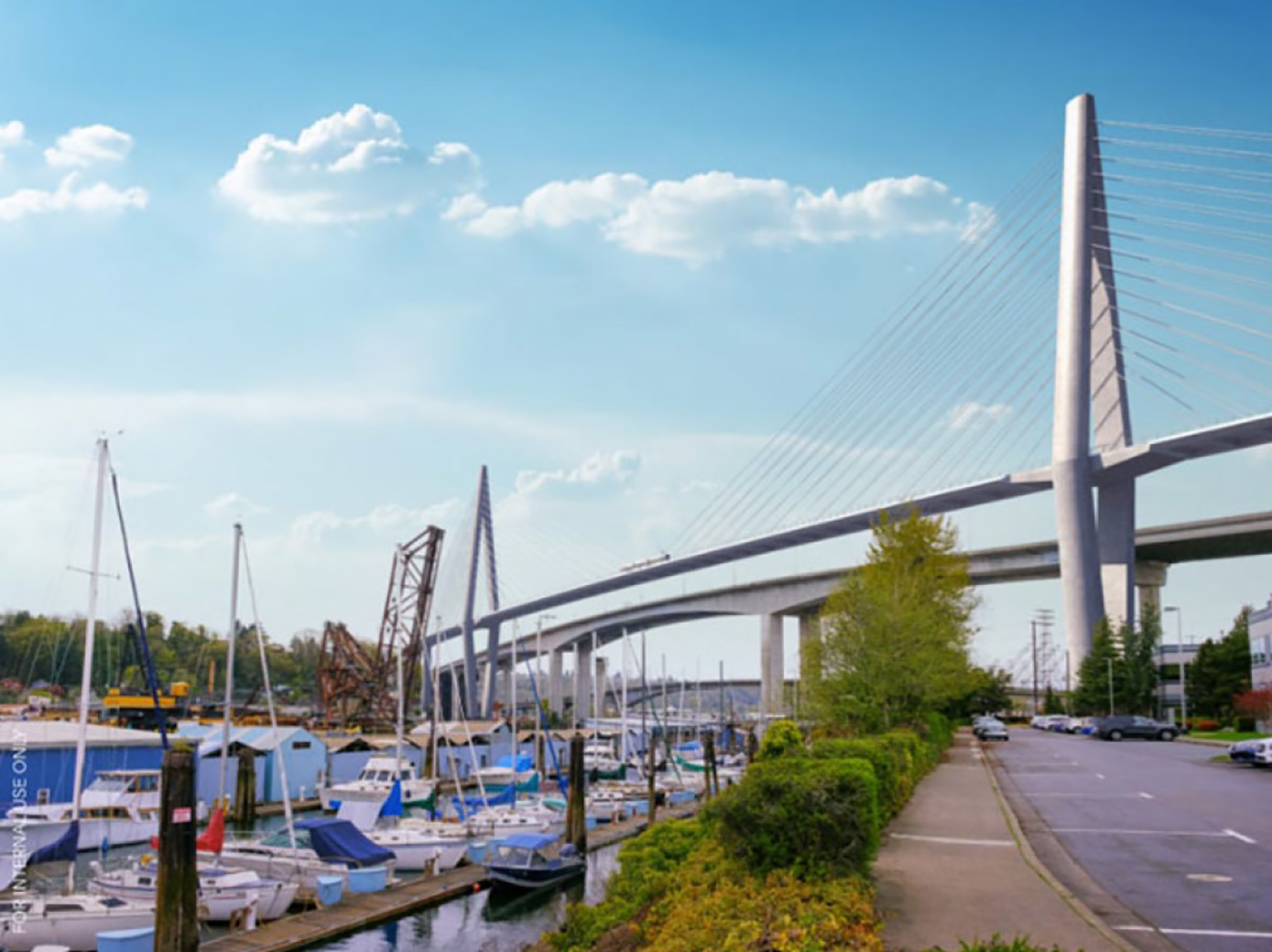
Unsurprisingly, the “diamond pylon” bridge is the glamor part. Project renderings — not a final design — depict a two-tower, 1,690-foot-long cable-stayed span. It would run just south of the existing West Seattle Bridge. The towers would both be about 374 feet in height, with the main span between them extending some 953 feet. Trains would, at their highest point, run about 140 feet above the waterway.
The two dramatic pier/tower structures would be set on Harbor Island, on land owned by the Port of Seattle, and on the near west shore of the west channel of the Duwamish Waterway. That's a privately held industrial property, and would require a condemnation/sale agreement with the longtime owner. (There would also be some similar land deals in SoDo.)
This would be the agency's first experience with such a cable-stayed design. HNTB has previously engineered such spans. For a somewhat local example, Vancouver, B.C., has its rail-only SkyBridge above the Fraser River. That was a late-1980s collaboration between Hyundai Engineering and Kerkhoff Construction.
On both ends of the Duwamish bridge, in SoDo and West Seattle, trains would run on elevated tracks before descending to grade. The authority calls them long-span structures, or elevated guideways. Crossing above various streets and obstacles, those are to range in height from 50 to 75 feet. We already see such elevated tracks as part of the existing 1 Line and currently Eastside-only 2 Line. Construction would involve pre-stressed concrete I-girders, “double-leaf columns” and “segmental box girders with balanced cantilever construction.”
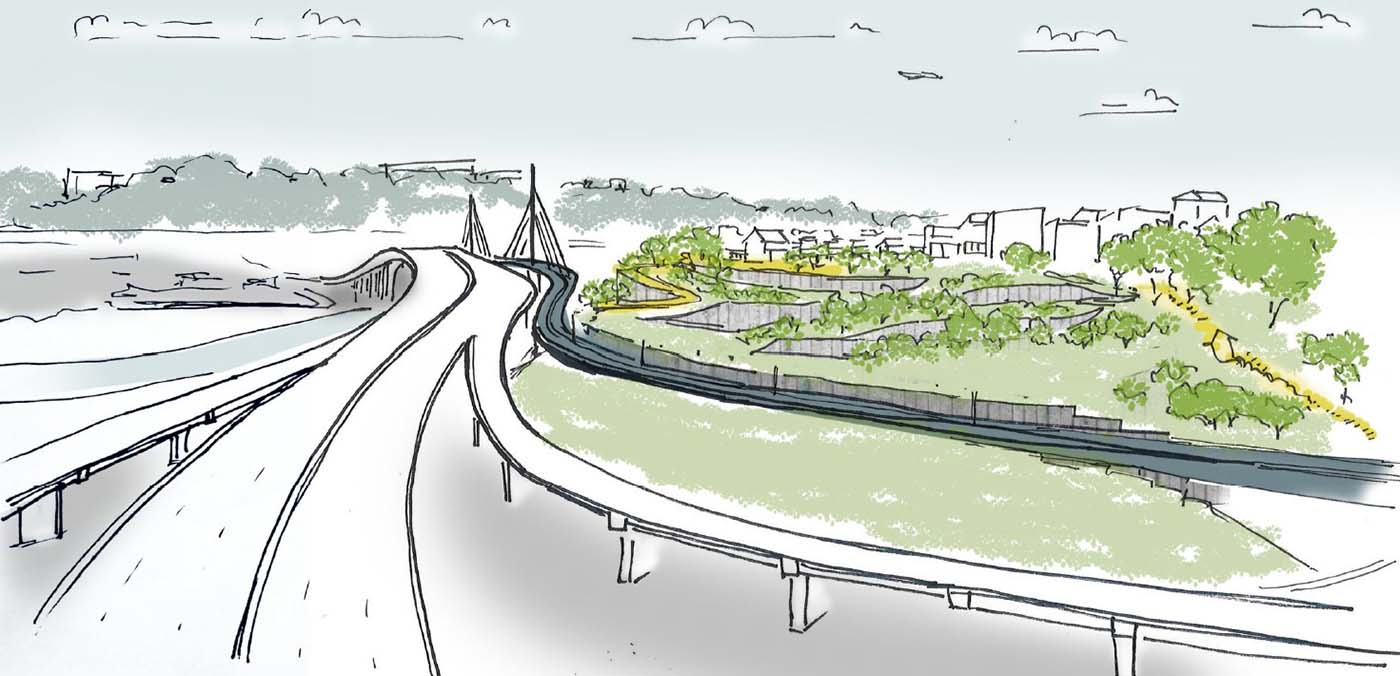
When the tracks return to grade at Pigeon Point, the route to Delridge Station is complicated by unstable soils, the West Duwamish Greenbelt and its trails, other bike/ped trails and some heron nests. Extensive grading, shoring and landscape restoration will be required there. And the residents of Pigeon Point also have their say.
The SoDo to West Seattle segment is to cover over four miles, with four stations — the west three being in West Seattle, culminating at Alaska Junction. The preferred route and station locations have been decided. Project cost is estimated at around $4 billion. The schedule is to complete the environmental impact statement this year, when final design and engineering by HNTB would also begin — then last into 2027. Construction might begin that same year and wrap in 2032.
HNTB's contract with Sound Transit is, into the 2030s, worth about $663 million — for both Ballard and West Seattle. (Budget revisions are frequent.) The agency's most recent procurement report says that, for SoDo to West Seattle, it'll put out a bid for a systems design engineering consultant later this year. Expected to follow early next year is a bid for a construction manager. Contract values aren't yet determined.
In the near term, the agency is now seeking a civil engineer for SoDo to West Seattle . Responses to that request for qualifications are dug Aug. 30.
The SoDo to Ballard section has its own timeline and station/route challenges — including downtown, South Lake Union and a probable tunnel beneath Salmon Bay. That would contribute to an overall 3 Line budget of some $12 billion to $13 billion, based on past Sound Transit estimates. All dollar figures and dates are likely to shift.
SoDo is the pivot point between the north and south ends of the future 3 Line. As transit riders know, there's already a SoDo Station for the existing 1 Line. That will be rebuilt to serve both lines, and Sound Transit expects to put that job out to bid late next year.
Brian Miller can be
reached by email at brian.miller@djc.com or by phone at (206) 219-6517.