 |
Subscribe / Renew |
 |
Contact Us |
| ► Subscribe to our Free Weekly Newsletter | |

Construction Bids
| home | Welcome, sign in or click here to subscribe. | login |


 print print  email to a friend email to a friend  reprints add to mydjc reprints add to mydjc |  |
June 25, 2025
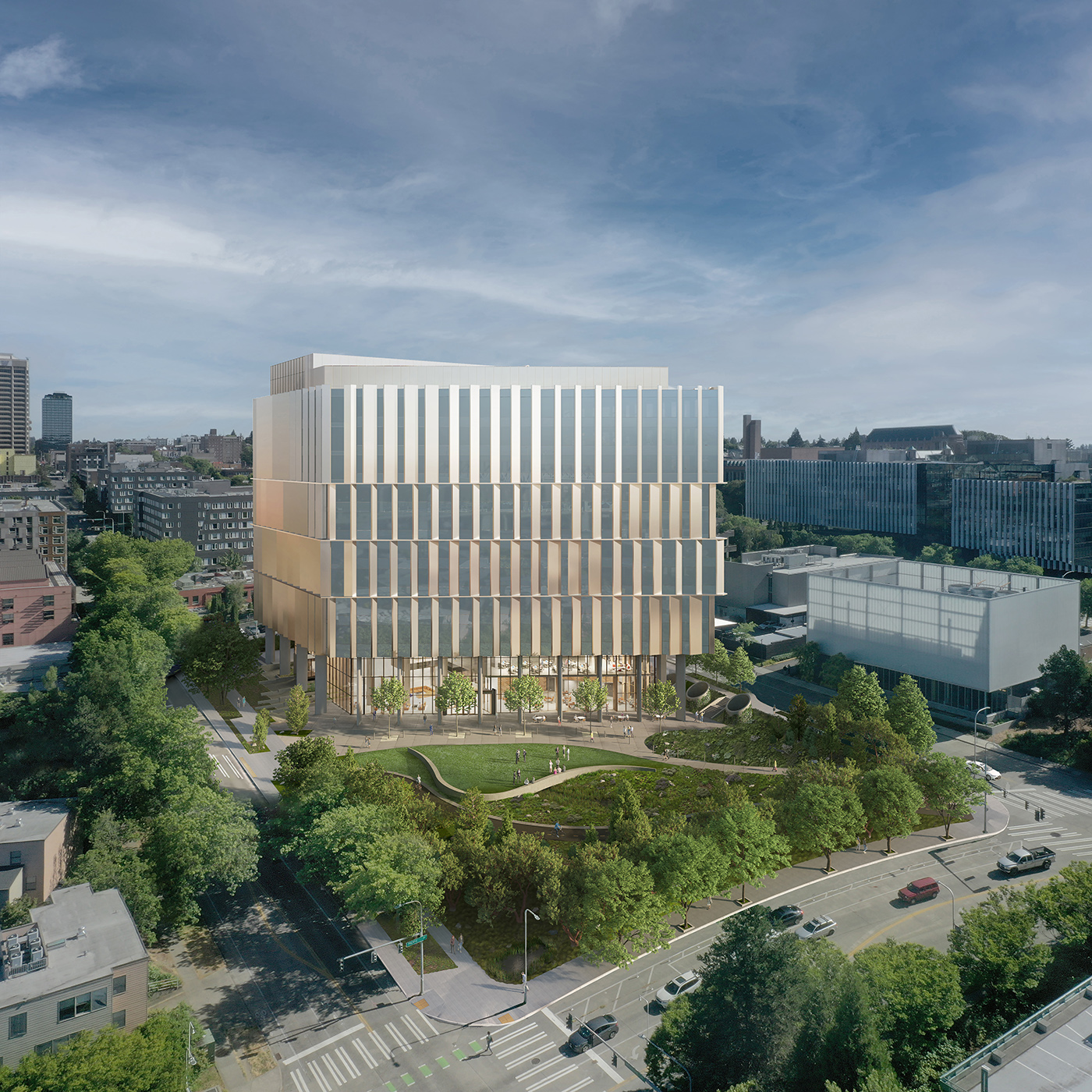
On its West Campus area, planning began nine years ago for the University of Washington to develop a significant new science and research building at 3919 University Way N.E. The proposal started as the W27 building and later became Brightwork. Over the same period, the West Campus became Portage Bay Crossing.
ZGF Architects designed the 11-story, 340,000-square-foot Brightwork building, with Wexford Science & Technology the developer, Whiting-Turner the general contractor, and Colliers the broker for the lab space. The project was initially valued at around $158 million, then upped to $282 million, and Wexford was to ground lease the property from the UW.
But, as GeekWire first reported this week, Brightwork is dead. The UW's Portage Bay Crossing website carries a February update that states, “Due to significant shifts in the broader economy, changes in the university funding landscape and evolving market conditions in Seattle since the project's selection in 2021, the University of Washington and Wexford Science & Technology have jointly decided not to move forward with the development of the Brightwork (W27) building at Portage Bay Crossing at this time.”
As the DJC reported in 2021, Wexford then won the university's RFP to develop the 1.3-acre site.
This year, however, all major U.S. universities — from the Ivy League to the West Coast — have been affected by the Trump administration's proposed federal funding cuts to basic science and research.
And even before the November elections, the tech and life-science sectors were confronting the rising costs of new construction and borrowing. An example on Eastlake was Fred Hutch's cancellation last year of its proposed Sloan Institute building; Fred Hutch opted instead to buy an existing building from Alexandria Real Estate Equities, rather than incur the higher cost of a new building.
And while there had been a pandemic bump to the life-sci market, the flame of that Bunsen burner has since cooled. Other life-sci projects from Alexandria and BioMed Realty in the Denny Triangle and South Lake Union remain on hold for all those same reasons. Over the past decade, per a recent market report from Yardi, SLU's life-sci inventory grew by 1.2 million square feet — not all of which has been absorbed.
Brightwork had once been envisioned to break ground last year. It never gained a master use permit or construction permit. There's a demolition permit for one old building on the north side of the Burke-Gilman Trail, which was to run in front of the new structure.
However, the 70-acre Portage Bay Crossing — aka PBX — is much bigger than the Brightwork building, which was slated to have private tenants in addition to the UW-affiliated Washington Clean Energy Testbeds, Institute for Protein Design and Brotman Baty Institute.
So, the 19 buildings once planned at PBX — over three decades — may yet proceed in a different fashion and scale. Those were once contemplated to have about 3 million square feet, thus creating “a dynamic, multidisciplinary urban community.” Alexandria has also sought to be a developer for that broader scheme.
And the UW's spring statement says that it “remains committed to fostering innovation, and will continue to monitor market conditions and evaluate the long-term potential of Portage Bay Crossing.”
So we're only a decade into the PBX saga, with more chapters to come. And the UW may decide, like Fred Hutch, that now's a better time to be a buyer than a builder.
Brian Miller can be
reached by email at brian.miller@djc.com or by phone at (206) 219-6517.


