 |
Subscribe / Renew |
 |
Contact Us |
| ► Subscribe to our Free Weekly Newsletter | |

Construction Bids
| home | Welcome, sign in or click here to subscribe. | login |


 print print  email to a friend email to a friend  reprints add to mydjc reprints add to mydjc |  |
July 11, 2025
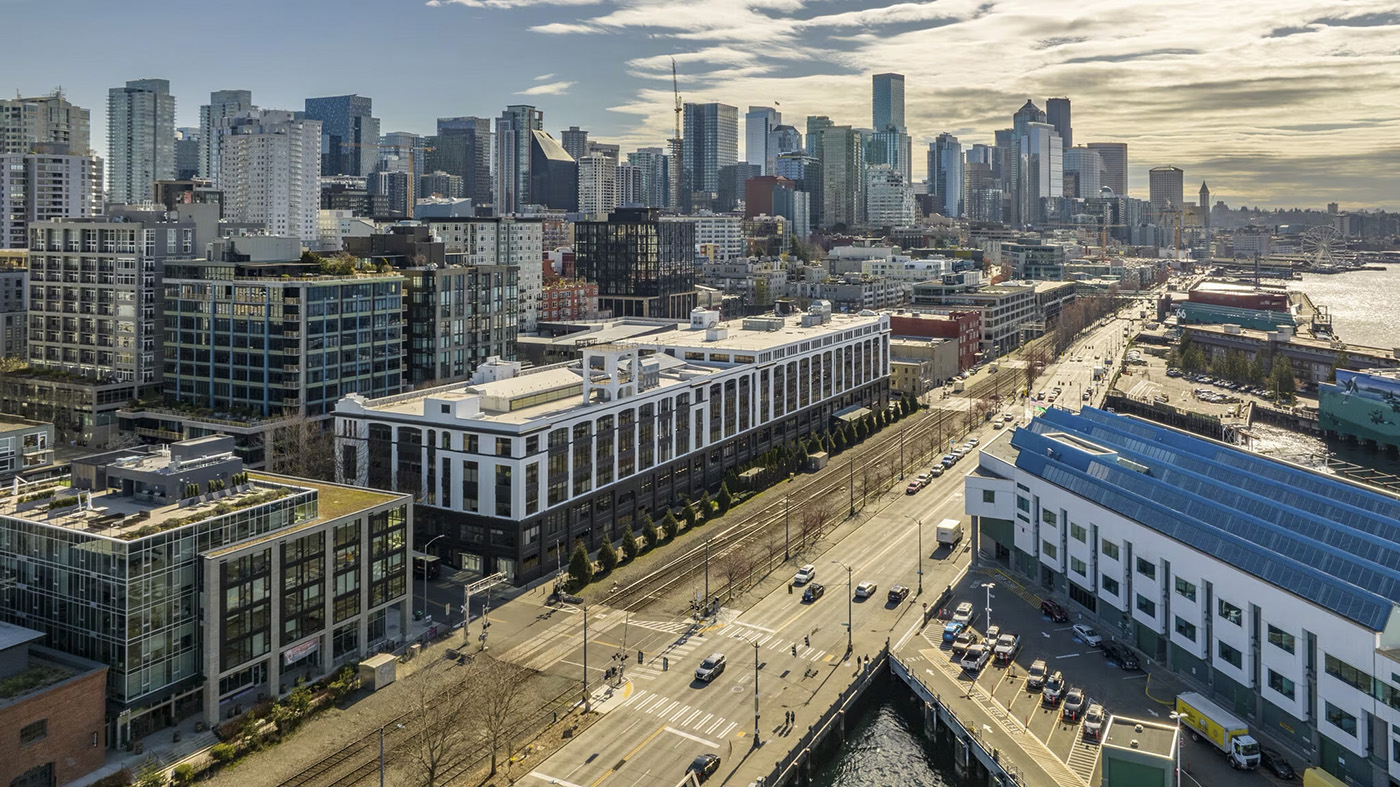
On the north end of the downtown Seattle waterfront, the former Zulily building, once the American Can building, has a new owner … and a new residential destiny. The all or mostly empty full-block complex at 2601 Elliott Ave. quietly changed hands in an April foreclosure sale. That was worth almost $81 million.
Prior owner Shorenstein Properties had acquired the property in 2015 for $185 million. Zulily decamped in 2023.
The new owner is Vanbarton Group, of New York, which also assumed the old $100 million loan from Wells Fargo. Buyer and seller both used LLCs in the deal, which hasn't previously been reported.
Then, in late May, Vanbarton and architect Gensler filed an early plan for seismic and structural improvements to the century-old complex. After that work, conversion to about 262 apartments is planned. The project entered the city permit process with a nominal value of $100 million. Design review isn't required.
Vanbarton, which recently sold the Danforth apartments on First Hill, has become something of a specialist in converting obsolete old office towers to apartments; and it often works with Gensler. In a few such cases, Vanbarton and partners have actually carved new central light shafts (!!!) into Manhattan high-rise towers, like putting a hole in an extremely tall donut.
Such details will come later for the very sturdily built 2601 Elliott, which presents as one structure. (Its two portions date to 1916 and 1925; the property also includes a separate 600-stall structured parking garage on its east side.) Extending corner-to-corner between Clay and Vine streets, 2601 Elliott totals about 360,000 square feet.
Gensler's early notes say that the ground floor of the five- and six-story building will become parking. It's not now landmarked, but the architect suggests 2601 Elliott may be submitted for such status. That could aid in getting federal historic preservation tax credits.
Besides new parking and amenity space, some of the bulky structure — with its very large floor plates — may be removed. There's now one skylight over the central atrium; more could be added. No structural engineer is indicated at this time. More names and details will emerge in the months ahead.
Vanbarton briefly mentioned the 2601 Elliott conversion in a recent press release about the conversion of a 20-story Manhattan office tower, in Sutton Place, that it purchased this week from the Roman Catholic Archdiocese of New York. That $103 million deal will eventually yield six new levels atop the old 1970s structure, with 420 units planned.
Its website says, “Vanbarton has been investing in the conversion of obsolete office product into efficient, highly amenitized, and enduring residential properties for more than a decade. Vanbarton's expertise in office-to-residential conversions allows us to identify and select the most feasible conversion candidates, typically focused in transit-oriented, Central Business District locations.”
The DJC was unable to reach Vanbarton before deadline for more details.
For now, 2601 Elliott looks west to Alaskan Way and the construction activity associated with the Elliott Bay Connections project. That'll wrap next year. A roof deck wouldn't be surprising, to take full advantage of the waterfront views.
The project would be Vanbarton's first building effort in our market. It entered these waters with its 2019 purchase, for $305 million, of the former Bank of California building, at 901 Fifth Ave. That was a pre-pandemic investment. Today, of course, one looks at the 41-story tower, developed in 1973, with different eyes. Could it convert? Are those floor plates small enough? We'll see.
Interestingly, at 2601 Elliott, there had been a prior conversion plan from Shorenstein, back in 2023, as the DJC first reported when the building became vacant. But life-science was then the notion, under SABArchitects.
The building was once dubbed the Seattle Trade & Technology Center. Others referred to it as the Art Institute of Seattle building. Shorenstein owned it twice: from 2021 to this past April; and from 2006 to 2015 (with Wright Runstad as a partner). Zulily leased almost all the space in 2013.
American Can departed in the 1970s; the building then became the Seattle Trade Center, with the new atrium added, housing various furniture and merchandise dealers. The 1990s saw new office users, under Martin Smith Real Estate; and RealNetworks later became the marquee tenant at 2601 Elliott.
Shorenstein, based in San Francisco, has long been a regular presence here. It partnered with Wright Runstad on the Spring District in Bellevue (with several office buildings since sold), and has a South Lake Union office plan that's currently on hold. Dubbed 9North, that seven-story project at 235 Ninth Ave. N. does have a master use permit. So Shorenstein hasn't completely exited our market.
Brian Miller can be
reached by email at brian.miller@djc.com or by phone at (206) 219-6517.


