 |
Subscribe / Renew |
 |
Contact Us |
| ► Subscribe to our Free Weekly Newsletter | |

Construction Bids
| home | Welcome, sign in or click here to subscribe. | login |


 print print  email to a friend email to a friend  reprints add to mydjc reprints add to mydjc |  |
November 18, 1999
By ANNU MANGAT
Journal A/E editor
Cutting edge research and antiquated facilities are no longer elements of the same formula. At Harborview's new Research and Training Building, the mysteries of science can now be unraveled in a $79 million facility, designed by MBT Architecture.
The new nine-story research and training center, on 325 Ninth Ave. in Seattle, formally opened in September, and over the last few weeks, researchers from the University of Washington have been moving into their new digs. The university manages the King County hospital.

Photos by James Frederick Housel |
Flexibility and simplicity are hallmarks of the new facility's design. It is equipped with 26 lab "modules" that can be rearranged as research needs change. University of Washington scientists at Harborview will be conducting research in several patient care areas, including trauma, neurological surgery, orthopedics, burns, AIDS, sexually transmitted disease and psychiatry.
The building was designed in contemporary Art Deco style to integrate it with older Harborview buildings. MBT Architecture, which has a local office in Seattle, devotes about 75 percent of its work to the design of scientific facilities.
Tully Shelley, president of MBT Architecture and lead designer for the building's interior, said the need for better and more pleasant laboratory facilities is driven, in part, by the growing prominence of the biotech and biomedical industry. "It's at the point where the UW and others are competing for the same minds. These environments are a great inducement for them to come here," he said.
|
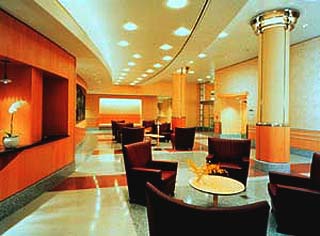
The 150-seat auditorium has seats, for example, wired to allow laptops users to simply plug in and connect to the Internet or to their desktop computers anywhere in the building. With state-of-the-art-the audiovisual equipment, the research and training center can also transmit and receive lectures for distance learning courses.
Achieving an open design was one of several challenges, Shelley said. At 180 feet wide and 35 feet long, the footprint of the new building was limited to a postage stamp-size lot -- which, he Shelley said, mandated the high-rise approach for the 180,000-square-foot building.
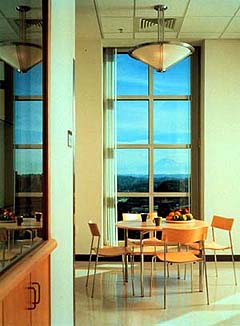
To make the high-rise more user-friendly and encourage interaction among scientists, stairwells lit by large, vertical windows traverse the length of the lab floors. Common areas on each floor are afforded generous views, also to provide a pleasant place for scientists to congregate.
Shelley said the specialized machines essential to scientific research require the support of specialized environments for heating, cooling and power. Architects designed a second-floor loading dock wide enough to take in deliveries such as large oxygen tanks and other lab equipment from tractor trailers. Power systems can be accessed from service closets on each floor, controlling functions for a specific lab while not affecting the operations of others. Circuit breakers were built with 40 percent extra capacity, as needs of the facility grow.
A host of other problems, such as relocating the city's steam lines and other underground infrastructure, also had to be tackled early on in the project. The emergency generator for the medical center, which was located in a pre-existing building, had to be "seamlessly relocated" while at the same time maintaining full back-up power, Shelley said.
Architects also had to set a corner of the new building back from the street, so as not to overshadow a historic neighboring building.
Like a number of contemporary buildings, balancing openness and security in a facility containing expensive equipment was another concern. The building can be locked from a remote location and uses infrared scanners to read computerized card keys. The system can be ratcheted up or down depending on the security needs.
Smaller details also illustrate MBT's commitment to functional design. "I just love these doors, " said Shelley, beaming with enthusiasm over doors for the training rooms that are held open magnetically to avoid the noisy, distracting "ka-chuck" of a heavy classroom doors opening and shutting. The auditorium, most of which contains rows of seats and retractable desks, also has several cushioned benches near the main doors in the rear. The benches, he said, accommodate latecomers and those who simply prefer to sit in the back.
|
Lab support areas, which are used less frequently than the lab rooms, are in the center of the building and receive less direct light. Many of the spaces are multipurpose, with corridors at the edge of the building on each floor, functioning as exits, as well as places for lab refrigerators and utility pipes. At the end of corridors on each floor are alcoves with large, vertical windows. Comfortable, movable furniture is nestled in the alcoves.
On a clear day, the building's height permits views of Mount Rainier to the south.
Harborview's new Research and Training Building is another notch in the belt of Seattle's growing biotechnology and biomedical market. Sharing Harborview's First Hill neighborhood is the new $37 million Benaroya Research Institute at Virginia Mason. The Fred Hutchinson Cancer Research Center, in the South Lake Union area, is another major player in the industry.
MBT has also designed the award-winning Genecor International's biotech lab in Palo Alto, Calif., in the Stanford Research Park. In the Puget Sound area, MBT has designed the Institute for Quantitative Systems Biology and Biomedical Research Labs for the University of Washington (with CNA Architecture); the University of Washington's Fialkow Medical Pavilion; and Commuter Rail stations in Kent and Tukwila for Sound Transit.


