 |
Subscribe / Renew |
 |
Contact Us |
| ► Subscribe to our Free Weekly Newsletter | |

Construction Bids
| home | Welcome, sign in or click here to subscribe. | login |


 print print  email to a friend email to a friend  reprints add to mydjc reprints add to mydjc |  |
March 16, 2001
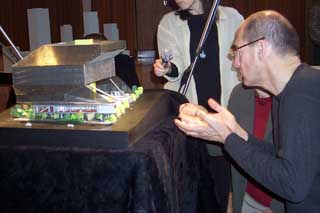
It took Dutch architect Rem Koolhaas less than an hour to silence the Seattle Design Commission on Thursday.
Photos by Sam Bennett |
Half-way through his allotted time with the commission, Koolhaas had addressed the remaining major issues on his $159 million library design and seemed to have won over the panel.
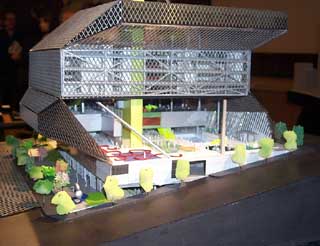
With the exception of signage and exterior lighting, the panel appeared satisfied that the "floating" platform design will live up to Koolhaas's promises.
"It just keeps getting better and better," said a joyful City Librarian Deborah Jacobs.
Koolhaas still has another meeting with the commission in June, as he completes design development and the process moves closer toward construction in August.
Photos by Sam Bennett |
Koolhaas's firm, the Office of Metropolitan Architects in Rotterdam, is working locally with LMN Architects. Hoffman Construction, builder of the Experience Music Project, is the general contractor.
The library's Capital Program Director Alex Harris said recent design modifications included eliminating one of two floors to be used as the Seattle Public Library staff headquarters. The staff will work on one floor instead, saving construction costs and allowing the staff to work more efficiently.
Harris said the modified 275-seat auditorium will connect the two main entry levels of the building, at Fourth and Fifth avenues. Koolhaas had originally located the auditorium at the Fourth and Spring corner of the building.
"The auditorium has become the centerpiece," said Design Commission member Jack Mackie. "One of the things the Design Commission is looking for is the urban design implications of the building and how it serves a nine-block area. The [auditorium] provides a mid-block hillclimb assist. It's a broader gift to the neighborhood."
With a sloped plane to the stage, and elevators and escalators on either side of the auditorium, the space will invite people to "stumble upon public discourse," Mackie added.
Other enhancements to the design discussed Thursday include the use of tinted glass where it is needed to reduce solar gain. The copper-colored mesh on the outside of the glass has been eliminated. Koolhaas, responding to a commission member's request the building not be opaque, said he would increase the percentage of clear glass where possible. From the outside, he said the glass would not be reflective.
The glass skin will wrap around a lattice-like system of steel tubing. The tubing will act like diagonal braces and provide lateral support to manage earthquake and wind loads.
The Fourth Avenue side will have what Koolhaas termed a "romantic garden," including evergreen trees and a fountain. The building's unique overhang will cover the entire boundary on the Fourth Avenue side. Trees of several varieties will line all four sides, and inside, Koolhaas said, he may use carpeting with images of trees and foliage.
The tall, slender Koolhaas, winner of last years Pritzker Architecture Prize, drew a standing-room-only crowd to Thursday's meeting at the Central Library. Working with assistant Joshua Ramus, Koolhaas happily backtracked through the program design process for newer commission members and spoke energetically about the library project.
"It's exciting to do libraries," he said. "They're not just about books."
Commission member Cary Moon reflected the commission's general approval of the floating platform structure. Books will be arranged along the spiraling floors following the Dewey Decimal system. "It's not a textbook urban design, but it's carefully inventive," Moon said. "Hopefully, it can be a catalyst for other buildings downtown."


