 |
Subscribe / Renew |
 |
Contact Us |
| ► Subscribe to our Free Weekly Newsletter | |

Construction Bids
| home | Welcome, sign in or click here to subscribe. | login |


 print print  email to a friend email to a friend  reprints add to mydjc reprints add to mydjc |  |
October 28, 2009
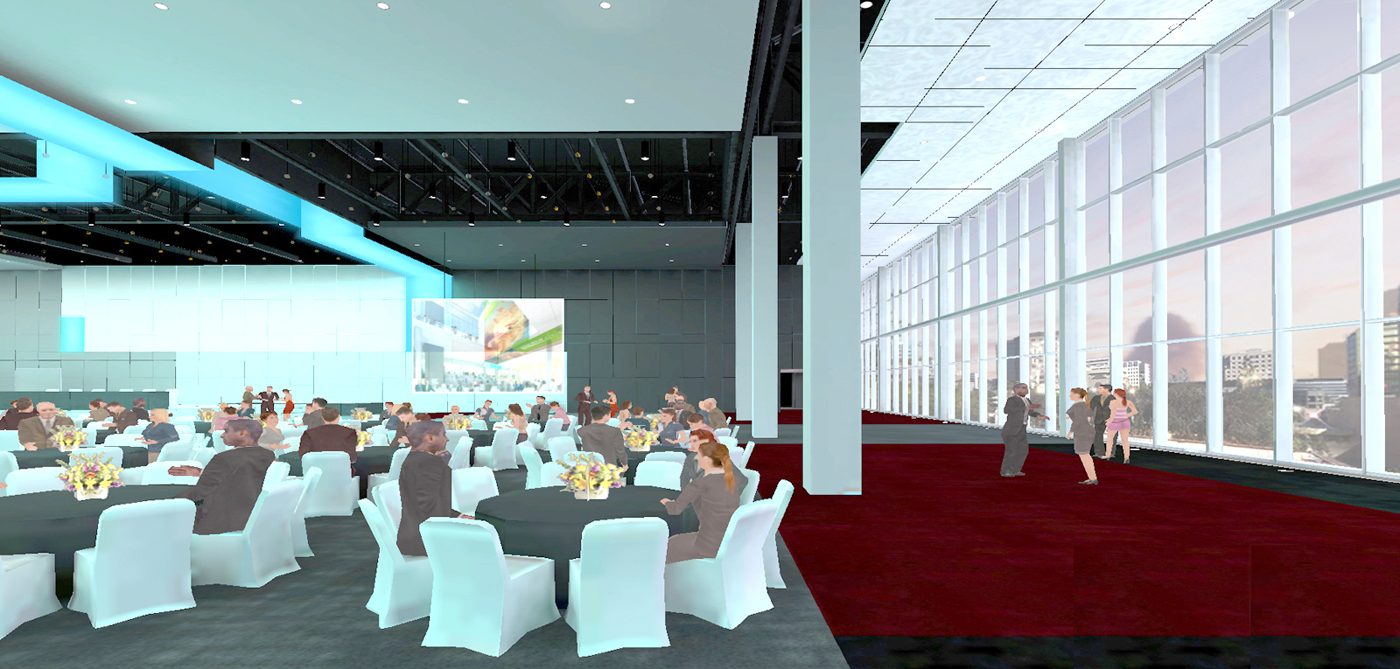
As they designed an expansion of the San Jose, Calif., convention center, architects at LMN came up with a number of ideas. They were not, however, sure how they would work and what the client would think.
First there was the upper floor ballroom. What would it look like when set up in different sizes, and what about views outside when interior walls were taken down?
Lighting was another issue. “[It] was going to be very theatrical in how it could change the sense of the room,” said LMN's Erik Indvik, an architect and design principal.
LMN could have created traditional renderings, but Indvik said that would not have adequately conveyed the changes.
So LMN turned to the Seattle firm Studio 216 to help tell the story using new technology that allows clients to “play” their projects using something Studio 216 calls architectural gaming.
A fly-through video gives viewers a set tour, but this virtual reality-like tool lets people use a computer to navigate through a project as they wish. Using arrow buttons and a computer mouse, users can move around through a space and test different scenarios.
| Check it out |
|
To test drive architectural gaming, click here. Use your computer’s directional arrows and mouse to navigate through part of the planned expansion of the convention center in San Jose, Calif. The test drive requires users to register on the Studio 216 Web site. |
“It was very interactive,” said Indvik. “It was like a game.”
Clients and designers can both get answers to their questions without having to request another rendering or fly-through video.
For NBBJ, Studio 216 set up an architectural gaming tour of Valley Medical Center's new Emergency Services Tower. Nurses and other staff members could see how long it would take them to get from one place to another, walking or running.
Studio 216, which has seven employees in Shanghai, China, was founded in 2006 to help designers and others visualize projects with still images and motion pictures. The firm began devising architectural gaming this year. Principals Boaz Ashkenazy, Charlie Choo and Jamie Fleming, who trained as architects, saw advances in the video gaming industry and realized the possibilities.
“We wanted to borrow the concept and apply it to capital projects,” Ashkenazy said. The firm doesn't plan to patent the tool, which uses existing software: 3D Studio Max and Quest 3D.
Architectural gaming files are surprisingly small and easy to use. “All you need is a keyboard and a mouse,” Ashkenazy said.
Applications for architects and contractors are numerous. Designers can use the technology for solar and sight line studies. Contractors can sequence projects, simulate the staging of sites and gauge crane sight lines.
As collaboration among AEC teams becomes more common, the tool will become more valuable, according to Studio 216 principals. “We help people see the future of their project. We can come in early and help fill in the gaps to avoid change orders,” Ashkenazy said.
Other groups could use architectural gaming. Colleges, for instance, could show prospective donors how a building will look. Lenders can get a better understanding of what kind of project they're being asked to finance.
Public agencies could use the tool for community outreach on large projects and to do disaster planning. Archaeologists might be able to model ancient sites.
“There's also a consumer side eventually,” said Ashkenazy. Hotel guests and golfers, for instance, could tour rooms and courses before making reservations or scheduling tee times. Hospitality companies might use it to plan events.
Ashkenazy and Choo said the cost of creating a game depends on the scope of the project. They wouldn't say how much the Valley Medical or San Jose games cost to create. It took Studio 216 about eight weeks to design the latter, though they said it could have been done faster.


