 |
Subscribe / Renew |
 |
Contact Us |
| ► Subscribe to our Free Weekly Newsletter | |

Construction Bids
| home | Welcome, sign in or click here to subscribe. | login |


 print print  email to a friend email to a friend  reprints add to mydjc reprints add to mydjc |  |
August 18, 2004
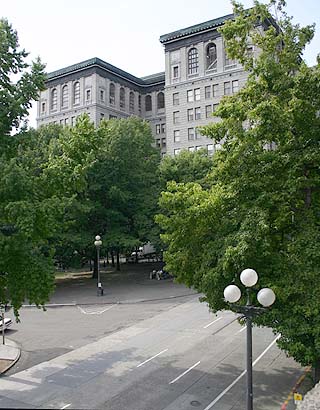
Photos by Benjamin Minnick
The 88-year-old King County Courthouse’s historic exterior was left intact. Skanska will complete an $8.5 million face lift for the lobby in February. |
It may not look like much for $86 million, but anyone who is in the King County Courthouse during the next earthquake will probably think the bill for seismic improvements was money well spent.
Skanska, the county's general contractor, completed the project on schedule last Friday after 22 months of work, often double shifts.
Most of the improvements are now buried in the walls of the 88-year-old courthouse — a good thing since the building and some of its 37 courtrooms are on the National Historic Register.
Seismic work started at the foundation, which was beefed up by adding concrete and steel to support new structural elements above.
Workers found that dirt had disappeared below the existing slab, leaving two-foot gaps in some places. Jim Napolitano, major projects manager for the county's Facilities Management Division, said under some parts of the foundation you could see from one end of the block to the other.
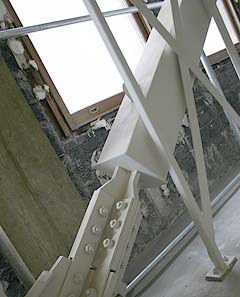
Yielding braces absorb energy from earthquakes.
|
Napolitano said it was likely that high tides over the years leached out the dirt. Gravel was used to fill the void.
Since the building is H-shaped, a lot of forces come into play during an earthquake. To fend off that energy, and to add strength, 48 diagonal yielding braces were installed on the north and south perimeter walls.
The braces use technology developed in Japan that is being introduced here.
Tina Gilbert, Seneca Real Estate Group project manager, the owner's representative, said the braces are steel tubes filled with concrete. They move during an earthquake, absorbing energy by stretching or compressing up to 8 inches.
Napolitano said the courthouse was the first public project to use this technology in the state. "This is very, very new technology," he said. "There's hardly any (yielding braces) in the United States."
Interior walls were outfitted with more traditional steel and concrete beams connected to 96 fluid viscous dampers that act like shock absorbers during a temblor. To make the beams, concrete often had to be poured from the floor above because of tight access.
Connecting the beams and dampers to the building required drilling about 38,000 holes into concrete columns, which were then wrapped in carbon fiber at the tops and bottoms.
Additional seismic fortification comes from 20 new shear walls located throughout the building.
"These guys have put everything they have learned in structural engineering school to work in this building," Napolitano said.
The result? The courthouse is designed to withstand a 500-year seismic event and slightly exceeds the building code for new structures, according to Napolitano.
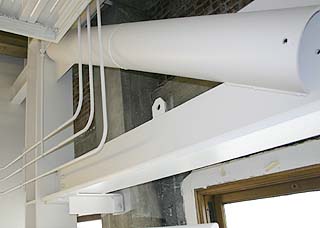
Crossbraces are used along with yielding braces to add strength and seismic stability.
|
"It's a pretty safe building," he said.
Most of the work was performed while the building was occupied. "It's analogous to repairing your car engine while it's still running," Napolitano said.
The seismic project is the largest chunk of a total of $105 million being put into the building, including new HVAC, fire alarms and sprinklers.
The most visible piece, the last of the puzzle, is an $8.5 million face lift for the lobby that Skanska is expected to finish in February.
The lobby renovation includes 10 new intelligent elevators.
Napolitano said it would have cost about $250 million to replace the building.
The project team included: The Seneca Real Estate Group, development manager; Coughlin Porter Lundeen, structural engineer; Stickney Murphy, architect; and Flack + Kurtz, mechanical/electrical engineer.


