Welcome, sign in or click here to subscribe.
Login: Password:


  Construction

Email to a friend   Print   Comment   Reprints   Add to myDJC   Adjust font size

August 30, 2012

Puget Sound commuters ready for more light rail

  • Sound Transit is building another 36 miles of light-rail line, mostly in five major projects.
  • By AHMAD FAZEL
    Sound Transit

    mug
    Fazel

    The past decade brought plenty of light-rail construction, with the 2009 opening of Link light-rail service moving rapidly into constructing the University Link extension. The coming decade will give Sound Transit the opportunity to really show what it can do.

    Between now and 2023, the agency will build up to 36 miles of light-rail extensions approved by voters in 2008 as part of the ST2 service expansion. This includes moving forward with five major light-rail projects while supporting the region’s economic recovery by creating more than 100,000 direct and indirect jobs.

    Stay informed about upcoming Sound Transit contracting opportunities by registering at www.soundtransit.ebidsystems.com.

    Here’s a look at what’s under way and what’s in the pipeline:

    University Link
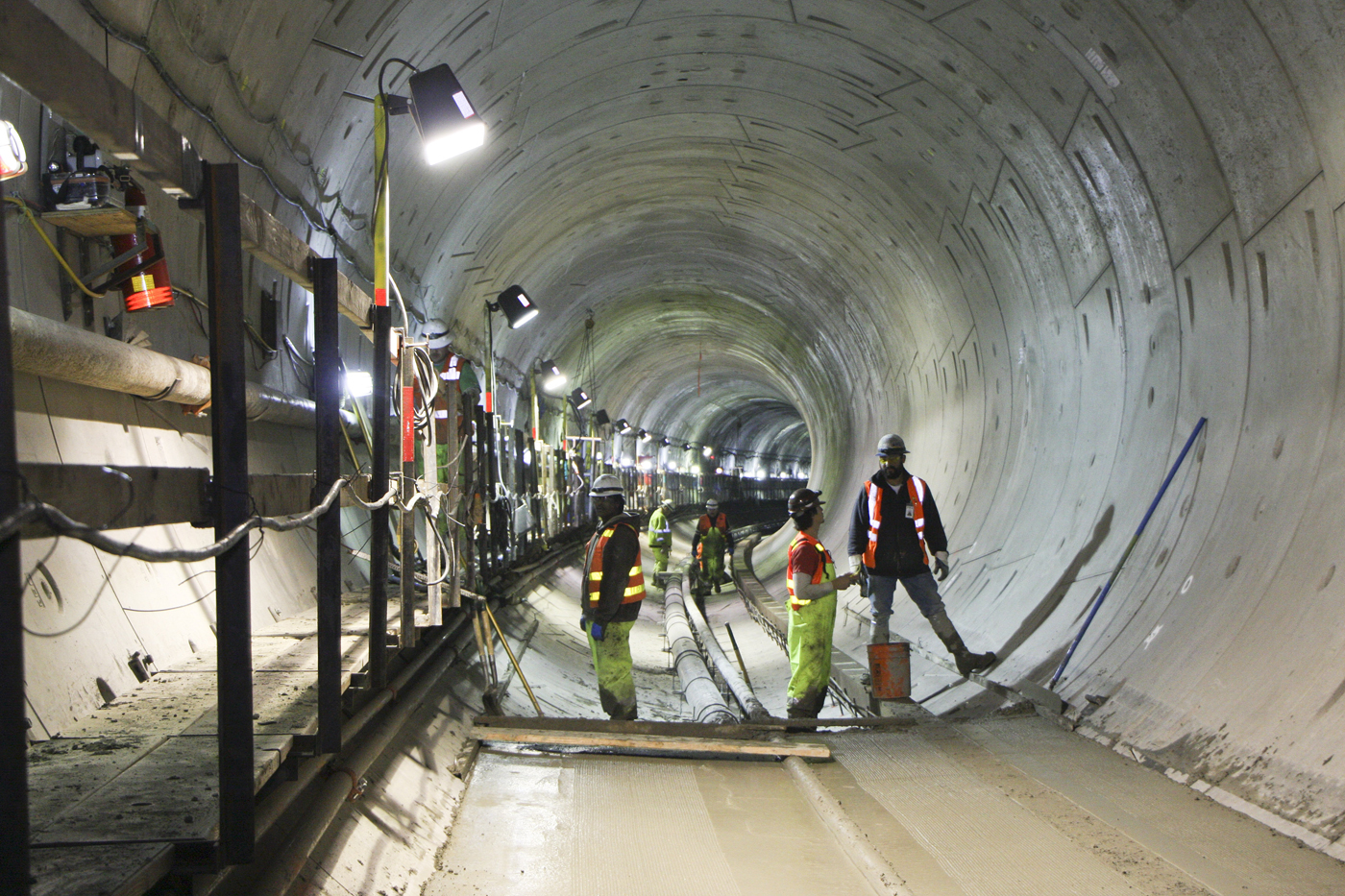
    Images courtesy of Sound Transit [enlarge]
    Workers pour a concrete slab in one of the University Link light-rail tunnels, which open in 2016.

    Construction of the 3.2-mile underground University Link light-rail extension from downtown Seattle to Capitol Hill and the University of Washington continues moving forward on schedule to open in late 2016. Earlier this year contractors completed mining the twin tunnels and are working on the cross passages between the tunnels that are necessary for fire, life and safety protocols.

    Station construction at the UW site adjacent to Husky Stadium is well under way and construction for the Capitol Hill Station is scheduled to begin next year. Power, control and communication systems contractors will start their work in the tunnels in 2014 as the last steps before final train testing.

    Northgate Link extension

    Sound Transit broke ground earlier this summer on the 4.3-mile light-rail extension from the UW to Northgate. The $2.1 billion line is mostly underground and will include stations at Northgate Mall, the Roosevelt neighborhood and University District near the west side of the UW campus.

    Site preparation work has begun at the Roosevelt and U District station sites, and the major station excavation and tunneling contract for the project should be out for bid in the second quarter of 2013 with that work getting under way in the fourth quarter of 2013. The station finish contractors are scheduled to begin work in 2016 and 2017. The line is scheduled to open in 2021.

    Lynnwood Link extension

    Sound Transit will extend light rail 8.5 miles north from Northgate to Lynnwood with at-grade rail service mostly along the Interstate 5 corridor. The project team is completing the draft environmental impact statement, scheduled for publication in 2013.

    Twin tunnel boring machines that mined the light-rail tunnels from the UW to Capitol Hill are being dismantled at the Capitol Hill Station site.

    The draft EIS will identify the potential benefits and impacts associated with building the route and stations at the following locations along I-5: Northeast 130th Street, Northeast 145th Street, Northeast 155th Street, Northeast 185th Street, 236th Street Southwest, 220th Street Southwest, and the Lynnwood Transit Center. A total of 13 alternative alignments and stations are being considered.

    Preferred alternatives for the alignment and station locations are expected to be ready for preliminary engineering and a final EIS in the summer of 2013.

    Construction is scheduled to begin in 2018 with the line opening in 2023.

    East Link extension

    The East Link extension will connect Seattle and the Eastside with light-rail service running across the Interstate 90 floating bridge to Bellevue and the Overlake neighborhood near the Microsoft campus. The line will include stations at I-90 and Rainier Avenue in Seattle, Mercer Island, south Bellevue, downtown Bellevue, Overlake Hospital, the Bel-Red neighborhood and Overlake.

    East Link is in final design with special emphasis on engineering track connections for the floating bridge segment and final alignments through south and downtown Bellevue. Construction is scheduled to begin in 2015 and the line will open in 2023.

    South 200th Link extension

    The South 200th Link extension consists of 1.6 miles of elevated light-rail tracks along 28th Avenue South extending from the existing SeaTac/Airport Station to a new elevated station spanning South 200th Street.

    The South 200th Station will serve as the southern terminus for Link until the rail line extends farther south and will include a 700-space parking garage and up to 400 additional temporary parking spaces.

    In September, the Sound Transit Board will be asked to approve the selection of a contractor to design and build the guideway, station, track work and systems. After contractor selection, major construction on the $383 million project will begin in late 2013.

    Getting to Federal Way

    Sound Transit has begun early planning and environmental work to extend mass transit 7.6 miles from South 200th Street in SeaTac to Federal Way, with stations in Kent/Des Moines near Highline Community College and in Federal Way near South 272nd and 320th streets. A public process beginning this fall will explore alignment options.

    In the coming years the agency will continue working with local communities on options for addressing the major impacts of the national recession on funding for expanding mass transit. With an estimated 32 percent reduction to South King County’s revenues for delivering ST2 projects, current financial projections show sufficient Sound Transit revenues to reach Kent/Des Moines by 2023. The environmental work that is getting under way will establish a shovel-ready plan for extending light rail all the way south to the Federal Way Transit Center and help identify costs and options for getting there.

    Tacoma Link

    Sound Transit is also in the early stages of gathering public comment on possible options for expanding the Tacoma Link system that operates between the Tacoma Dome and Theater District stations.

    The 1.6-mile line, which began operation in 2003, serves 3,800 riders at six stations each weekday. Last year, nearly 1 million riders used the system.

    Ridership increases

    The 16 miles of light rail that Sound Transit opened in 2009 between downtown Seattle and Sea-Tac International Airport gave our region its first taste of a long-anticipated mass transit rail system. Link has generated double-digit ridership growth every year, including a 12 percent jump in 2011 over 2010. The line currently carries about 28,000 riders every weekday and has become a hugely popular way for fans to get to Seattle Seahawks, Sounders and Mariners games.

    Following the scheduled completion of the ST2 light-rail projects in 2023, Link ridership is projected to grow to more than 280,000 each weekday by 2030 as the Puget Sound region grows by more than 2 million people. Those 280,000 riders will enjoy fast, frequent and reliable service 20 hours a day. Each one of them will avoid experiencing and adding to rising congestion as the region’s population grows.

    This is the future that our staff and those who work for our many public and private partners keep in our sights as we move these projects forward.


    Ahmad Fazel is executive director of Sound Transit’s Design, Engineering and Construction Management Division. He was the executive director of Link light-rail during Central Link construction.


    Reader comments

    Re: Puget Sound commuters ready for more light rail
    Could Director Fazel please explain why the Puget Sound Regional Council estimates of ridership are only half those he is quoting as the major benefit of all this construction?
     
    Some of his ridership projections don't pass the 'giggle test' and leave one wondering if the rest are equally suspect.
     
    15,000 daily boardings at Lynnwood TC would be 100 packed buses arriving every hour during the 3 hour morning commute period, or double the number of buses traveling through the current transit tunnel in Seattle today. Perhaps it's all the cars veering off I-5 into the parking garage spaces that aren't planned for.
     
    For the multi billion price tag, surely we deserve a short answer to his leap of faith number.
    Mike Skehan
    Mon Sep 3, 2012 9:36 am

    Re: Puget Sound commuters ready for more light rail
    While the headline above claims that Puget Sound commuters are "ready for more light rail" the reality is that our commuters are not ready for today's Seattle light rail in operation since 2009.


    Forecasts of ridership are an important justification for investment in mass transit. Sound Transit rail ridership is not meeting its forecasts so far -- not on light rail and not on Sounder commuter rail.


    In fact the agency now provides clues that it has given up on ever meeting the 47,500 daily average weekday forecast for the airport light rail line as operating in its current configuration.


    By now, three years after opening, given promises made all during the 13 years before opening in 2009, one can surmise that the airport line would be expected to get to at least 40,000 customers on a really good ridership day. In fact, the maximum single day paid ridership reported to date is 33,543 last June 15. And ridership is as good as it is only because of airline travelers and ball game fans, not daily regular commuters who have failed to show up as expected.


    The enormous discrepancy between the planning office ridership forecast from Puget Sound Regional Council and the forecast of the rail agency itself is documented in a web page from Public Interest Transportation Forum that comes up quickly by entering "Sound Transit profound differences rail ridership" into the Google search engine.
    John Niles
    Mon Sep 3, 2012 6:08 pm

    Re: Puget Sound commuters ready for more light rail
    DJC, could you fact check your comments?


    The projection for Link ridership in 2020 - eight years from now - is 45,000. That will be handily surpassed. Niles likes to mix projections for future years with measurements today.
    Ben Schiendelman
    Wed Sep 5, 2012 1:08 pm

    Re: Puget Sound commuters ready for more light rail
    You can't ride it if it doesn't go where you're going.


    For myself, the light rail is nearly useless until it reaches Northgate. I've considered taking it to the airport, but for an early morning flight there's not enough early morning bus service to the downtown transit tunnels, so again it doesn't yet work for me. I'd rather spend $40 on a cab than wake up 90 minutes earlier to catch a 5am bus.


    But I have no problems believing that, when light rail goes from Lynnwood to the airport, there will be a lot more riders than there are today.
    Matthew Fleming
    Wed Sep 5, 2012 1:40 pm

    Re: Puget Sound commuters ready for more light rail
    I do not own a car, nor do I ever intend to again. As an MBA at the U, I am the future Seattle commuter. I would not consider living in a city without sophisticate mass transit such as the light rail and street car system- mass transit is a hugely important investment in the future of the city. Even though the system doesn't yet reach my Capitol Hill neighborhood, I still ride at least once a week for one reason or another.
    Edward C.
    Wed Sep 5, 2012 10:12 pm

    Re: Puget Sound commuters ready for more light rail
    These light rail expansions are exactly the kind of infrastructure investments Seattle needs to secure its economic future. As soon as $7/ gallon gas and the reality of climate change set in, well be kicking ourselves for not building these lines faster.


    Now what we need is to aggressively streamline the development process the way LA mayor Villaraigosa has done. We need to build 30 years of light rail in 10 years. Time to man up, McGinn!
    David Perlmutter
    Thu Sep 6, 2012 9:06 am

    Re: Puget Sound commuters ready for more light rail
    Regarding Lynnwood, Sound Transit has not published station-level ridership projections for the extension between there and Northgate. We estimate about 52K average weekday riders for that extension by 2030. Station-level estimates will be developed once we move into a final EIS after the ST Board identifies a preferred alternative.


    The commentor may have been referring to the Northgate Station boarding estimates, which are about 15K daily boardings. Northgate is a major transit hub today and we're confident the addition of fast light rail service will make it an even bigger draw for riders looking for a fast way through one of the most congested corridors in the state. It will be an interim terminus, much like Westlake and Airport are today - which are already near their 2020 station-level boarding projections.


    The Central Link line opened in 2009 amid the worst recession since the Great Depression yet it continues to show double-digit ridership growth three years after opening. The line is still maturing. Generally, most new systems level off after a couple years. Link is bucking that trend and will see a major spike when the University Link extension opens in 2016.


    As for the long-range ridership forecasts Sound Transit developed for the ST2 plan - these were based on industry-standard best practice methods and models. Before going to the ballot in 2008 an independent expert review panel vetted the planning assumptions and found them sound. We stand behind our long-term projections and look forward to building out the system a majority of regional voters asked for.
    Bruce Gray - Sound Transit Spokesman
    Thu Sep 6, 2012 11:37 am

    So what's the tax cost of this going to be?
    I sent an e-mail to the ST CFO to get some clarification on this, but no response.


    I understand the ST2 measure just had cost estimates, and that some of the final figures are known now, but I can’t find them. What is the tax cost going to be of the ST2 financing plan? The big driver of the tax costs are the pledges in the bond sales contracts to collect the taxes at or near the maximum rates while any of the bonds are outstanding. There supposedly will be ~$8.5 billion in long term bonds sold, but what that means in terms of the necessary taxing to secure them hasn’t been disclosed.


    We can get a sense of the magnitude of the huge taxing scheme targeting people here from this Sound Transit document:


    http://crosscut.com/static/static_file/2010/04/20/soundtransit1.pdf


    That is from early 2010. It shows that through 2040 the tax collections necessitated by the bond sale contract security pledges will be over $44 billion. Those projections were prepared before the significant downward revisions of the tax revenue forecasts for the near term, but the $44 billion figure as of 2040 may still be accurate.


    Those recent near-term lowered tax revenue revisions from Sound Transit staff mean: 1) the bulk of the bonds would need to be sold later than what was anticipated for that document, 2) the amount of debt outstanding in 2040 will be greater than what the footnote shows (“$4.9 billion; Interest Balance = $2.1 billion”), and 3) there won’t be the reserves shown on that exhibit, which could have been used to pay off bonds on an accelerated basis in the 2040’s.


    That exhibit shows the annual tax collection level in 2040 at the $2.3 billion level. That massive level of taxing might need to continue for 15 years after that, due to the bond sale contract security pledges Sound Transit uses which require it to continue taxing at or near the maximum rates while any of the bonds are outstanding. That means the tax costs to the public of financing the approximately $13.5 billion of ST2 capital costs could well reach $85 billion. Is that a fair estimate, Ahmad?
    Mr. Baker
    Thu Sep 6, 2012 2:13 pm

    Re: Puget Sound commuters ready for more light rail
    John Niles writes: "Forecasts of ridership are an important justification for investment in mass transit. "


    Nope. Ridership forecasts only are important for FTA grants. They played no role in justifying the overwhelming public support for Sound Transit's plans. They also are irrelevant to the financing package -- fare revenues aren't even used for the capital costs (of course they offset operations costs).


    Get over it John, you lost. You and Kemper can go whine about it in Bellevue!
    Perry Whiteside
    Thu Sep 6, 2012 3:07 pm


    Other Stories:

    Search Stories
     Find:
     With:
     In:
     Depth:
     Sort by:
    Advanced options

    --