 |
Subscribe / Renew |
 |
Contact Us |
| ► Subscribe to our Free Weekly Newsletter | |

Construction Bids
| home | Welcome, sign in or click here to subscribe. | login |


 print print  email to a friend email to a friend  reprints add to mydjc reprints add to mydjc |  |
December 30, 1999
By JON SAVELLE
Journal Environmental editor
Mount Rainier National Park is a great place to visit, but you wouldn't want to camp there all the time.
In fact, if you worked there, you'd probably want to live in the new Paradise dormitory, a building built to take the extremes of cold and snow at the mile-high elevation of Paradise Center.
Designed by Jones & Jones Architecture and built by Charter Construction, the building features a massive concrete foundation, oversized wood beams, wood siding and a copper-clad, steeply sloped roof. It will house park staff and provide covered storage for bulky snow-removal equipment.
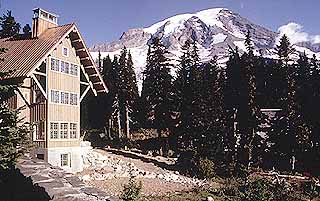
Photo courtesy of Charter Construction |
The contract was reached through "fast-track competitive negotiations," rather than by taking the lowest bid. Under this approach, the Park Service's Denver Service Center, which awards construction contracts nationwide, puts the emphasis on evaluating a contractor's capabilities and not on price alone.
In a fast-track program, which is used for projects costing $3 million or less, the entire process of contractor review and negotiation takes about 65 days.
Rod Keiscome, contracting officer for the Denver Service Center, said the review allows the Park Service to know what it is getting when it hires a contractor.
"You are working with a known entity, looking at their experience and ability to do the job for a certain price," he said.
Contractors agree.
"The Park Service is trying to find a more efficient way to deliver projects," said Charter President Frank Firmani. "They want the opportunity to select the appropriate contractor for historically significant buildings. They're tough buildings (to build), and they want a good job at a reasonable price."
Paradise was one of the first Park Service projects to be contracted via competitive negotiations. Keiscome said the process effectively weeded out the contractors who pad their profits with change orders and claims.
"There are some shady contractors out there who just put in claims and try to get the most out of the government," Keiscome said. "It has been a problem with all the agencies who do sealed bids.
"In competitive negotiations, you have more advance notification. You check references very completely."
For contractors, much depends on the information they submit to the Service Center. The Park Service usually requests the following resume:
l A two-page history of the contractor;
l Descriptions of similar work in the last five years, covering not more than 10 projects;
l The experience, training and qualifications of key personnel;
l Subcontractor references (creditors and suppliers); and
l A total cost breakdown in the format of the Construction Specifications Institute.
Keiscome said contractors quickly learn how to turn in an effective resume. But leaving pertinent information out, even if it is negative, can hurt their chances because the Park Service may learn of it from another source.
If a number of contractors are found to be equally well qualified to do the project, the final selection is likely to be based on price. It was a combination of qualifications and price that won the Paradise job for Charter Construction, Keiscome said.
Charter normally avoids public work because almost all of it is based on low-bid awards. Instead the firm specializes in high-end residential and commercial jobs.
But the Paradise project was an exception. Firmani said the competitive negotiation process made the job attractive to Charter, and the Park Service got the kind of work it was looking for.
"This is kind of a poster child for the Denver Service Center," Firmani said. He added that the Park Service staff, both at Mount Rainier and in Denver, were highly talented and professional. Firmani would do another job with them "in a heartbeat."
"It was like a big love-in up there," he said. "The job was completed ahead of time, there were no disputed extras, and the closeouts have (had no problems)."
That's a remarkable record, considering the difficulty of the project. Firmani said the site is 85 miles away from the nearest materials supplier, and last winter Paradise was buried under 944 inches of snow. A short building season -- May to October -- complicated matters, as did the single access road and tourist traffic. The project also involved demolition of an existing dormitory and removal of asbestos tile and contaminated soil.
For the Park Service, competitively negotiated contracts are the way to go. Paradise was one of the first to be used, but now the Denver Service Center is awarding 90 percent of its contracts through the fast-track process. The center handles 25 or 30 construction projects each year.
According to Keiscome, the new system works. In the last 18 months, he has not received a single contractor claim stemming from a competitively negotiated contract.
"The bottom line is, the contractors we're dealing with are the types you would like to work on your home," Keiscome said.
Though successful so far, the process can be improved, Keiscome added. For the Park Service, it's mainly a matter of educating project managers and technical staff on how to evaluate proposals. And for contractors, it's a question of becoming familiar with the process and honing their presentation skills.
It's a two-way street: the Parks Service will hold debriefings with any of the contractors who didn't win a given contract, and they in turn will provide feedback to the agency.
"It's an exciting wave of the future as far as I'm concerned," Keiscome said. "It's hard for me to understand why we didn't do this long ago."


