 |
Subscribe / Renew |
 |
Contact Us |
| ► Subscribe to our Free Weekly Newsletter | |

Construction Bids
| home | Welcome, sign in or click here to subscribe. | login |


 print print  email to a friend email to a friend  reprints add to mydjc reprints add to mydjc |  |
April 20, 2000
Ed Guy's business card could read catalyst for change. The description would be more fitting, if not catchier than his formal title of information technology consultant.
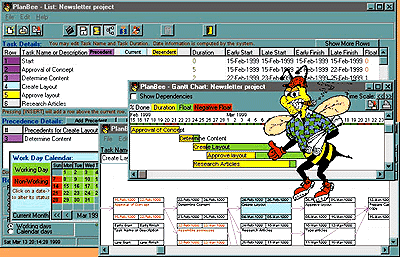
In either case, the Vancouver, B.C. businessman's goal is to make our lives simpler through developing task software. Guy's newest product, PlanBee, is what he calls a critical path project management tool.
Advertised as easier than most spreadsheets, yet with a similar interface, PlanBee helps businesses or individuals sort out priorities and timelines for large projects or business ventures.
Whether a company uses the program to plan home building or an individual is planning to produce a newsletter, Guy said PlanBee establishes a template for all activities and reduces inefficiencies by eliminating lag times.
|
Guy said a British professor, Albert Battersby, brought the critical path planning process into the public's eye in the early 1960s, after learning of a train robbery in which the robbers meticulously planned dozens of events in a timeline -- from the robbery itself to the money laundering.
In his 1964 book, "Network Analysis for Planning and Scheduling," Battersby used the train robbery as an example of critical path planning at its best. Guy said DuPont had also incorporated critical path planning in chemical plant construction projects in the late '50s.
"Critical path planning is when you're planning to get a lot of things done at the same time," Guy said. "The activities along the critical path are those that most affect the time of the total project. PlanBee will tell you what is time-sensitive on any project." In homage to the train robbery that gave rise to the term critical path, Guy includes a Great Train Robbery scenario as a sample project for beginners on PlanBee.
Having worked in the public and private sectors as a software development specialist, Guy prides himself on slashing budgets through developing and acquiring better software programs.
Guy worked in the late 1980s and early '90s with British Columbia's Industrial Relations Council as manager of information systems. "I was always looking to get the best deal," he said.
Guy also worked as supervisor of systems design programming on the Arctic Gas Project in the early- and mid-70s, coordinating planning and scheduling for the massive project. For that project, he turned to mainframe computers for scheduling, but the advent of PCs has made project planning more widespread with broader applications, he said.
Both experiences helped him develop the foundation for PlanBee, which was in early release last summer and officially released in January.
Microsoft offers a project planner of its own, Project 2000, which runs about $499. "It's an excellent program that does about everything except make the coffee," Guy conceded.
But for the money, Guy contends that PlanBee has Microsoft beat in terms of value. PlanBee can handle up to 1,000 activities and multiple projects, he said.
The program runs on systems installed with Windows 95/98 or Microsoft NT. With disk and manual, PlanBee is $39.95 for individual users, or $129.98 for systems with six or more users. Purchasing information can be found at http://www.guysoftware.com. The program can be downloaded from his Web site for a 30-day trial.


