 |
Subscribe / Renew |
 |
Contact Us |
| ► Subscribe to our Free Weekly Newsletter | |

Construction Bids
| home | Welcome, sign in or click here to subscribe. | login |


 print print  email to a friend email to a friend  reprints add to mydjc reprints add to mydjc |  |
December 28, 2004
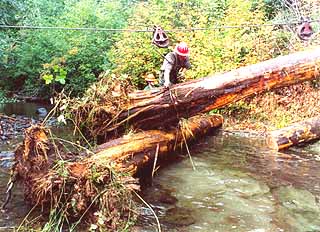
Photos courtesy The Watershed Co.
Crews use "sky logging" techniques to set woody debris for salmon habitat.
|
A Sitka spruce log with a huge root still attached swung dizzily on a high wire above the southwest Washington forest as a logging crew maneuvered it into place.
The men had lassoed the log and were lowering it carefully into position along the stream bank. Water cascaded over and around the wood, creating a pool and trapping gravel in its wake.
This spruce will never see a logging truck or sawmill; instead it is creating habitat for salmon. It is part of a stream-restoration project on Trap Creek near Raymond in Pacific County. The $514,000 project, completed in 2002, enhanced more than two miles of stream.
The state Department of Natural Resources sponsored the project in partnership with the Willapa Bay Fisheries Enhancement Group and Weyerhaeuser. Funding was from the state Salmon Recovery Funding Board and the FishAmerica Foundation. The Watershed Co. of Kirkland was designer and the contractor was NDC Timber of Elma, Grays Harbor County.
"Trap is one of our star projects — from the diagnosis of the stream's problems to the designing and engineering of a solution," says Brian Abbott, project manager for the Salmon Recovery Funding Board, which the state Legislature in 1999 to protect and restore salmon habitat.
"This is a shining example of community partners working for salmon recovery," he said.
Fisheries biologists and enhancement designers are selectively adding woody debris to streams statewide to recreate habitats where salmon once flourished.
The board has financed $51 million of enhancement projects, including stream bank re-vegetation, culvert removal and in-stream wood and rock structures. It has spent another $80 million on studies and land acquisition.
"Humans think that the wood in the creek is a mess that they have to clean up or they worry about it causing blockages for fish or flooding," says Ron Craig, project manager for the Willapa Bay Fisheries Enhancement Group. "But it is critical habitat."
Trap Creek is noteworthy because logging techniques usually engaged to take timber out of the forest were used to bring it in. Lumbermen who normally load their harvest onto logging trucks headed for the mill were instead employed to bring timber back into the watershed.
Results of a monitoring project this year show tremendous benefit for salmon so far.
Success on Trap Creek
Every benchmark for judging such projects — aquatic insects, channel substrate and integrity, fish presence, woody debris and spawning gravel recruitment — has been enhanced, according to independent fisheries studies.
Trap Creek has larger pools and riffles. Installed log structures are creating woody debris jams that are catching and holding spawning gravels, through which passes the oxygenated water salmon eggs need to survive.
Pools for fish to rest are deepening and widening. Redds, or nests of salmon eggs, are growing in numbers. Salmon fry are hatching from the gravel and feasting on an insect population that has doubled since the work was completed.
Trap Creek had all the appearances of a productive stream to the untrained eye when fisheries biologists first surveyed it in 2000. There was good water quality, decent riparian vegetation and stream bank integrity with little erosion.
The state DNR was planning to abandon an adjacent road, which would leave the watershed to heal itself after logging. But a closer examination showed the channel was devoid of the gravel critical for aquatic insect production and salmon spawning, according to Greg Johnston, senior fisheries biologist with The Watershed Co.
A flood had stripped the channel of woody debris, and gravel was never able to be re-established. Because the substrate was bedrock, desirable gravel acted like marbles in a chute; they just kept rolling down hill. Johnston said the situation was bleak for the fish, but would have eventually been rectified as trees grew, died and fell into the creek, softening the chute.
"Frankly, we couldn't wait 150 years for that to happen," says Craig of Willapa Bay Enhancement. "If we did, the salmon would have been gone. We had to do something now to make the stream function in the interim so that it could be productive immediately."
The Watershed Co. designed a restoration project of 40 in-stream structures made of 68 logs. Some structures were planned to deflect water; some to absorb it. All had large rootwads attached to interrupt stream flows, dissipate energy and add cover for fish. Designs called for all structures to be chained and anchored to the bedrock with hydraulic calculations completed to ensure they would stay put.
The old growth trees that historically have enhanced stream channels are typically more than twice the 24-inch diameter minimum size planned for Trap, but moving and siting anything of that size was impractical. So logs were chained together to create comparable volume. Their crisscross designs helped them function as "seed" stock to recruit wood that might float down stream naturally, according to Johnston, who has planned and supervised the use of logging techniques on previous restoration projects.
Still the volume and weight of material that had to be moved delicately into position was about 100 tons because bulky rootwads dramatically increased the weight of the logs. The steep ravine of the stream further complicated matters, making accessibility of heavy equipment impossible.
The challenge was roughly the equivalent of having 20 elephants tiptoe through the forest and down a cliff, touching the ground only when they absolutely had to.
"Yes, this took some imagination for logistics and finesse on our part though the techniques are classic skyline logging engineering," explains John Evans, vice president at NDC Timber.
NDC needed to muster equipment that was husky enough to do the job without breaking a tight budget. It suspended a skyline cable from a tail hold high on the bank opposite a 100,000-pound log loader on the road. Logs were "flown" down into the ravine along the cable, their speed and location controlled by a second line mounted to a winch.
Maneuvering the materials precisely into position in such tight quarters was a challenge only an experienced logging crew could handle, Evans said.
Installing anchors and testing them to required strength required new skills and new tools for the crew. One type used a toggle that could be buried in substrate to secure the structures. Another had an expanding wedge and was used when only bedrock was available.
From trucks to boots, different equipment was required. Trash trucks, not logging trucks, worked best to bring materials to the site because of the rootwads. Members of the crew wore rubberized waders, not their typical leather boots.
Progress was slow. A logging crew that would normally take 200 trees out of the forest during a productive day, could place only four to six logs per shift.
When the project was done, the crew was satisfied. "Everyone here is a fisherman," Evans said. "We really got into the idea of helping the fish."
Nancy Way is vice president of The Watershed Co.


