 |
Subscribe / Renew |
 |
Contact Us |
| ► Subscribe to our Free Weekly Newsletter | |

Construction Bids
| home | Welcome, sign in or click here to subscribe. | login |


 print print  email to a friend email to a friend  reprints add to mydjc reprints add to mydjc |  |
January 25, 2005
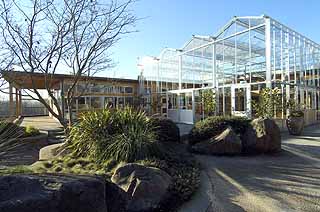
Photos courtesy University of Washington
This greenhouse-like lobby expansion is Merrill Commons.
|
Four years after eco-terrorists set fire to the University of Washington's Merrill Hall, its replacement has opened.
Merrill Hall is located at Northeast 41st Street near University Village and is the focus of a cluster of buildings and greenhouses called the Center for Urban Horticulture, part of the College of Forest Resources.
The $7.2 million, 20,000-square-foot building is registered with the U.S. Green Building Council for LEED certification.
UW project manager Norm Menter, whose capital projects office oversees $300 million in construction projects each year, says Merrill Hall is expected to get a silver LEED rating.
The university says the new building is the greenest on its Seattle campus.
Features include natural ventilation and solar panels, a system to recycle stormwater, and the use of recycled and renewable products such as certified wood. A company called Urban Hardwoods made some of the furniture by hand from salvaged urban hardwood trees.
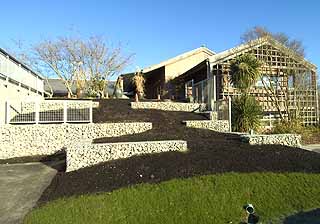
Stormwater captured on site is used to irrigate a green roof.
|
"Sustainable design practices fit really well into the educational mission," said Menter.
The center does horticultural research on preserving Washington's endangered plants and restoring urban landscapes.
Getting the building LEED-certified was one of the center's goals, so officials raised $1 million in private donations and UW grants to build sustainable features. There may be a rainwater garden in the future.
The construction cost was $5.3 million. Work began in September 2003 and occupants moved in late December 2004.
| What makes it so green? |
|
Here are some of the building’s sustainable features.
|
The new Merrill Hall houses a horticultural library, laboratories, an herbarium with plant samples, and offices for outreach and education. The building is in the same location as the original, but is 2,600 square feet larger. Little site work was required as roadways and parking lots were already in place.
The architect was Miller/Hull Partnership of Seattle. Contractor was CDK Construction Services of Duvall. Landscape architect was Seattle-based Berger Partnership.
Engineers were Quantum Consulting Engineers, structural; SvR Design, civil; Keen Engineering, mechanical; and Travis, Fitzmaurice & Associates, electrical.
Contractors were Anderson Magruder, mechanical and plumbing; Aztech Electric, electrical; Deeny, civil; and J.P. Landscape Services.
Eco-terrorists who set the fire had targeted biology professor Toby Bradshaw who they wrongly accused of genetically engineering trees, according to UW spokesperson Sandra Hines. "The ironic thing is they didn't ruin his research."
Bradshaw was able to continue his work at a nearby building for the last four years.


