 |
Subscribe / Renew |
 |
Contact Us |
| ► Subscribe to our Free Weekly Newsletter | |

Construction Bids
| home | Welcome, sign in or click here to subscribe. | login |


 print print  email to a friend email to a friend  reprints add to mydjc reprints add to mydjc |  |
April 29, 2008
Tracy Bowen, executive director of the Alice Ferguson Foundation in Accokeek, Md., is leading the development of a “living building,” but she said the only way to get the project team to truly push the limits of sustainability is by being a “pushy broad.”
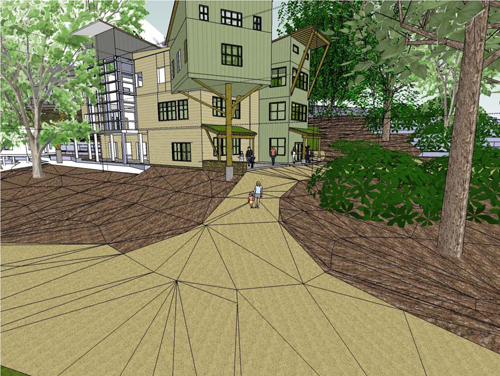
The foundation is located on a 330-acre farm, and is dedicated to connecting local kids and teachers to nature. Two buildings are being designed for the farm. One, called the Moss Building, will replace a structure that is slowly being rendered unusable by mold. It will have 12,000 square feet with a kitchen, two teaching labs and overnight space for students.
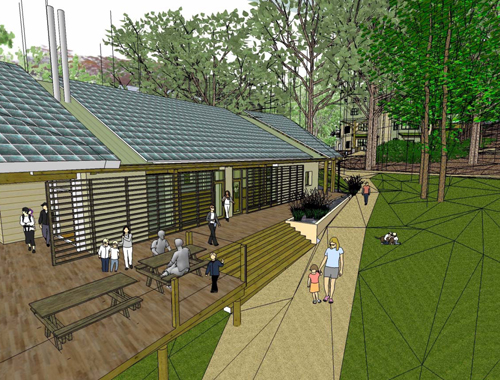
A second structure, called the Grass Building, will be a 4,000-square-foot space in an open meadow, providing training space for visitors and allowing the foundation to expand programs.
Both are being built to meet the Living Building Challenge, a green design approach to making buildings that minimize their environmental impacts and are self-sustaining when it comes to water and energy use. Only a handful of projects in the country are being designed and built to be living buildings.

She said she decided to try to create a living building because LEED doesn't go far enough. “I felt like LEED was a really good baseline but it was going to create a ceiling... (that) wasn't high enough.”
Working together
The two buildings will supply each other's needs. For example, solar panels from the Grass Building's 72-kilowatt photovoltaic system will provide all the energy for both buildings. The Moss Building will supply water for both buildings from cisterns in the basement.
About 40 ecologically oriented design firms nationwide expressed interest in working on the project. The foundation liked two equally — M2 Architecture and Re:Vision Architecture, both of Philadelphia — and asked them to work together on it. They agreed.
Sandy Wiggins of Consilience LLC in Philadelphia and immediate past chair of the U.S. Green Building Council, is owner's representative on the project.
Muscoe Martin, principal at M2 Architecture, is the former chairman of the AIA Committee on the Environment and a director of the Sustainable Buildings Industry Council. He said the way the buildings are connected is special. “The fact that we have got multiple buildings that are working together in a symbiotic way... that is pretty unique.”
Still too linear
Even with national leaders of the green movement on board, Bowen said the process has been challenging because the process of design is still too linear.
Bowen said integrated design is in its infancy, which she finds shocking. “Don't think you're doing great things by including the contractor and engineer in design... It's not enough. You've got to think more creatively than that.”
Bowen said she pushed the team to design more sustainably, but its also been important as the client to give them permission to be more creative. “They all have what we're looking for but we're really pushing them out of their comfort zone, along with us, to figure out how to integrate.”
Martin said Bowen made the team look at the foundation's goal of educating children, which led to some design solutions that were not initially obvious. “Tracy has a very high standard that she wants us to live up to, which is great. You always want a client that is pushing you to do your best.”
Wiggins said the questions asked at the very beginning of a project need to change from looking at what doesn't work to concentrating on how it could work. “Every site is ideal. We need to learn how to create living buildings on every site.”
In addition to sharing water and energy, the buildings are being designed to create no trash and use on-site materials for construction. They will have composting toilets and a constructed wetland to treat gray water. Other features include a living wall and converting rainwater to potable drinking water.
Asking the kids
Many ideas for the project have come from children who will use the site. Bowen said kids wanted to see a connection between the buildings: grass on the roof, milk in gutters, holes in the roof that get covered at night, a poop chute and a trash monster that separates the recycling. Kids also described the building as an organism, with rooms like the stomach of a cow, and that idea influenced the design.
There won't be milk in the gutters but kids will each get a port hole in their sleeping bunk that looks outside. The moral, Bowen said, is that thinking big and talking with children can help bypass some of the places where teams get stuck.
Once the project is complete, kids will also have an energy budget. There will be two meters at the site: one that measures energy use for the year and one that is reset with each new group of children. Children will be able to see how their actions affect the budget. Visitors to the site already have a trash budget.
Design changes have brought cost changes. The original project, a bare-bones building to replace the current sleeping quarters, was budgeted at $3 million. The total cost estimate is now up to $10 million. The team will begin the Grass Building next summer and the Moss Building in 2010.
Other team members include Marion Construction, general contractor; Andropogon Associates, landscape architect; AKF Engineers, MEP engineer; and Ann Rothman, structural engineer. For more information about the foundation, visit hardbargainfarm.org.
Katie Zemtseff can be
reached by email or by phone
at (206) 622-8272.


