 |
Subscribe / Renew |
 |
Contact Us |
| ► Subscribe to our Free Weekly Newsletter | |

Construction Bids
| home | Welcome, sign in or click here to subscribe. | login |


 print print  email to a friend email to a friend  reprints add to mydjc reprints add to mydjc |  |
October 19, 1999
By JON SAVELLE
Journal Environmental editor
Last week's Journal story about salmon-friendly culvert design seems to have touched a nerve. Lots of people, it seems, are pondering just how to improve passage for fish. And lots of people want to help.
One of those who called in response to the story was Allen de Steiguer, an engineer with URS Greiner Woodward Clyde in Seattle. He is working on a stream restoration project on Longfellow Creek, in West Seattle, where culvert construction is an integral part of the job.
Photos by Jon Savelle |
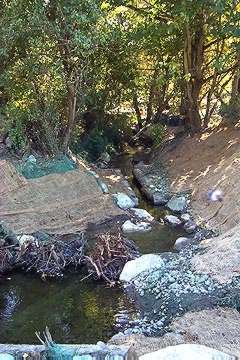
Besides taking a blackberry-choked ditch and turning it into something a salmon could love, the restoration involves use of arched culverts instead of the standard round pipe. De Steiguer said this has a number of advantages, particularly when it comes to in-stream construction and restoration.
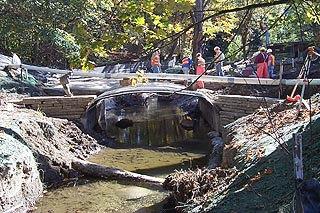
For one thing, the arch -- essentially a bridge -- can be set in place after the in-stream work is finished. It can be placed over large rocks or woody debris that would be difficult to install in a pipe.
Another advantage of this approach is that a wider, lower culvert opening can be achieved with less work and fewer materials than would be required if a round pipe were used.
At the Longfellow Creek site last week, crews from Tri-State Construction were building their second culvert. Like the first, it employs prefabricated steel arches which then are topped with salvaged concrete slabs. The slabs, according to de Steiguer, once filled the spaces between the city's trolley tracks.
As the work winds down for this year, the culverts are the last items to go in or over the stream. Late next summer, after the salmon have finished their run, work will resume on the upper two thirds of Longfellow Creek.
At the moment, these untouched sections look the way the first section did before restoration began -- with a washed-out channel between steep banks, and a thicket of blackberries smothering it all.
First to come out are the blackberries. Then come the old tires, twisted metal and other trash that had accumulated over the years.
|
Beyond the banks of the stream a massive earthmoving effort is underway to create wetlands, stormwater detention, walking paths and park areas. Managed by Seattle Public Utilities, on land owned by Seattle Parks and Recreation, the work has the multiple objectives of salmon recovery, stormwater management and implemention of the Delridge Neighborhood Plan.
Colleen Browne, senior project manager with Seattle Public Utilities, said these elements mesh together very well. And, thanks to a new drainage and wastewater utility fund that was born of the city's disastrous 1997 mudslides, her department now has the money to do it right. At the Yancy Street site, that's about $1.2 million.
Stormwater control is one of the big targets for that money. Longfellow Creek, which originates in White Center, drains a huge and heavily developed area of 2,685 acres. When it rains, it roars -- turning the burbling little beck into a raging torrent.
"It's knocked out bridges and flooded downstream places before," Browne said. Previous Millennium Project work has involved building or enlarging retention ponds to try to control peak flows.

|
The Longfellow Creek restoration is one of four undertaken as part of the Urban Creeks Legacy Program. The other creek restorations are at Piper's Creek in northwest Seattle, Thornton Creek in the Northeast, and Taylor Creek in the southeast. Together they form the drainage system for about one fifth of the city's area.
When the Longfellow project is finished it will have opened up some five miles of creek to fish. Improvements will occur not only at Yancy Street, but also within the golf course, at Southwest Graham and Willow streets, and at the Webster Street detention site.
Running roughly parallel to Delridge Avenue Southwest, the creek has been embraced by its community, Browne said.
"It's really cool," she said. "It's great for the environment, people around there really like it and are dying to help. They want to keep it up afterwards, and I have the money to do it."


